
Biblical Artifacts Museum: What It Is and Why It Matters

You may be standing outside a museum or seminary classroom with a familiar question: Can physical objects really help me understand the Bible better? A lamp, coin, seal, or fragment of pottery can't prove every detail of a biblical passage. It can, however, place Scripture within the cultures, economies, and historical periods in which God's redemptive work unfolded.
A biblical artifacts museum is most valuable when it joins careful archaeology with responsible interpretation and faithful Christian formation. At The Bible Seminary, the 3J Museum offers a working example of that vision, connecting artifacts from Khirbet el-Maqatir with classroom learning, public education, and the preparation of pastors, teachers, missionaries, and other ministry leaders.
Stepping Into a Biblical Artifacts Museum
The doors close behind you, and the atmosphere changes. Cool air replaces the warmth outside. The lighting is subdued. In front of you, a glass case holds a small oil lamp, the kind of ordinary household object that may once have illuminated a home during the Second Temple period.
Your first instinct may be to search for something dramatic. Many visitors arrive expecting an Indiana Jones adventure, a grand natural history hall, or a room filled with spectacular treasures. A biblical artifacts museum often feels different. The galleries may be more intimate, the labels more substantial, and the objects arranged according to chronology, geography, or a carefully chosen theme.
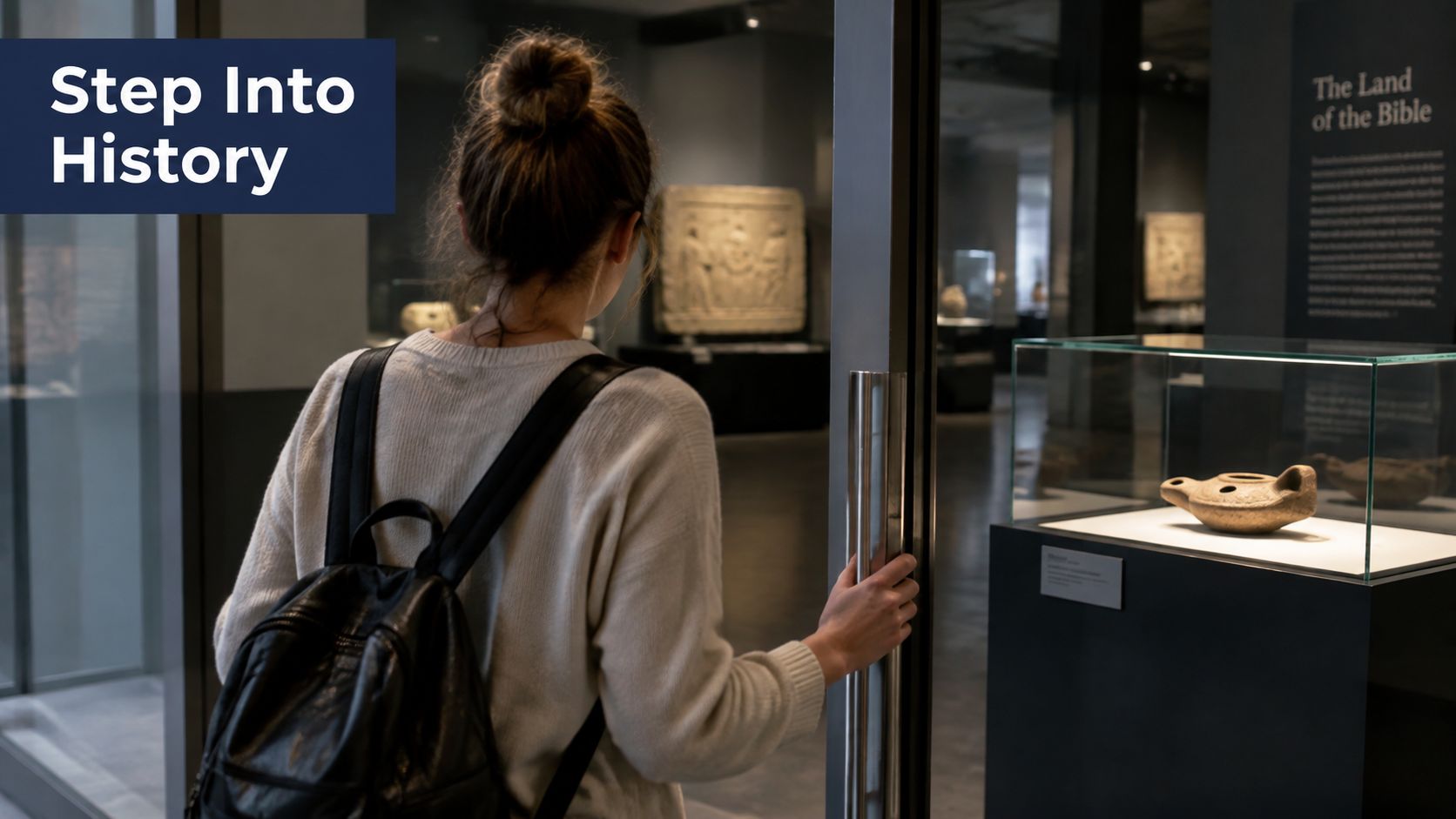
That difference matters because the way a museum frames an object shapes the way you read it. A lamp isn't merely an old piece of clay. It can prompt questions about domestic life, fuel, craftsmanship, poverty, hospitality, and the ordinary settings in which people heard and practiced God's Word.
Read the gallery before rushing to the case
Begin by noticing the museum's organizing principle. Ask whether the displays move through time, follow a biblical region, or group objects by use. This first orientation prevents you from treating every artifact as an isolated curiosity.
Then read the labels slowly. Look for the object's date or period, material, place of discovery, archaeological context, and stated relationship to the biblical world. Good labels distinguish what the evidence demonstrates from what a curator presents as a possible interpretation.
The Bible itself gives us reason to take the material world seriously. Luke begins his Gospel by describing an orderly effort to investigate and communicate events concerning Jesus, while John identifies the Word who became flesh in a real human history (Luke 1:1-4; John 1:14). Archaeology doesn't replace Scripture. It helps us understand the world Scripture addresses.
Practical rule: Let the artifact raise informed questions, but let the biblical text govern theological conclusions.
What Defines a Biblical Artifacts Museum
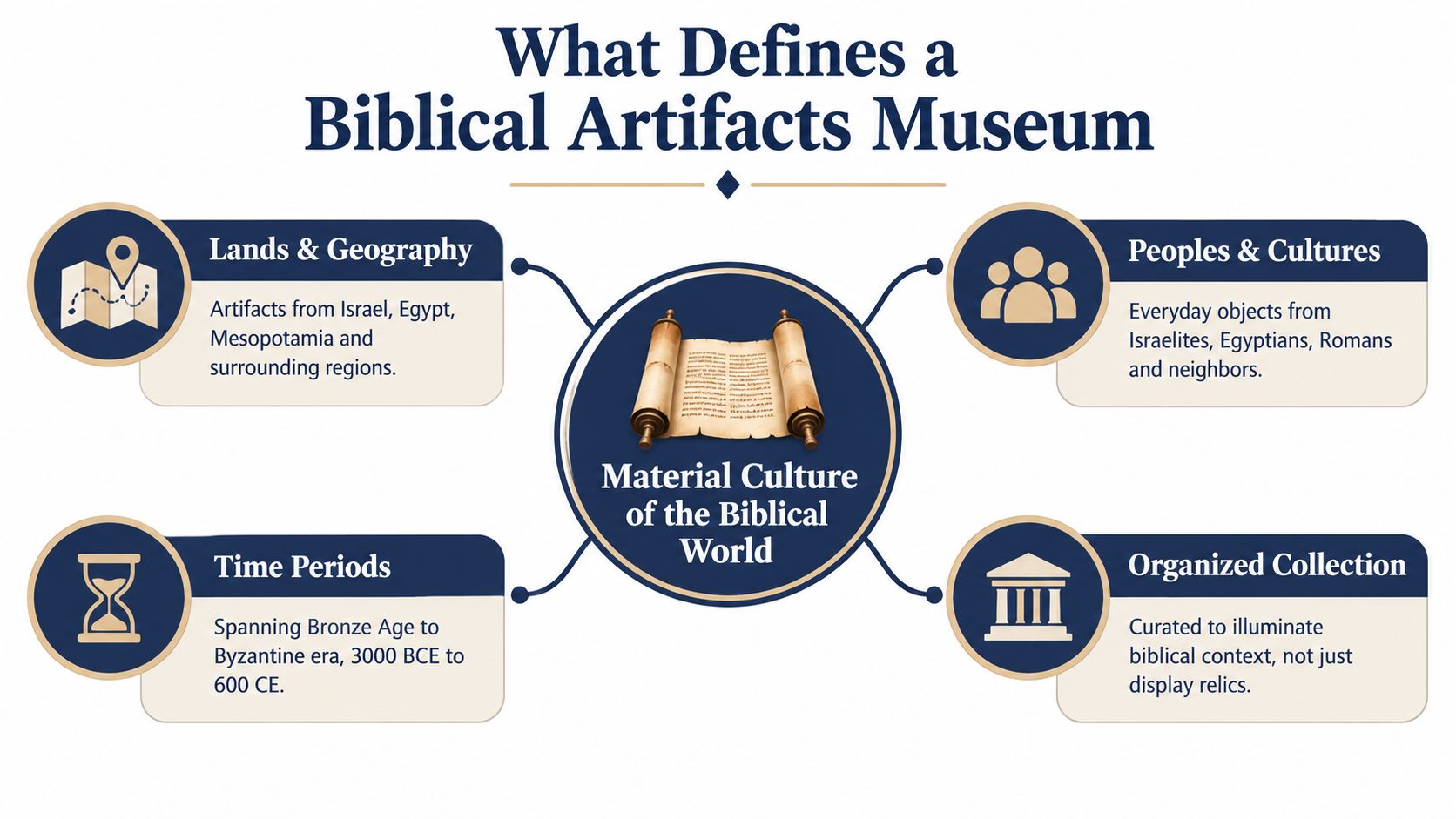
A biblical artifacts museum begins with a focused premise: its collection is organized around the material culture of the biblical world. That means objects connected with the lands, peoples, practices, and historical periods represented in or surrounding Scripture.
The connection is more specific than displaying ancient items. Curators may explain how pottery reflects household life, how coins reveal political authority, or how a city gate helps visitors understand settlement patterns and biblical geography. The museum's labels make the relationship to the biblical world visible without claiming that every object directly confirms a particular verse.
Four features help visitors identify the institution
Geography: The collection may include material from Israel, Egypt, Mesopotamia, and neighboring regions.
Cultural breadth: Objects can represent Israelites, Egyptians, Romans, and other peoples who shaped the ancient Near Eastern and Mediterranean setting.
Chronological range: Displays may move from the Bronze Age through later periods associated with the rise of Christianity.
Interpretive purpose: The museum organizes evidence to illuminate historical and biblical context, rather than presenting relics without explanation.
A regional history museum may focus on the story of a particular city or nation. A fine arts collection may emphasize aesthetic achievement, artistic movements, or the biography of an artist. A biblical artifacts museum can include those dimensions, but its central question is different: What can this object help us understand about the world of the Bible?
The scale varies considerably. A teaching collection may be small enough for students to study individual objects closely, while a major institution can hold tens of thousands of items. The Museum of the Bible says it holds about 40,000 objects overall, and public coverage has described around 1,500 objects on display across roughly 4,000 years of history in its 2024 impact report. The Bible Lands Museum in Jerusalem, founded in 1992, presents material from periods before 1550 B.C.E. through the rise of Christianity, showing how a focused institution can tell a broad historical story through its collection and galleries.
The 3J Museum represents a more focused, mission-driven model. Its exhibits draw on archaeological work connected with Khirbet el-Maqatir and are designed for public learning and seminary education. Visitors who need accessible navigation and advance orientation may also find inclusive wayfinding for museum visitors useful when planning an inclusive experience.
Exhibit Types Visitors Encounter
Pottery usually provides the clearest introduction to archaeological interpretation. Storage jars, lamps, cooking vessels, and building ceramics survived because fired clay can endure long after organic materials disappear. A broken rim or distinctive handle may help specialists identify a period, trade pattern, or household practice.
Khirbet el-Maqatir offers a concrete example of this process. Exhibit coverage describes pottery, jewelry, coins, building materials, and instruments of warfare among over 40 artifacts used in biblical-archaeology displays at Lee University. Another traveling exhibition presented over 50 artifacts dating from the Middle Bronze Age, 2200–1500 BC, to the Byzantine Period, AD 324–638, and identified excavation work at the site from 1995 to 2017 under the Associates for Biblical Research in its exhibition materials.
Coins add another layer. A coin can identify a ruler, political authority, economic system, or period of circulation. Academic coverage of Khirbet el-Maqatir reports 1,322 ancient coins recovered across the 1995–2016 excavation seasons in a published synthesis. In a gallery, such evidence can help students connect broad biblical periods with the political and commercial realities of daily life.
Objects speak differently about the ancient world
Stone objects often preserve evidence of public construction, administration, or personal identity. Exhibit coverage has identified gate socket stones from Ai, Egyptian scarabs, and ceramic vessels associated with the period traditionally connected with Joshua's narratives in reporting on a mobile exhibit. The evidence can illuminate a biblical setting without claiming that an artifact proves every detail of the narrative.
Other categories deserve patient attention:
Inscriptions and ostraca: These can provide evidence for writing, names, administration, and literacy.
Metal tools and weapons: These reveal technologies, labor, conflict, and changing craft practices.
Glass and jewelry: These can suggest trade, status, decoration, and personal identity.
Textile remnants: These are fragile but can contribute to understanding clothing, labor, and domestic production.
Artifact Category | Typical Examples | Biblical Insight |
|---|---|---|
Pottery | Lamps, storage jars, cooking vessels | Household life, chronology, trade, and food preparation |
Coins | Local and imperial issues | Political rule, economy, taxation, and circulation |
Stone objects | Gate stones, seals, weights, scarabs | Architecture, administration, identity, and authority |
Inscriptions | Ostraca and marked fragments | Writing, names, record keeping, and literacy |
Metal, glass, and textiles | Tools, ornaments, vessels, fabric traces | Technology, status, exchange, and daily practice |
The strongest lesson is methodological: quantity matters less than context. A single well-documented potsherd with a readable inscription may contribute more to scholarship than a room full of objects with no reliable history. Readers interested in how museum work connects with seminary education can explore the history of museum-based learning.
Authenticity, Forgeries, and the Provenance Question
A visitor enters a biblical artifacts museum expecting the glass case to settle the question of authenticity. The display can establish context, but lighting, design, and a polished label cannot prove an object's origin. The better question is: What is known about this object's history from excavation or discovery to the museum?
The Dead Sea Scroll fragments associated with the Museum of the Bible provide a cautionary case. German technical analysis found characteristics inconsistent with ancient origin. The museum removed five fragments from display, and later reviews concluded that all 16 fragments were forgeries as reported by National Geographic.
The lesson is not that every biblical artifact should be distrusted. Rather, a museum earns confidence by testing an object's story instead of allowing an attractive object to carry an appealing claim.
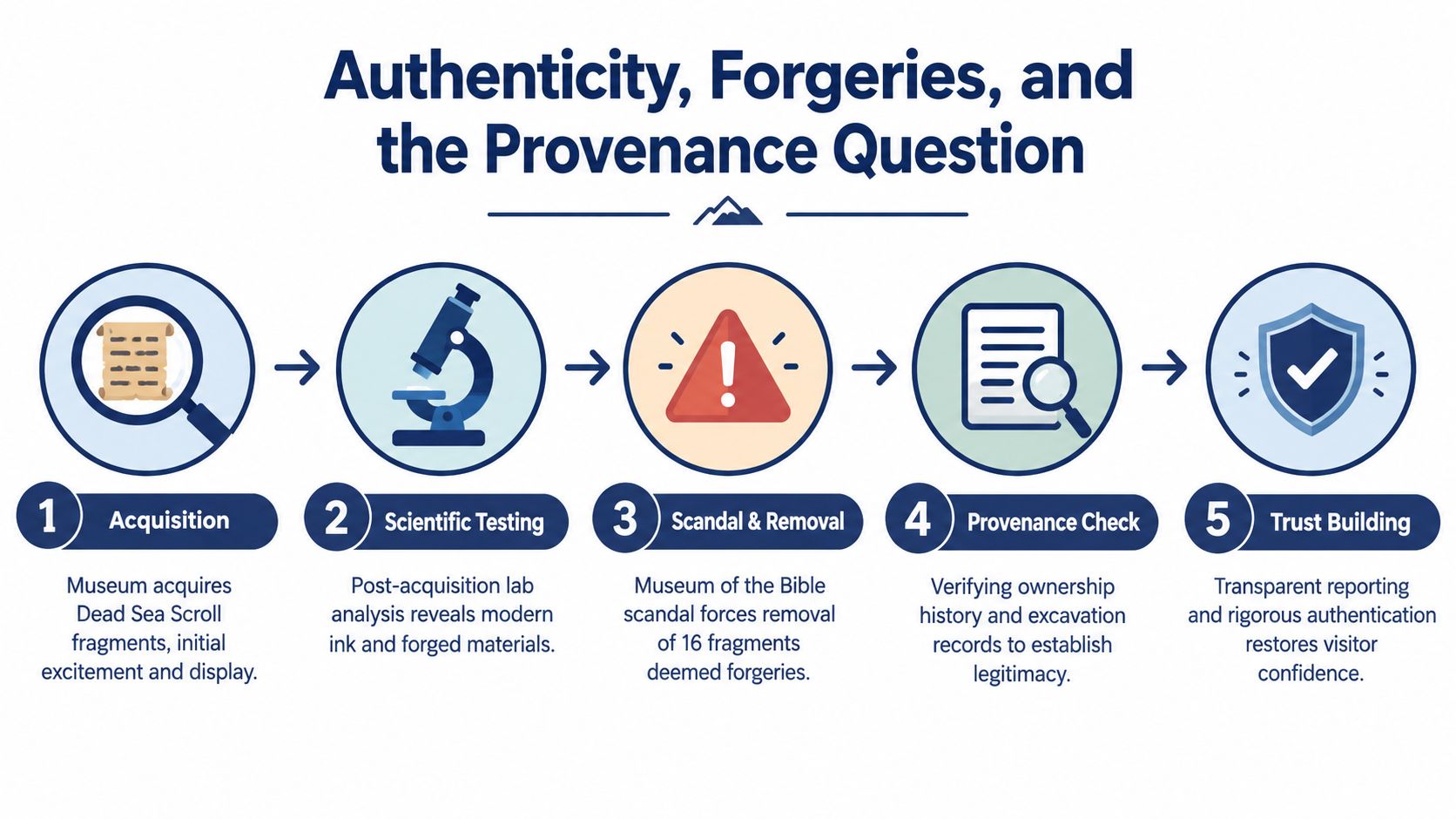
Provenance is the documented history of an object's ownership and location. It functions like a chain of evidence. Each link, from excavation records to scientific examination, helps curators assess authenticity, legal title, ethical acquisition, and historical context.
A careful review may draw on curatorial files, excavation documentation, sales records, collectors' papers, auction catalogs, exhibition and publication history, export and import documents, and scientific testing such as carbon-14 or ink analysis when appropriate.
The Museum of the Bible describes provenance as part of its process for confirming authenticity and legal and ethical acquisition in its provenance materials. Its public FAQ explains that objects undergo review before acquisition and display in its collection guidance.
The 3J Museum applies this discipline to objects connected with documented excavation. Field records, photographs, archaeological locations, and published analysis allow students, ministry leaders, and visitors to examine how evidence is gathered and interpreted. In that setting, the museum becomes a training ground linking archaeology, ministry formation, and public faith engagement, rather than a curiosity cabinet.
Trust grows through clear labels. A replica, facsimile, or contested object can still teach well when its status and limits are stated plainly. Honest uncertainty strengthens learning and protects the historical setting of Scripture from careless claims.
How Biblical Artifacts Support Ministry Training
A student preparing to teach Joshua may encounter Khirbet el-Maqatir through the 3J Museum's documented archaeological material. Pottery, fortifications, settlement patterns, and excavation records give the class concrete evidence to examine. The student then asks what those observations can, and cannot, establish about the biblical account. A gate stone or destruction layer may illuminate historical setting, but it cannot replace careful exegesis.
That habit of disciplined interpretation is a ministry skill. A museum serves as a bridge between academic archaeology, formation for ministry, and conversation with the public. Students learn to handle evidence with care before they explain it from a pulpit, classroom, or church gathering.
An Old Testament course might use scarabs, ceramics, and coins to clarify political relationships and daily life. A biblical geography exercise could study gate stones and foundation courses, asking how residents entered, defended, and organized a settlement. In a preaching course, students might separate cultural background from the central theological claim of a passage.
Archaeology clarifies setting, vocabulary, material practices, and historical possibilities. Scripture retains the authority for teaching, correction, and training in righteousness, as Paul writes in 2 Timothy 3:16-17. Museum objects support ministry when they help teachers read the text more accurately and communicate its meaning more faithfully.
The learning process can take several forms:
Object research: Students identify an object's material, form, period, and archaeological context.
Interpretive writing: They explain what the evidence supports and where uncertainty remains.
Public presentation: They translate technical findings into language a church group can follow.
Ministry application: They connect historical understanding with preaching, teaching, discipleship, or apologetics.
The 3J Museum makes these exercises tangible within a seminary setting. Faculty-led sessions, selected groups of objects, and research assignments bring scholarship into contact with spiritual formation and practical ministry. Church leaders and adult education teachers can use the same environment to prepare lessons that give biblical passages cultural depth without making archaeology carry conclusions it cannot support.
In that sense, the museum functions like a classroom with evidence on the table. Visitors learn not only what an artifact may reveal, but also how responsible interpretation strengthens public faith engagement and protects the reliability of Scripture from careless claims.
Planning a Meaningful Visit
A meaningful visit begins with practical preparation. Smaller academic museums may admit visitors by appointment, offer guided tours on selected dates, or handle group visits differently from large public institutions. Before leaving, confirm current hours, reservation procedures, accessibility information, and group-tour policies through the museum's official channels.
Once there, let the museum's arrangement guide your first pass. A chronological display, when available, can provide a framework for later thematic galleries. After gaining that orientation, follow one question through the exhibits: How did people prepare food, write, worship, trade, fight, or organize family life? This approach turns separate objects into evidence for a historical setting.
Apply the label-reading approach described earlier, and add one question: does the label state evidence, possibility, or tradition? That distinction helps visitors recognize where documented context ends and interpretation begins without treating every uncertainty as a failure of scholarship.
Plan for change between visits. Fragile materials such as papyrus, textiles, and some metals may require environmental control, limited light exposure, conservation treatment, or periods away from public display. Rotation protects vulnerable objects while preserving access, so a returning visitor may see a different selection.
Good questions often open better conversations. Ask, “What is the excavation context?” or “What evidence supports this identification?” A docent can then explain the object's setting and the limits of current knowledge. The question “Is this mentioned in the Bible?” may begin a discussion, but it cannot replace archaeological examination.
If photography is permitted, bring a notebook and follow the rules closely. Flash may be restricted, and some objects may not be photographed. Leave time for a docent conversation, handling table, lecture, or educational activity. These encounters show how a museum connects academic archaeology with ministry formation and public faith engagement.
Museum design also communicates institutional values. For readers considering donor recognition, this discussion of ways donor walls can inspire prospective donors provides useful context. The visitor's lasting benefit, however, comes from careful interpretation of the objects themselves.
The 3J Museum and the Mission of TBS
The 3J Museum serves as a public-facing expression of a broader seminary mission. Located at The Bible Seminary, it brings archaeological material connected with Khirbet el-Maqatir to visitors who may never travel to the excavation site near Jerusalem. At the same time, it gives students a setting in which historical evidence becomes part of serious biblical and ministry education.
A coin can open discussion about economic life in the Second Temple period. Gate stones can support a careful conversation about settlement and the narratives in Joshua. Iron Age pottery can help students work with chronological frameworks they'll later explain from the pulpit or classroom.
A museum becomes more than a collection. It becomes a place where the Bible comes alive through archaeology and Scripture together, while Scripture remains the authoritative foundation for Christian faith and practice.
The seminary's wider work joins academics with spiritual formation and ministry preparation. Students and ministry professionals can pursue graduate study, certificates, audited courses, and other learning opportunities through TBS academic programs, while the museum provides a concrete setting for public engagement and applied learning.
Donors and volunteers also contribute to the museum's ministry. Support can help sustain conservation, exhibit rotation, educational programming, and traveling displays. That kind of partnership isn't merely patronage of a museum. It participates in training hearts and minds for kingdom service, equipping leaders to impact the world for Christ through churches, classrooms, missions, and community conversations.
Frequently Asked Questions
Is a biblical artifacts museum only for Christians?
No. These museums can serve secular historians, students, families, educators, archaeology enthusiasts, and visitors who are curious about the ancient world. A respectful exhibit should welcome questions from people with different convictions while presenting its evidence clearly.
How do museums verify that objects are genuine?
They examine provenance, excavation or ownership records, comparative typology, publication history, and scientific evidence when appropriate. Testing may include methods such as carbon analysis, ink examination, thermoluminescence, or petrographic study, depending on the material and research question.
Can church groups and homeschool families visit?
Often, yes. Guided tours, classroom resources, handling activities, and lectures may be available with advance booking. Contact the museum before planning your visit so staff can confirm current programs, group reservations, and access requirements.
Can visitors buy or remove artifacts?
No. Museum collections remain under institutional care. Replicas or educational materials may be available through approved channels, but displayed artifacts aren't items for private purchase or removal.
Check the 3J Museum's official channels for current hours, tour availability, group reservations, and scheduled lectures before traveling.
The Bible Seminary offers Bible-centered graduate education, certificates, flexible study options, and archaeology resources that connect scholarship with spiritual formation and practical ministry. Visit The Bible Seminary to explore how you can study the biblical world, serve the church, and prepare to equip leaders to impact the world for Christ.