
What Is Eschatology in the Bible

Eschatology is the Bible's teaching about the “last things,” the final consummation of all things, including Christ's return, resurrection, judgment, and the new creation. Its apocalyptic expression flourished from about 200 BCE to 200 CE, but its roots reach back through the whole biblical story.
Why do end-times conversations so often become arguments about timelines, secret codes, and frightening headlines? The question exposes a gap in the way we often approach the subject. Scripture presents the future not mainly as a puzzle to decode, but as the conclusion of God's redemptive work in history.
The word eschatology comes from a term meaning “last” or “final.” In biblical theology, it includes more than the end of the world. It encompasses death, resurrection, final judgment, heaven, hell, Christ's second coming, and God's renewal of creation. The Encyclopedia of the Bible's overview of eschatology describes it as teaching about the last things and connects future events with God's redemptive purpose in history.
A helpful analogy is the final chapter of a well-written story. The last chapter doesn't float above everything that came before it. It gathers earlier promises, conflicts, losses, and hopes into a meaningful conclusion. Biblical eschatology works similarly. The Bible's future hope grows from God's covenant promises, Israel's history, Jesus' death and resurrection, and the church's patient expectation of his return.
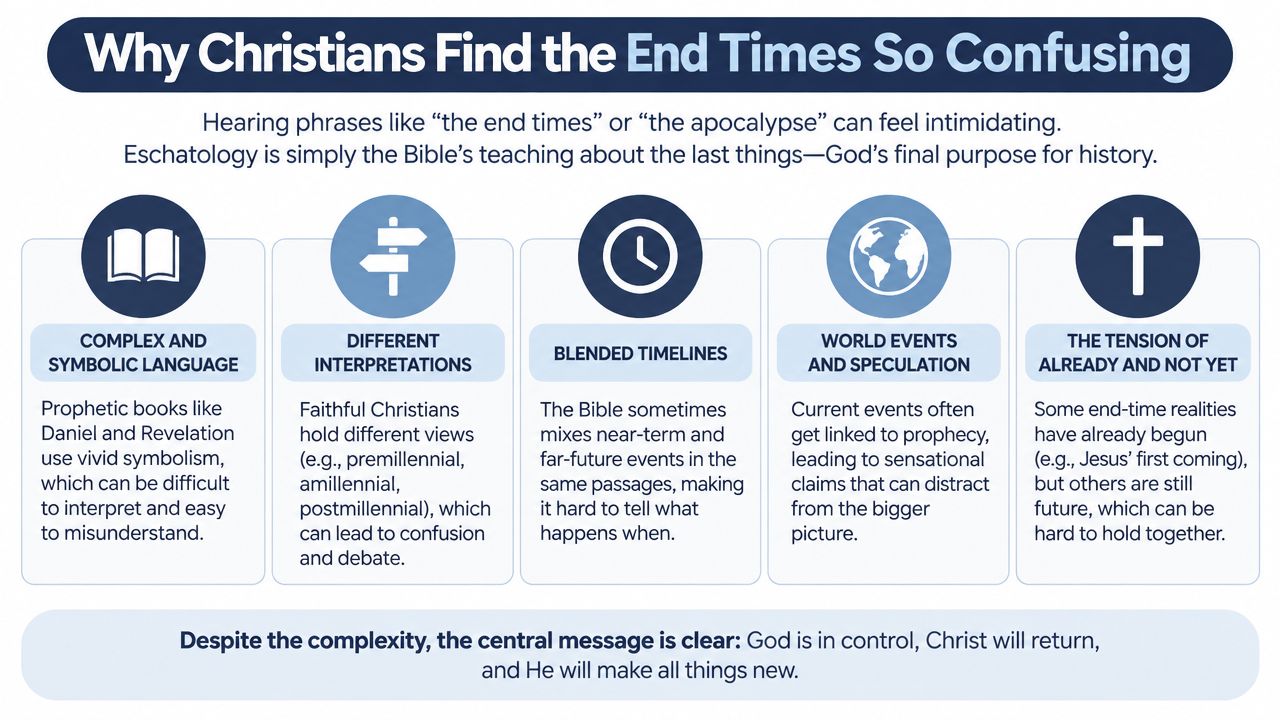
Why Christians Find the End Times So Confusing
Hearing phrases such as “the end times” or “the apocalypse” can feel intimidating. The imagery is intense, different Christian traditions arrange passages differently, and popular discussions often treat prophecy as a prediction chart rather than as part of the gospel.
A sound working definition brings order: eschatology is the Bible's teaching about God's final purpose for history. It includes the return of Jesus, resurrection, judgment, and the final restoration of creation. A standard Christian framework also discusses the tribulation, the kingdom, and related events, as described in Crossway's introduction to eschatology.
The subject is larger than one event
Readers sometimes assume that eschatology means only the rapture or only the book of Revelation. Those subjects matter, but they're parts of a larger whole. Biblical eschatology holds together two dimensions:
Personal destiny: death, the intermediate state, resurrection, judgment, heaven, and hell.
Cosmic history: Christ's return, the resurrection of the dead, final judgment, and the renewal of creation.
This wider framework helps us read individual passages responsibly. A verse about Christ's return belongs within the larger story of God's victory, justice, salvation, and restoration.
History matters
The Bible's last-things language didn't develop as detached speculation. It grew through Israel's covenant history and through events such as the Exodus, Assyrian invasion, Babylonian exile, and restoration under Persian rule. Scholarly treatments trace foundational promises to Genesis 12:1–3, a major prophetic shift to the eighth century BCE, and another decisive development after the exile in texts such as Isaiah 60–66 and Daniel. The Oxford Research Encyclopedia's treatment of biblical eschatology explains this movement from covenant history toward judgment, renewal, and a new heaven and new earth.
Practical rule: Hold firmly to the Bible's central hope, and approach disputed timelines with humility.
Eschatology should make Christ more central, not less. It should strengthen perseverance, deepen worship, and teach us to live faithfully while waiting for God's promised consummation.
Old Testament Foundations of Eschatology
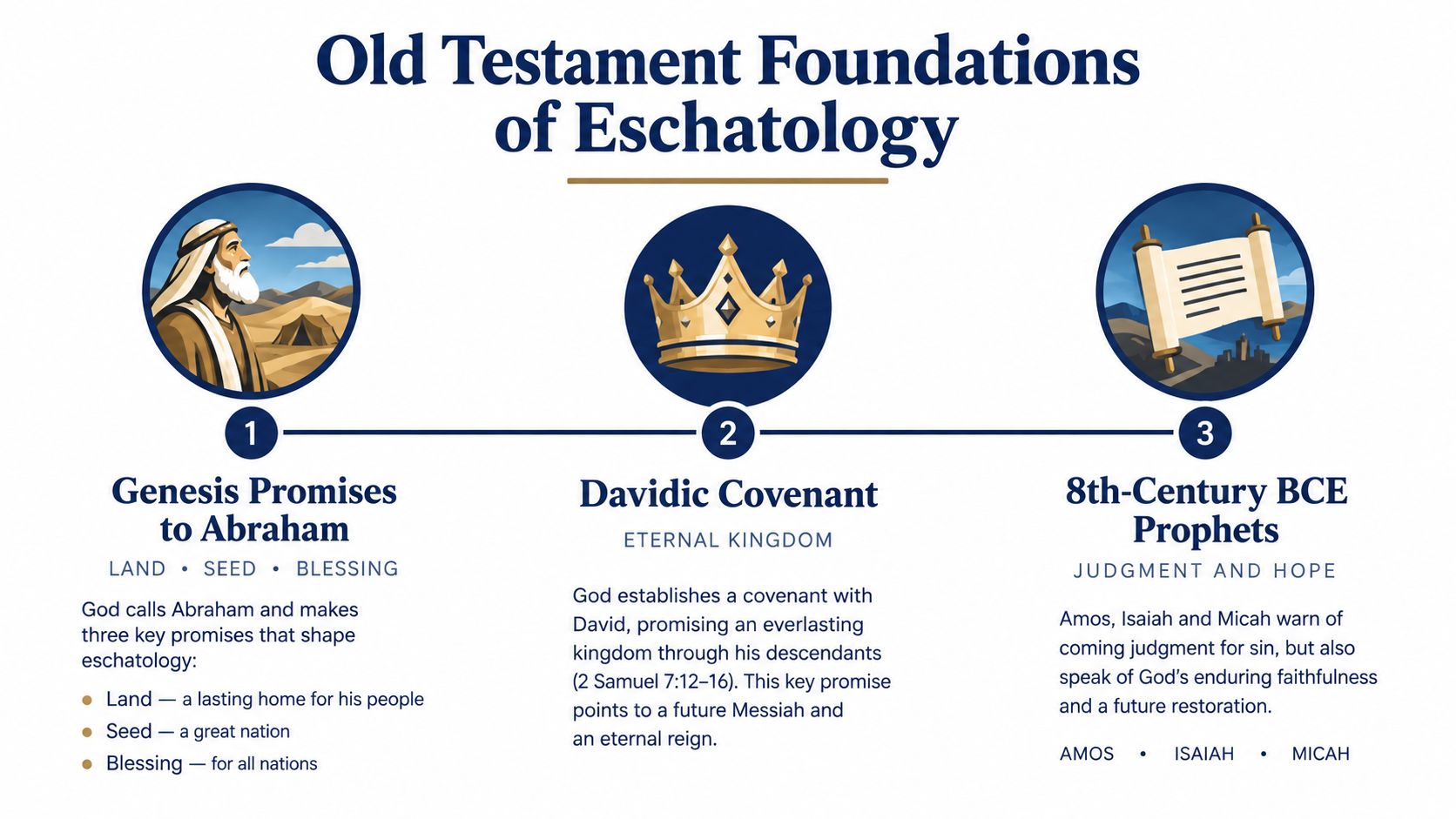
The Old Testament doesn't begin with a fully formed chart of end-times events. It begins with a promise. God calls Abram in Genesis 12:1–3 and promises blessing that will extend beyond one family. That promise establishes a pattern: God's future purpose involves a people, a land, blessing for the nations, and the faithful completion of his covenant word.
The promise develops through Israel's story. God's covenant with David gives royal shape to Israel's hope, while the prophets explain what happens when God's people pursue injustice and idolatry. The future becomes a question of judgment and restoration: Will God abandon his promises, or will he redeem his people and establish righteous rule?
Prophetic warning and hope
The eighth-century BCE prophets Amos, Isaiah, and Micah spoke into real political and spiritual crises. Assyrian expansion threatened Israel and Judah, while social injustice exposed the people's covenant unfaithfulness. Their language about the Day of Yahweh, or the Day of the Lord, communicates God's decisive intervention in judgment and salvation.
Isaiah's vision reaches beyond immediate political events. The prophet speaks of God's servant, the restoration of Zion, and ultimately “new heavens and a new earth” in Isaiah 65:17 and 66:22. Micah combines judgment with the hope that nations will learn the ways of the Lord. Amos warns that religious activity cannot substitute for justice and faithful obedience.
These promises weren't abstract philosophy. They addressed communities facing invasion, displacement, grief, and uncertainty. The prophets taught Israel to understand present suffering within God's larger purposes.
Exile and the shape of resurrection hope
Babylonian conquest and exile created a profound theological crisis. Jerusalem fell, the temple was destroyed, and many people were carried from their land. Yet the exile also sharpened hope for restoration, righteous judgment, and God's victory over death.
Post-exilic writings, including Daniel and Zechariah, use visions and symbols to describe God's rule over earthly kingdoms. Daniel 7 presents the “Son of Man” receiving authority and a kingdom, while Daniel 12 includes a vision of resurrection and judgment. Isaiah 60–66 presents a future marked by glory, renewal, and God's presence.
The Hebrew Bible doesn't use one technical word that neatly equals “eschatology.” Jewish sources connect the phrase “end of days” with aḥarit ha-yamim, showing that the doctrine is assembled from many texts and themes. The SAGE reference entry on eschatology describes this biblical development and identifies the final consummation as including resurrection, judgment, the Parousia, and humanity's eternal destiny.
The New Testament takes these threads up and centers them on Jesus. The promises are not discarded. They're interpreted through the Messiah who has come, died, risen, and will return.
Key New Testament Passages on the Last Things
The New Testament presents eschatology through several complementary windows. Jesus teaches about his return and the coming of the Son of Man. Paul explains resurrection and comfort for grieving believers. John shows the final renewal of creation. Read together, these passages give us a coherent hope without pretending that every interpretive question is simple.
Passage | Context | Main Contribution |
|---|---|---|
Matthew 24, Mark 13, Luke 21 | Jesus' teaching on the Mount of Olives | Calls disciples to endurance, watchfulness, and faithfulness amid distress and expectation |
Daniel 7 | Vision of beasts and the Son of Man | Provides background for Jesus' authority, kingdom, and self-identification as the Son of Man |
1 Corinthians 15 | Paul addresses questions about resurrection | Grounds Christian resurrection hope in Christ's own resurrection and the defeat of death |
1 Thessalonians 4 | Paul comforts believers grieving deceased Christians | Connects the Lord's return with resurrection and encourages believers not to grieve without hope |
1 Thessalonians 5 and 2 Thessalonians 2 | Teaching about the Day of the Lord and opposition to God | Calls believers to alertness and addresses the “man of lawlessness” |
Revelation 21–22 | John's vision of the final renewal | Portrays God dwelling with his people in a renewed creation, rather than salvation as mere escape |
Jesus and the Son of Man
In Matthew 24, Mark 13, and Luke 21, Jesus speaks about coming judgment, distress, perseverance, and the appearance of the Son of Man. His teaching draws on the imagery of Daniel 7, where the Son of Man receives authority and an everlasting kingdom.
Jesus' use of this title identifies him with Daniel's promised ruler. It also places his death, resurrection, ascension, and return within Israel's biblical hope. The Olivet Discourse therefore isn't a permission slip for date-setting. Jesus tells his disciples to remain faithful because the Father's purposes will be fulfilled.
Resurrection, comfort, and renewal
First Corinthians 15 makes resurrection central. Paul doesn't describe eternal life as the soul escaping creation. He announces that Christ has been raised and that death itself will be defeated. Christian hope rests on a person and an event, not on vague optimism.
First Thessalonians 4 speaks directly to grieving Christians. Paul's purpose is pastoral comfort. The return of the Lord means that those who belong to Christ won't be forgotten, and believers can encourage one another with resurrection hope.
Revelation 21–22 completes the biblical movement toward renewal. John sees God dwelling with his people, death removed, and creation restored. The final Christian hope is not just leaving the world behind. It's the presence of God making all things new.
Major Views Christians Hold About the End Times
Christians who affirm Scripture and historic Christian orthodoxy can disagree about the sequence and symbolism of certain end-times events. The disagreement is real, but it shouldn't obscure the central confession that Jesus Christ will return, the dead will be raised, God will judge, and creation will be renewed.
The most familiar debate concerns the millennium in Revelation 20. The three major positions interpret that passage differently.
View | Millennium | Israel and the Church | Christ's Return | Key Strength |
|---|---|---|---|---|
Premillennialism | Christ returns before the millennium, understood as a future reign | Interpretations vary; dispensational forms distinguish Israel and the church more sharply | Precedes the millennial reign | Takes the future kingdom promise and sequence seriously |
Amillennialism | The millennium symbolizes Christ's present reign, with final consummation at his return | Often emphasizes the unity of God's people in Christ | Occurs at the end of the present age | Reads Revelation's symbolism within the whole biblical storyline |
Postmillennialism | The gospel's influence brings a prolonged period of kingdom blessing before Christ returns | Usually emphasizes continuity between God's people across the covenants | Follows the anticipated era of gospel prosperity | Highlights the transforming power of the gospel in history |
Dispensational and covenantal traditions also shape how Christians read prophecy. Dispensational approaches commonly distinguish Israel and the church in God's unfolding plan and often connect premillennialism with a future tribulation and rapture. Covenant theology emphasizes the unity of God's covenant purposes and often reads Old Testament promises through their fulfillment in Christ and his people.
For a focused explanation of one major approach, see The Bible Seminary's guide to dispensationalism.
Where charity belongs
These models differ over the millennium, the relationship between Israel and the church, the timing or nature of the rapture, and the interpretation of symbolic passages. They don't all answer the same questions in the same way.
Christians can disagree about the map without losing sight of the destination.
A humble reader distinguishes essential hope from secondary interpretation. We should teach what Scripture clearly affirms with confidence, explain disputed readings fairly, and refuse to treat sincere disagreement as proof of spiritual unfaithfulness.
How to Read Apocalyptic Texts with Wisdom
Daniel, Ezekiel, and Revelation can feel unfamiliar because they use visions, beasts, heavenly beings, numbers, cosmic signs, and dramatic contrasts. That style is not accidental. Apocalyptic literature communicates God's truth through symbolic revelation, especially when human empires appear powerful and faithful people feel vulnerable.
The first wise habit is genre awareness. We don't read poetry as a legal contract or a parable as a newspaper report. In the same way, we shouldn't assume every image in Revelation functions as a literal description of a modern object or political event.
Let Scripture interpret Scripture
Biblical images often carry meaning from earlier passages. Revelation's use of beasts, Babylon, the temple, the throne, and the Lamb becomes clearer when readers trace those themes through Daniel, Exodus, the Psalms, Isaiah, Ezekiel, and the Gospels.
A sound approach includes several practices:
Read the whole passage: Don't build a doctrine from one striking phrase detached from its surrounding argument.
Trace earlier imagery: Ask where the Bible has already used a symbol and what it meant there.
Weigh clear passages carefully: Plain teaching about Christ's return, resurrection, and judgment should guide interpretations of highly symbolic visions.
Respect the first audience: Revelation spoke to churches facing pressure, temptation, and suffering before it speaks to later readers.
Keep Christ central: The Lamb, not the beast, stands at the center of Christian hope.
Already and not yet
The New Testament presents God's promises as both inaugurated and awaiting completion. Christ has already come, died, risen, and poured out the Spirit. Yet believers still wait for the resurrection, final judgment, and the renewal of all things.
Second Corinthians 1:20 points to God's promises finding their “Yes” in Christ, while Matthew 24 directs believers toward a future completion that has not yet arrived. This tension keeps us from two errors. We shouldn't deny what Christ has already accomplished, and we shouldn't claim that the final consummation has already occurred in full.
Read prophecy to become faithful, not merely to become certain about your schedule.
The safest interpretation is one that produces worship, endurance, holiness, and love. A coded prediction chart that generates fear but not faithful obedience has missed the pastoral purpose of biblical prophecy.
Why Eschatology Matters for Ministry Today
Eschatology belongs in the pulpit, the counseling room, the classroom, and the prayer meeting because future hope changes present faithfulness. The doctrine of Christ's return doesn't pull Christians away from ministry. It gives ministry a sure horizon.
Preaching and pastoral care
A pastor who teaches eschatology proclaims that history has a King and that evil won't have the final word. That message strengthens congregations living with injustice, persecution, illness, grief, and uncertainty.
At a graveside, resurrection is more than an inspirational metaphor. First Thessalonians 4 gives ministers language for grief shaped by hope, while 1 Corinthians 15 anchors that hope in Christ's resurrection. Pastoral care can acknowledge sorrow without surrendering confidence in God's promise.
Ethics and perseverance
Future renewal also dignifies present obedience. Christians serve neighbors, resist injustice, practice generosity, and pursue holiness because God's future makes those actions meaningful. We're not trying to rescue creation through our own efforts, but we are called to live as people who belong to the coming kingdom.
For ministry leaders, eschatology offers a practical test:
Does this sermon lead people toward Christ or toward speculation?
Does this teaching produce alertness and courage rather than panic?
Does it comfort sufferers and honor the resurrection?
Does it make room for charitable disagreement on secondary matters?
Training hearts and minds for kingdom service means joining theological depth to spiritual formation. That kind of preparation helps pastors teach difficult texts with conviction, patience, and care.
Common Questions About the End Times
Popular end-times conversations often focus on the rapture, the Antichrist, the mark of the beast, and the identity of those taken at Jesus' return. Those are legitimate questions, but Scripture gives us different levels of clarity. The return of Christ, resurrection, judgment, and final restoration stand at the center. Dates, names, and modern code-breaking usually belong to more speculative territory.
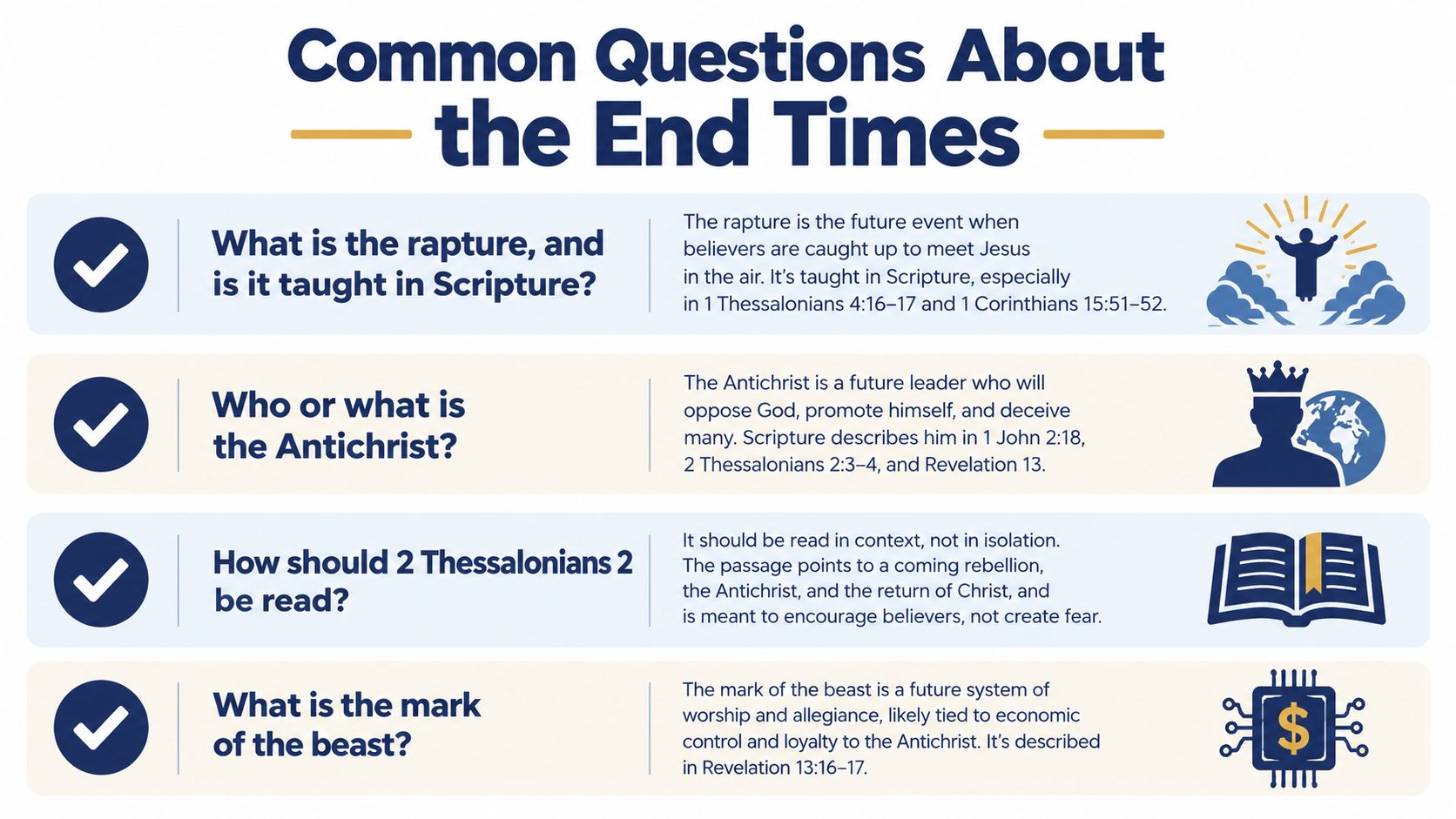
What is the rapture, and is it taught in Scripture?
The word “rapture” isn't a biblical term, but Christians use it to describe the gathering of believers to Christ, especially in connection with 1 Thessalonians 4:13–18. Christians disagree about how this event relates to tribulation and Christ's visible return.
Some place the gathering before a future tribulation, while others understand it as part of Christ's public return. The passage itself clearly offers comfort about Christ's coming and the resurrection of believers. The precise timeline remains disputed.
Who or what is the Antichrist?
The term “Antichrist” appears in the Johannine letters, while 2 Thessalonians 2 speaks of the “man of lawlessness.” Revelation uses different imagery, including the beast. Christians have connected these figures in various ways, but readers should avoid turning every political leader or cultural development into a confident identification.
The biblical emphasis is that opposition to God will not overcome God's rule. Curiosity should lead to vigilance and faithfulness, not accusation without evidence.
What is the mark of the beast?
Revelation 13 presents the mark within a larger vision of beastly power, worship, allegiance, and economic coercion. The passage calls readers to discernment and steadfast loyalty to God.
It doesn't authorize readers to label every new technology as the mark of the beast. Modern technology may raise serious ethical questions, but identifying a contemporary device with Revelation's symbol requires more certainty than the text gives.
Who is taken in Matthew 24:40–41?
Jesus says that one person will be taken and another left. Christians interpret this image differently, partly because the surrounding context includes judgment, watchfulness, and the days of Noah. The passage should be read alongside the wider teaching of Jesus and the New Testament rather than used alone to settle a complete rapture timeline.
The faithful response is readiness. Christians should hold tightly to Christ's promised return while treating disputed interpretations with humility.
Going Deeper with Seminary Study
Readers who want to keep learning can begin with accessible works such as George Eldon Ladd's The Last Things and Richard Bauckham's The Theology of the Jewish-Christian Scriptures. N. T. Wright, Craig Blaising, and Kim Riddlebarger also represent important conversations about resurrection, inaugurated eschatology, dispensationalism, and amillennial interpretation.
A useful study path follows the Bible's own movement:
Study Old Testament prophets: Read Isaiah, Daniel, Ezekiel, Zechariah, Amos, and Micah in their historical and covenant settings.
Read Jesus' teaching in context: Compare Matthew 24, Mark 13, and Luke 21, paying attention to discipleship and perseverance.
Explore Paul's teaching: Examine 1 Corinthians 15, 1 Thessalonians, and 2 Thessalonians alongside the concerns of their original churches.
Read Revelation slowly: Trace its worship, symbolism, Old Testament allusions, warnings, and hope for renewed creation.
Use systematic theology carefully: Compare interpretations only after you understand the biblical texts themselves.
Seminary courses in Old Testament prophecy, New Testament eschatology, and systematic theology can help students integrate exegesis, historical study, doctrinal reflection, and pastoral application. The Bible Seminary offers graduate degree programs, certificate options, audited courses, and ministry-focused study that unite scholarship, spiritual formation, and hands-on ministry. Its archaeology resources also support a setting where the Bible comes alive through archaeology and Scripture together.
The Bible Seminary equips students and ministry professionals to study Scripture thoroughly, teach with pastoral warmth, and serve Christ faithfully in the present while awaiting his return. Visit The Bible Seminary to explore graduate programs, certificates, and flexible learning opportunities for training hearts and minds for kingdom service.