
What Is Biblical Inspiration and Why It Still Matters Today

Biblical inspiration is the Holy Spirit's superintending work over human authors so their writings communicate God's intended message while preserving their personalities, research, and literary styles, not mechanical dictation. In the latest U.S. Bible-attitude survey, 51% of adults selected a view affirming inspiration, 34% selected views that deny it, and 15% remained undecided (Still More to Say).
But what does “inspired” mean when Christians say the Bible is both God's Word and a collection of human writings? Does inspiration mean every sentence was dictated, every passage should be read in a literal sense, or every interpretive disagreement disappears?
Those questions matter in a church, classroom, counseling conversation, or personal devotional time. They also matter when a digital study tool summarizes a passage and presents its interpretation with confidence. Faithful readers need categories that are clear enough for everyday use and strong enough for serious theological study.
What Biblical Inspiration Really Means for Everyday Readers
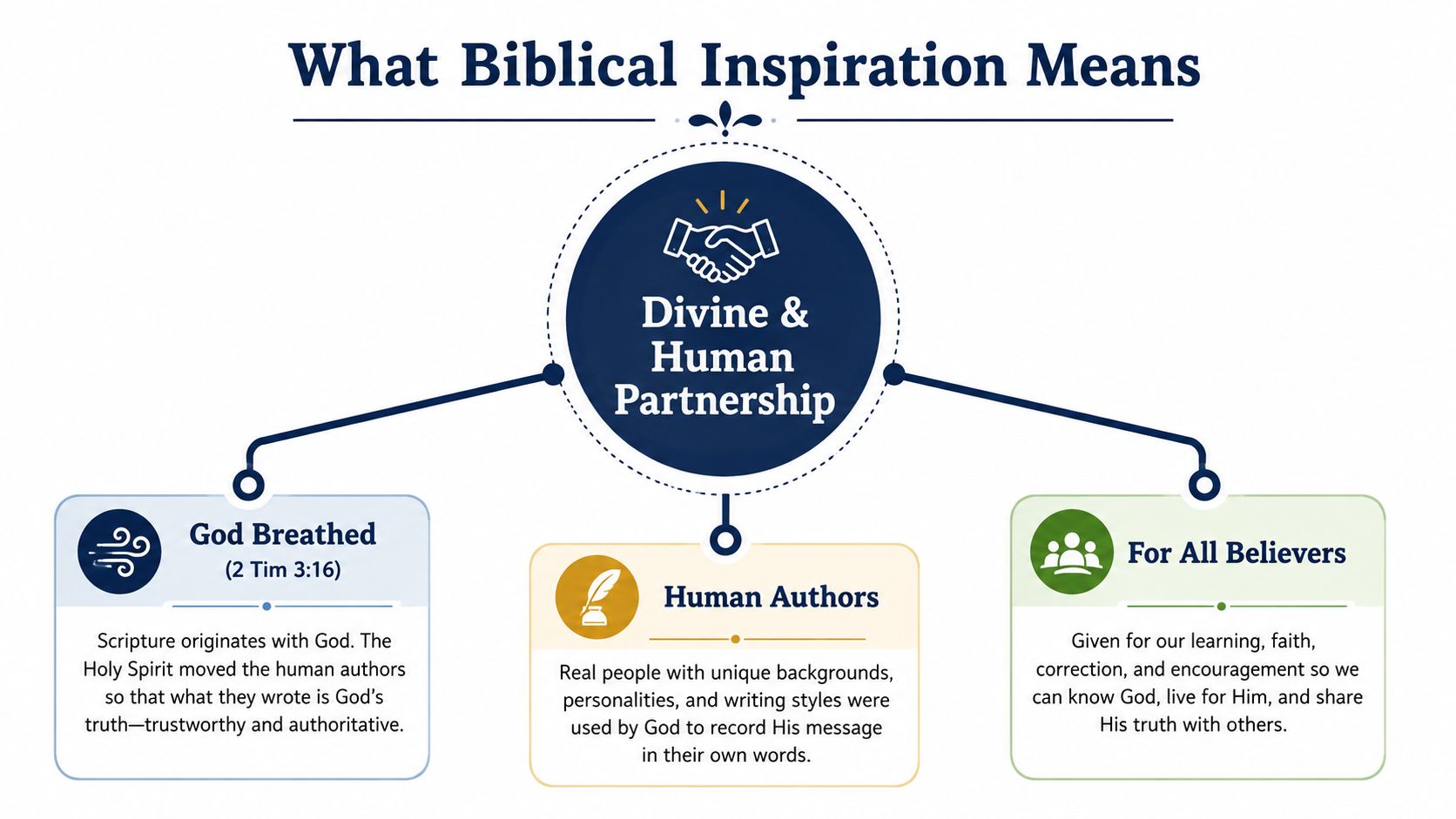
What is biblical inspiration? It begins with communication. God spoke through human writers, and the Holy Spirit guided their work so Scripture conveys God's intended message. The writers were not erased. Their vocabulary, circumstances, research, literary forms, and personal voices remain visible.
A physician may write about healing, a poet may express truth through imagery, and a historian may arrange material with deliberate purpose. Inspiration works through these differences rather than bypassing them. God's guidance does not turn every biblical passage into the same kind of writing.
Technical theology calls this the Holy Spirit's superintending work over human authors, preserving divine intention alongside genuine human authorship. The Bible's theological definition of inspiration therefore distinguishes inspiration from mechanical dictation.
Why the doctrine matters
Inspiration gives Christians reason to receive Scripture as more than religious reflection. The Bible comes through real people in real settings, yet it also bears God's authority. That is why faithful study attends to grammar, genre, history, and culture while also seeking wisdom and obedience.
The quartet of terms can still cause confusion. Inspired describes Scripture's divine and human origin. Inerrant concerns its truthfulness, understood according to what each passage intends to communicate. Literal can mean reading words plainly, but every text still requires attention to genre. Authoritative describes Scripture's rightful claim on the church's belief and life. These words overlap, but they do not mean the same thing.
Inspiration is not a shortcut around interpretation. It is a reason to interpret carefully, especially when an AI summary or digital study tool presents one reading with confident wording. Such tools may assist comparison and research, but they do not replace context, prayer, the gathered church, or responsible judgment.
A careful reader asks:
What did the human author communicate?
How does the genre shape the passage's meaning?
What did the original audience need to hear?
How does the passage fit the whole canon and point toward Christ?
How should this truth shape faithfulness today?
At The Bible Seminary, biblical study joins careful scholarship with spiritual formation and practical ministry, training both mind and heart.
Practical rule: Treat the Bible as God's authoritative communication, not as isolated statements detached from context.
Inspiration explains why Scripture deserves trust. Interpretation teaches us to read that trusted Word faithfully.
Key Bible Passages That Shape the Doctrine of Inspiration
The doctrine of inspiration doesn't begin with a later theological system. It grows from the Bible's own testimony about Scripture and prophecy. Two passages receive particular attention because they describe Scripture as originating with God while also acknowledging human servants.

God-breathed Scripture in 2 Timothy
Paul writes:
“All Scripture is inspired by God and is profitable for teaching, for rebuking, for correcting, for training in righteousness.”2 Timothy 3:16, CSB
The Greek word commonly discussed here is theopneustos, often explained as “God-breathed.” The phrase points to Scripture's divine origin and practical purpose. Paul immediately connects Scripture with teaching, correction, and training, so inspiration isn't merely a claim about where the Bible came from. It explains why Scripture forms the people of God.
The passage doesn't describe the Bible as a magical object that removes the need for understanding. It presents Scripture as a means through which God teaches and shapes his people.
Prophecy carried along by the Spirit
Peter writes:
“Above all, you know this: No prophecy of Scripture comes from the prophet's own interpretation, because no prophecy ever came by the will of man; instead, men spoke from God as they were carried along by the Holy Spirit.”2 Peter 1:20–21, CSB
The image of being carried along by the Holy Spirit emphasizes divine initiative. Prophecy didn't begin as a private human invention. Yet Peter still speaks of “men” who spoke. The passage holds divine direction and human participation together.
This is why Christians often describe the doctrine as verbal and plenary inspiration. “Verbal” means inspiration extends to the words of Scripture. “Plenary” means it extends to the whole of Scripture, every book and part without exception, as explained in this theological treatment of verbal and plenary inspiration.
The terms don't require a dictation model. They express confidence that God's message reaches the words and the whole canon through human authors whom the Spirit guided.
This short video can help visual learners connect the biblical language with the doctrine:
We should also distinguish inspiration from illumination. Inspiration refers to the Spirit's work in the production of Scripture. Illumination refers to the Spirit's help as readers understand and apply Scripture. A reader may be Spirit-led without producing new inspired Scripture.
Major Models of Biblical Inspiration Explained Simply
Christians have used several models to explain how God communicated through human authors. These models don't all carry the same theological implications, and they shouldn't be treated as interchangeable labels.
A useful comparison starts with three questions:
What role does the human author play?
How extensively does inspiration operate?
Does the model preserve both divine authority and authentic human authorship?
Verbal plenary inspiration
This view says the Holy Spirit superintended the biblical writers so that the words they wrote communicate God's intended message. “Verbal” concerns the words. “Plenary” concerns the whole of Scripture.
An everyday analogy might be a skilled composer working with an accomplished musician. The musician performs with recognizable skill and expression, yet the finished work communicates the composer's intended music. The analogy isn't perfect, but it helps show why divine authorship doesn't require human passivity.
This model aligns closely with historic evangelical convictions because it takes Scripture's complete authority seriously while recognizing the distinctive voices of biblical writers.
Dictation
A dictation model pictures God supplying the words while the human writer records them like a secretary. It protects divine initiative, but it struggles to explain the varied vocabulary, literary structures, research processes, and personal styles evident across Scripture.
If every biblical writer functioned only as a passive recorder, the Bible's human texture would be difficult to account for.
Dynamic inspiration
Dynamic views emphasize God's guidance of the author's thoughts or message rather than inspiration extending to every word. This can highlight the human writer's activity, but it may leave readers uncertain about how fully God's intended message reaches the actual text.
Illumination
Illumination describes the Spirit's work in helping people understand Scripture. It's important for faithful reading, but it isn't the same as inspiration. A pastor may gain insight into a passage without receiving new revelation equal to Scripture.
Neo-orthodox approaches
Some neo-orthodox accounts place emphasis on God's self-revelation through the biblical witness, especially as Scripture encounters readers and points them to Christ. These approaches can remind the church that the Bible is meant to bring us into relationship with God, but they may define inspiration differently from evangelical verbal and plenary theology.
Model | Role of Human Author | Scope of Inspiration |
|---|---|---|
Verbal plenary | Genuine author with personal style under the Spirit's superintendence | The words and the whole of Scripture |
Dictation | Primarily a recorder of supplied words | The dictated wording |
Dynamic | Active communicator of a divinely guided message | Often the central ideas or message |
Illumination | Reader or teacher aided by the Spirit | Understanding and application, not production of Scripture |
Neo-orthodox | Witness to God's self-revelation | Defined through the encounter between revelation, text, and reader |
The comparison helps us speak charitably without blurring important distinctions. A Bible-based, Christ-centered approach can affirm that the Spirit worked through human authors while refusing to reduce those authors to writing instruments.
How Christians Have Understood Inspiration Through History
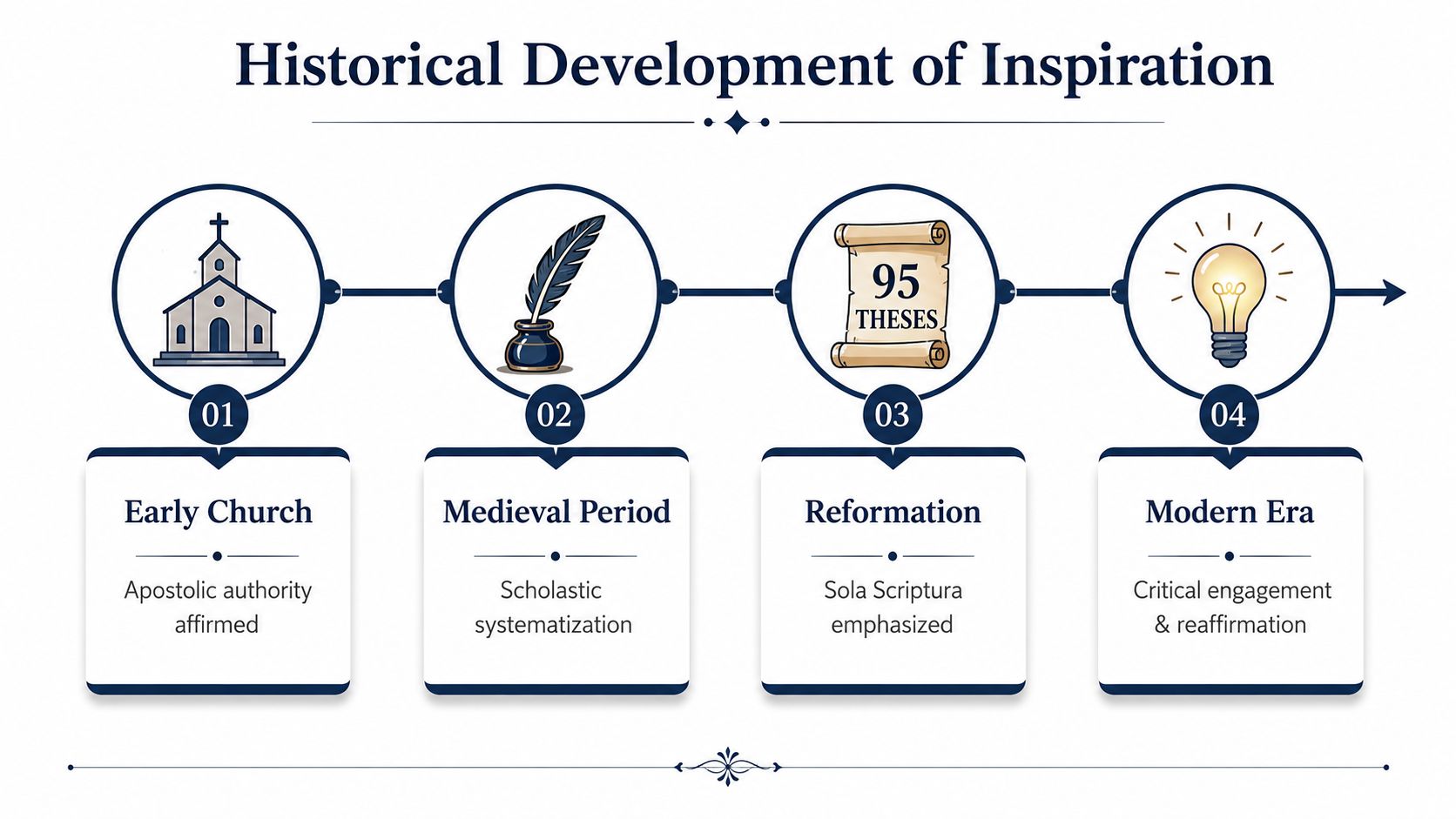
The church didn't receive a fully developed vocabulary for inspiration in one moment. Early Christians treated apostolic teaching and Scripture as authoritative, and later Christian theologians worked to explain how divine authorship related to human writers.
Over time, Protestant theology increasingly emphasized Scripture as divinely authored through human instruments. The Reformation's concern for Scripture's authority gave this doctrine particular importance, especially as Christians asked how the church should be corrected and formed.
A developing confession
The Westminster Confession of Faith in 1646 crystallized this conviction by stating that the Scriptures “are given by inspiration of God, to be the rule of faith and life” (historical overview of the doctrine of inspiration).
That wording brings doctrine and discipleship together. Scripture isn't inspired merely to satisfy curiosity about origins. It directs belief and conduct. Christians read the Bible to know what to trust, how to worship, how to repent, how to love neighbors, and how to serve Christ.
Historical timelines used by Bible scholars commonly place the writing of Revelation around AD 95, a date that helps mark the close of the canonical period in many Christian traditions. That historical marker shouldn't be used as a substitute for theological reasoning, but it helps readers place the New Testament writings within the church's developing canonical horizon.
The history also teaches humility. Christians today stand within a long conversation shaped by worship, persecution, theological debate, translation, teaching, and confession. We shouldn't pretend that every question is simple, but neither should complexity make us abandon the church's confidence that God has spoken through Scripture.
For seminary students, that confidence supports serious study rather than opposing it. Historical research, language study, archaeology, and theology can serve the church when they help readers understand the world of the Bible and hear its message more accurately.
How Inspiration Shapes Reading Teaching and Ministry Today
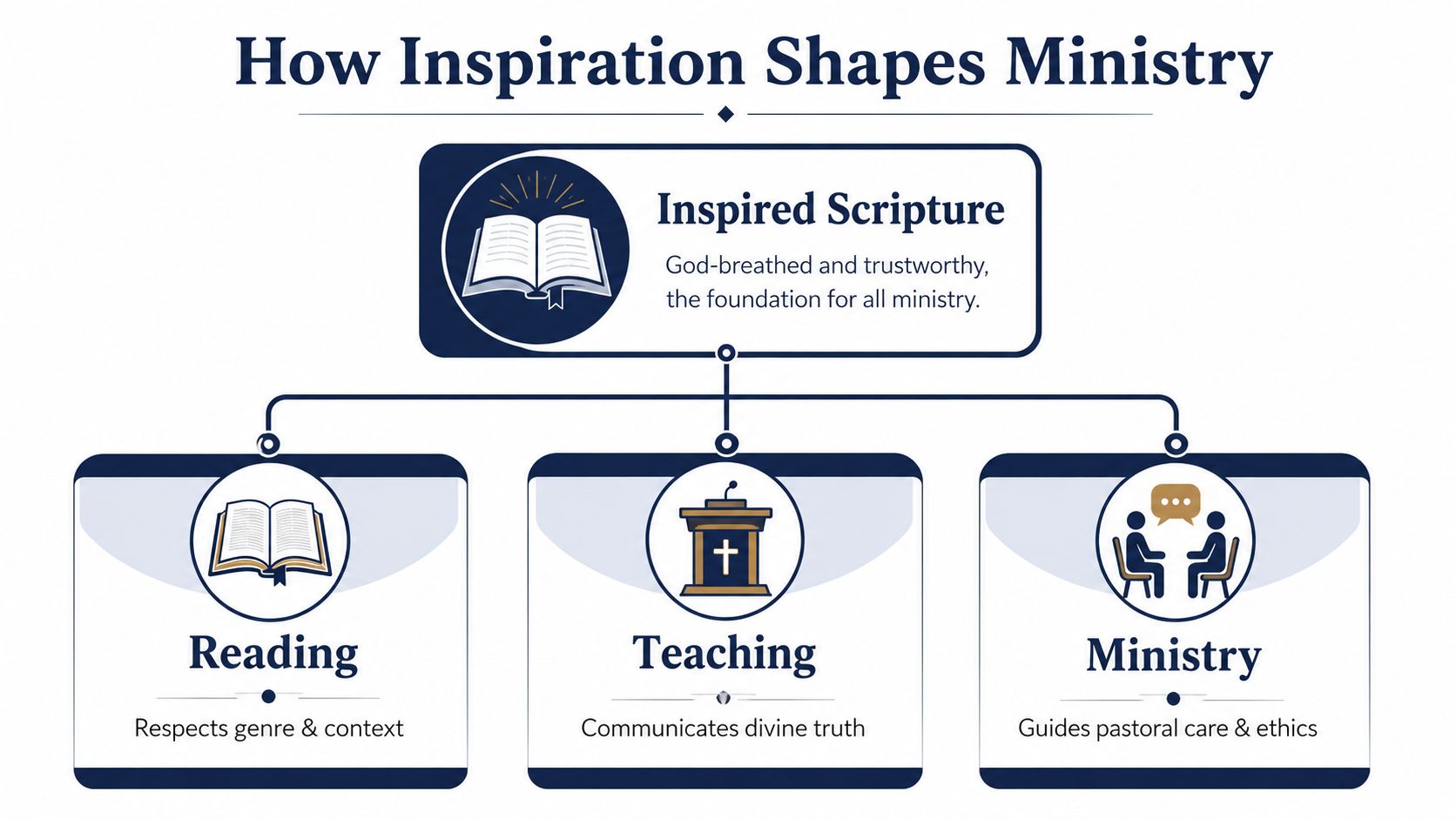
How should Christians read a text that comes through both divine inspiration and human authors? Inspiration calls us to attend to what the authors wrote, how they wrote it, and how each passage contributes to the Bible's wider witness. It also helps clarify four related terms. Inspired speaks of Scripture's origin through God's Spirit working through human writers. Authoritative speaks of Scripture's right to shape belief and practice. Inerrant concerns truthfulness within a particular theological framework. Literal should not mean forcing poetry, parables, or visions into the form of modern prose.
A psalm communicates through poetry. Proverbs offers wisdom sayings. The Gospels narrate Jesus' ministry. Paul develops arguments in letters, while apocalyptic passages use symbolic imagery. Faithful interpretation respects each form, much as a reader understands a song differently from a legal instruction without treating either as untrue.
Reading with context
A Bible study leader may ask students to trace an argument through an entire paragraph rather than isolate one sentence. A pastor preparing a sermon may examine the passage's historical setting, repeated words, literary structure, and relationship to the book's central message. These practices honor inspiration by taking seriously the human authors through whom the Spirit communicated.
For Bible teachers: Ask, “What did this author communicate to the original audience, and how does the whole canon guide faithful application?” before asking, “What does this verse mean to me?”
The same approach helps homeschool families and church groups. Children can learn that the Bible is trustworthy while also learning that a proverb, parable, and historical narrative communicate truth in different ways.
Using digital tools wisely
AI summaries and digital study aids can help locate themes, compare translations, or generate discussion questions. They can also misrepresent a passage, flatten context, combine distinct interpretations, or present uncertainty as settled fact.
An AI explanation is not inspired Scripture. It is machine-generated commentary that should be tested against the biblical text, sound interpretation, the church's theological wisdom, and responsible scholarship. Phones, search engines, study platforms, and algorithmic recommendations can assist study, but they cannot replace prayerful reading, accountable interpretation, or pastoral wisdom.
Public discussion about biblical belief makes clear language especially important. As noted earlier, reported attitudes toward inspiration have changed over time. Churches need teachers who can explain these categories without mockery, panic, or slogans (survey discussion and trend report).
For ministry, inspiration encourages patient proclamation. Pastors do not treat Scripture as raw material for personal preferences. They listen to the text, explain it in context, connect it to Christ, and apply it with compassion.
Clearing Up Common Questions and Misunderstandings
How do inspired, inerrant, literal, and authoritative differ? These terms belong together, yet each answers a different question about Scripture.
Inspired describes Scripture's divine origin through the Spirit's work in human authors. Inerrant refers to Scripture's truthfulness and freedom from error, understood within a particular theological framework. Literal may mean reading words in their ordinary sense, but it can also be misused to treat every genre as straightforward modern prose. Authoritative describes Scripture's right to guide Christian belief and life.
A Christian can affirm that the Bible is inspired and authoritative without reading every passage in the same manner. Psalms use metaphor, Jesus teaches through parables, and Revelation communicates through visions and symbols. Taking a figure of speech according to its literary form does not weaken Scripture's authority. It takes the author's words seriously.
Inspiration and inerrancy
Many Christians connect inspiration with inerrancy, though public discussions show that people distinguish the terms in different ways. A 2011 Gallup survey found that 49% of Americans described the Bible as inspired by God but not literally true, the most common response in nearly four decades of polling on that question (survey summary on biblical inspiration).
In the United Kingdom, an Evangelical Alliance study reported 78% believing the Bible is divinely inspired, while 34% believed it is free from error. The figures illustrate why Christians need clear definitions when discussing inspiration and inerrancy. They do not settle the theological debate.
Inspiration and difficult questions
Questions about science, archaeology, apparent tensions, or denominational disagreement deserve patient examination. That examination may include manuscripts, context, genre, translation, historical setting, and the theological assumptions shaping an interpretation. A slogan cannot do that work.
Christians also distinguish biblical revelation from God's witness through creation. For a related explanation, read what general revelation means. Scripture remains the normative written revelation for Christian faith, while general revelation describes God's self-disclosure through the created order.
Digital study tools and AI summaries can make these questions easier to encounter, but they do not make them easier to answer. A generated summary may flatten context or blend interpretations, so readers should test it against Scripture, wise Christian teaching, and responsible scholarship.
A humble reader can hold firm convictions while admitting that some interpretive questions require care. The goal is to know God, submit to his Word, and help others read faithfully.
Growing Deeper and Taking Your Next Step With TBS
Biblical inspiration brings the whole life of the church into focus. It calls us to receive Scripture as God's authoritative Word, read it according to its literary and historical character, and obey it as people being formed in Christ.
That work requires more than information. Pastors need theological depth for preaching and care. Teachers need interpretive skill for guiding students. Ministry leaders need wisdom for applying Scripture amid cultural change and digital confusion. Students need habits that unite prayer, scholarship, community, and service.
The Bible Seminary offers pathways for that kind of formation, including degree programs, certificates, flexible course options, archaeology study through its archaeology resources, and opportunities connected with the 3J Museum. Its approach joins Bible-based academics, Christ-centered spiritual formation, Spirit-led ministry preparation, and hands-on learning.
A faithful goal: Let careful study deepen worship, and let worship send us back to Scripture with greater patience and obedience.
This is how scholarship serves the kingdom. It equips leaders to impact the world for Christ, trains hearts and minds for kingdom service, and unites academic preparation with practical ministry. It also helps the church show how the Bible comes alive when archaeology and Scripture are studied together, without exaggerating what evidence can prove.
Explore how biblical inspiration can shape your calling through the programs, certificates, archaeology resources, and ministry-focused training at The Bible Seminary. Visit the seminary online to learn how you can train your heart and mind for faithful kingdom service.