
What Is a Biblical Studies Degree and How It Prepares You

You may be asking this question after sensing a call to serve Christ more faithfully. Perhaps you lead a Bible study, teach students, serve in your church, or want to understand Scripture beyond personal devotional reading. You may also be wondering whether a biblical studies degree prepares only future pastors, or whether it can serve you in education, missions, writing, nonprofit work, or further theological study.
The phrase biblical studies degree can be confusing because programs differ by school, level, denomination, and purpose. Some emphasize languages and exegesis. Others combine Bible courses with theology, church history, ministry practice, or general education. The title alone won't tell you how far a program engages Scripture.
This guide will help you discern the difference. We'll begin with the degree's purpose and structure, then examine its coursework, the skills and spiritual formation it develops, how it compares with professional ministry degrees, and what paths may follow graduation. We'll also consider the questions that matter before you enroll, including accreditation, faculty, biblical languages, ministry experience, and the need for further credentials.
At The Bible Seminary, we believe theological education should unite scholarship, spiritual formation, and hands-on ministry. Scripture is authoritative and foundational, and careful study should lead to faithful obedience and loving service. As Paul writes, believers are entrusted with the ministry of reconciliation as “ambassadors for Christ” (2 Corinthians 5:20, ESV). A biblical studies degree can help you handle that responsibility with humility, competence, and hope.
Introduction to Understanding a Biblical Studies Degree
Consider a student named Jordan. Jordan has spent years serving in a local church and feels increasingly drawn to teaching Scripture. Yet the next step isn't obvious. Should Jordan pursue a biblical studies degree, a theology program, an MDiv, or perhaps a certificate that fits around work and family responsibilities?
That uncertainty is understandable. A degree can sound like a collection of Bible classes, but strong programs involve far more than reading familiar passages. They teach you how to examine a text's genre, historical setting, literary structure, theological message, and practical significance. They also ask you to write, research, discuss, receive correction, and apply what you learn in the life of the church.
A biblical studies degree commonly centers on a defined Bible and theology core rather than a single broad survey. The Association for Biblical Higher Education explains that graduates of its institutions must complete the equivalent of 30 semester credit hours in a Bible and Theology Core within a bachelor's program, along with practical ministry formation (ABHE accreditation guidance). That structure shows why the degree should be evaluated by its depth and design, not merely by its name.
You'll find answers here for several kinds of readers:
Prospective students: Learn what you'd study and how to evaluate program quality.
Pastors and ministry leaders: See how formal training can strengthen teaching, discipleship, and leadership.
Christian educators and families: Understand how biblical studies supports curriculum, communication, and formation.
Bible students and archaeology enthusiasts: Consider how Scripture, history, and material evidence can be studied responsibly.
The central question isn't, “What jobs can I get?” It's also, “Will this program help me know Scripture accurately, love Christ, and serve people wisely?” That is the measure we'll keep in view.
What a Biblical Studies Degree Really Is
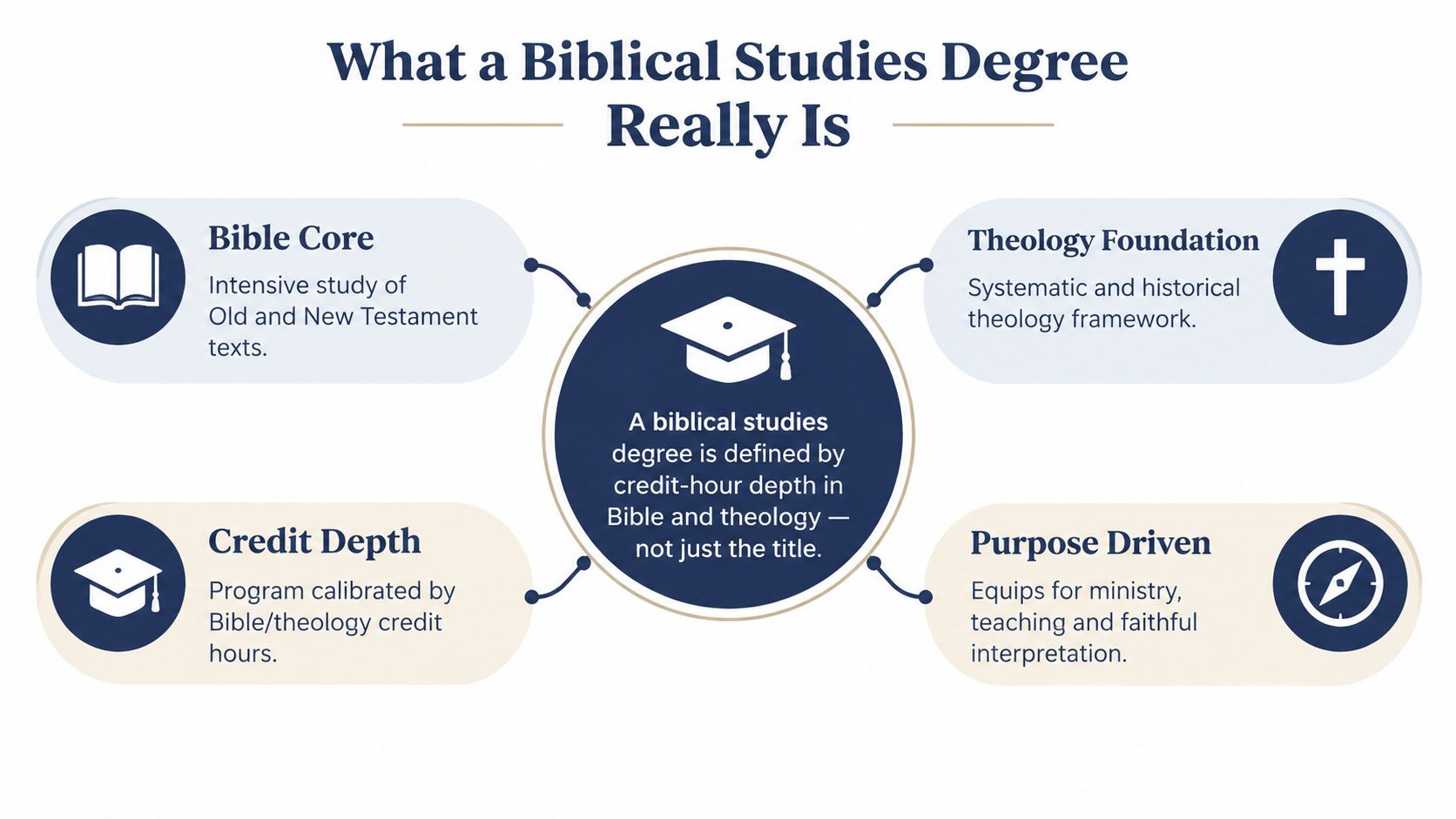
A biblical studies degree is an academic program focused on the Bible's contents, contexts, languages, interpretation, theology, and application. It's designed to form students who can engage the biblical text directly and responsibly, rather than relying only on devotional impressions, popular summaries, or isolated verses.
A useful analogy is the difference between a map and a journey. A brief Bible survey may show you the major roads and landmarks. A full biblical studies program asks you to learn how the roads connect, how the terrain shaped travel, how the original languages communicate meaning, and how the entire journey points to God's redemptive work in Christ.
Depth is measured by structure
The degree's depth appears in its curriculum. ABHE's policy guidance specifies that traditional four- or five-year baccalaureate programs require 30 semester hours, or 45 quarter hours, of biblical and theological studies. Traditional one- and two-year programs require 12 semester hours (ABHE policy guidance).
Those requirements don't mean every program looks identical. They do show that biblical studies education is calibrated by credit-hour depth and progression. An associate program, bachelor's program, and master's program may all use similar words in their titles, but they won't provide the same scope or level of analysis.
The discipline exists across multiple levels. In the federal higher-education data cited by the National Center for Education Statistics, Bible/Biblical Studies was a recognized program category that conferred 4,021 degrees during the 12-month period from July 1, 2011, to June 30, 2012. That included 2,920 bachelor's degrees, 547 master's degrees, and 526 associate degrees (ABHE accreditation guidance).
It is more than devotional reading
Devotional reading seeks communion with God and faithful response. Biblical studies honors that purpose while adding disciplined academic tools. Students learn to ask what a passage meant in its original setting, how its argument works, how it relates to the canon, and how it should be applied without distorting its message.
At a Bible-centered institution, this study should never become detached from worship or obedience. Jesus' command to make disciples includes teaching them “to observe everything I have commanded you” (Matthew 28:20, CSB). Sound study serves that mission by training hearts and minds for kingdom service.
The best programs therefore bring together Bible content, theological reflection, spiritual formation, and ministry practice. They prepare students to read carefully, teach truthfully, and serve people with Christlike character.
Core Coursework That Shapes Your Study
A well-designed curriculum moves from orientation to analysis, then from analysis to responsible ministry application. You shouldn't encounter advanced interpretation before learning the basic shape of the biblical narrative. You also shouldn't finish with information alone, without practicing how to communicate and use that knowledge.
Foundations establish the biblical landscape
Most programs begin with Old Testament and New Testament studies. These courses introduce the books, major themes, historical settings, literary forms, covenantal development, and place of each passage within the whole canon.
A survey isn't meant to replace close reading. It gives you the framework needed to understand why Torah, Prophets, Gospels, and Epistles speak in different ways and how their messages contribute to the unified witness of Scripture.
The next layer often includes theology and Christian history. Theology helps you connect biblical teaching across topics such as God, creation, sin, redemption, the church, and the hope of new creation. Church history helps you recognize how Christians have interpreted, defended, proclaimed, and sometimes mishandled these teachings across generations.
Method turns reading into interpretation
Courses in hermeneutics and biblical interpretation teach principles for understanding a text according to its genre, context, grammar, structure, and purpose. Exegesis then applies those principles to particular books or passages.
For example, a student reading a prophetic text must account for symbolism, historical setting, covenant language, and poetic form. A student studying an epistle must trace the author's argument, identify the recipients' situation, and distinguish commands from supporting explanations.
One representative curriculum includes Introduction to the Bible, Biblical Interpretation, Research Methods, and a Senior Seminar (Eastern University curriculum). That sequence signals a method-driven discipline. Students aren't merely collecting information. They're learning to investigate, interpret, write, and synthesize.
Practical rule: Before applying a passage, identify what kind of text it is, what it meant in context, and how its theological truth connects to the rest of Scripture.
Languages and capstone work deepen the process
Greek and Hebrew courses provide tools for examining words, syntax, verbal forms, and textual relationships. You may not translate every passage independently after graduation, but language study can sharpen your awareness of how meaning is carried in the original text and how translations make interpretive decisions.
Advanced courses might include Greek syntax and exegesis, hermeneutics, Torah, and Prophets. A senior seminar or capstone then asks you to bring research, interpretation, theology, and communication together in one sustained project.
Look for a program whose course sequence is coherent. ABHE standards require written student outcomes, a program of study designed to reach those outcomes, regular faculty review, and sequencing that moves from foundational to advanced study (ABHE programmatic accreditation standards).
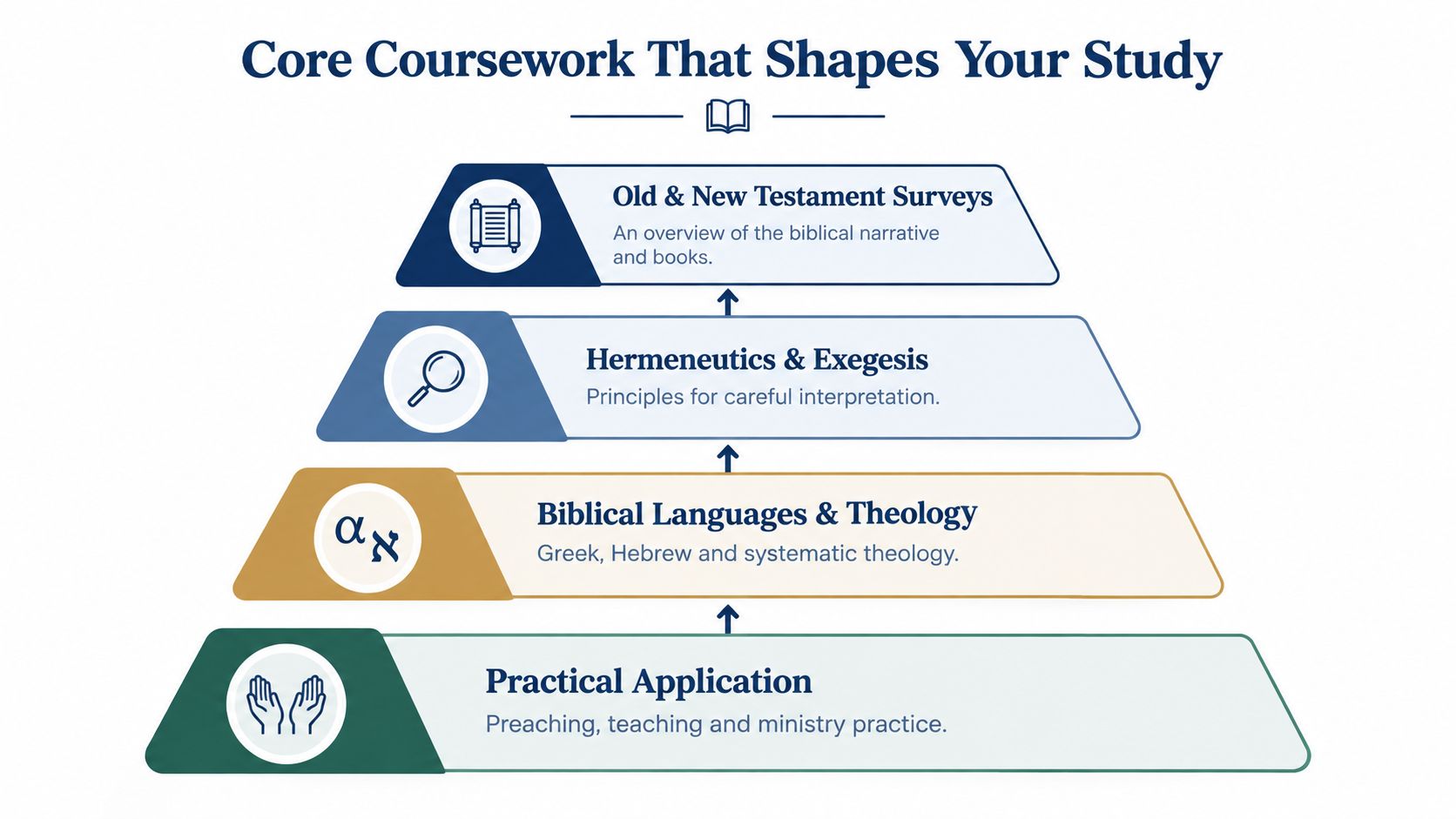
A visual overview can help you see how surveys, interpretation, languages, theology, and practical ministry belong together rather than functioning as disconnected subjects.
Skills and Spiritual Formation You Will Gain
A biblical studies degree shapes both what you can do and how you approach people, texts, and ministry responsibilities. Research and interpretation are not abstract exercises. They influence the accuracy of a sermon, the quality of a curriculum, the wisdom of a pastoral conversation, and the way a leader responds to cultural complexity.
Method develops durable skills
Careful exegesis teaches patience. You learn to slow down, identify assumptions, compare interpretations, examine evidence, and distinguish what the passage says from what you wish it said.
Research methods strengthen your ability to locate credible sources, frame a question, organize an argument, and document conclusions. Those habits support sermon preparation, Bible study leadership, curriculum writing, ministry communications, and graduate theological work.
Writing assignments develop more than grammar. They train you to explain complicated ideas clearly, anticipate questions, and make a case without exaggeration. Independent university career guidance identifies communication and writing, research and cultural context, critical thinking and analysis, and ethical reasoning as transferable skills associated with biblical studies (Faulkner University career guidance).
Languages improve interpretive judgment
Biblical Hebrew and Greek can help you notice details that are less visible in translation. Syntax, repeated terms, word relationships, and verbal forms may affect how a passage should be understood.
Language study doesn't make a person spiritually superior, and it doesn't eliminate the need for prayer, community, or wise teachers. It gives you an additional tool for responsible interpretation. A student who understands how language tools work is better prepared to consult commentaries and translations critically rather than treating any single resource as infallible.
Formation keeps scholarship connected to love
Academic ability without humility can harm a church. A program should cultivate teachability, integrity, prayer, accountability, and a willingness to serve people who may not share your vocabulary or educational background.
ABHE's institutional standards describe programs that support a biblical worldview through Bible engagement and theological reflection while preparing graduates to engage diverse and multicultural contexts (ABHE institutional standards). That emphasis matters in Katy, Texas, the Greater Houston area, and global ministry settings alike.
You may leave a course with stronger analytical skills, but the deeper aim is faithful stewardship. “Whatever you do, do everything for the glory of God” (1 Corinthians 10:31, CSB) gives theological education its proper direction.
How Biblical Studies Compares to MDiv and Other Ministry Degrees
Students often choose the wrong program because they compare titles instead of purposes. Biblical studies usually emphasizes the text, interpretation, languages, and research. An MDiv generally provides broader professional formation for ordained or pastoral ministry, including preaching, pastoral care, leadership, supervised ministry, and other requirements that vary by institution and denomination.
A theology degree may concentrate more heavily on doctrine, philosophical questions, historical theology, and the development of Christian belief. A ministry degree may prioritize leadership, discipleship, evangelism, administration, counseling support, or practical ministry settings. None is automatically superior. The right choice depends on the work you believe God may be calling you to do and the requirements attached to that role.
A practical comparison
Program Focus | Typical Length and Core | Best Fit For |
|---|---|---|
Biblical Studies | Undergraduate or graduate study centered on Scripture, interpretation, research, theology, and often biblical languages | Students seeking deep engagement with the biblical text, teaching preparation, writing, Christian education, or a foundation for further study |
Master of Divinity | Professional graduate formation combining Bible, theology, ministry practice, pastoral care, leadership, and often supervised experience | Students pursuing pastoral ministry, ordination, chaplaincy preparation, or roles requiring broad professional formation |
Theology | Study organized around doctrine, theological systems, church history, philosophy, and Christian thought | Students drawn to doctrinal development, apologetics, theological writing, or advanced academic work |
Christian Ministry | Applied preparation in preaching, discipleship, evangelism, leadership, administration, or specialized ministry | Students preparing for church leadership, youth ministry, missions, or ministry coordination |
Certificate or continuing education | Focused study in selected Bible, theology, archaeology, or ministry subjects | Lay leaders, volunteers, working ministers, and students discerning whether a longer program fits their season |
Know which doors need another credential
A biblical studies degree may provide a strong foundation for teaching in a church, Christian education, writing, ministry communications, nonprofit service, or entry-level ministry leadership. It doesn't automatically confer ordination, counseling licensure, or eligibility for every chaplaincy role.
Pastoral requirements differ by denomination and local church. Some churches may value a biblical studies background, while others expect an MDiv or denominational training. Counseling roles may require a counseling degree, supervised practice, certification, or a state license. Professional chaplaincy commonly involves additional theological education, endorsement, and clinical or institutional requirements.
Ask the institution, denomination, or employer what credential it requires. A clear answer can save you from investing in a program that doesn't match your intended role.
Career Paths and Next Steps After Graduation
The career reality after biblical studies is often non-linear. Some graduates enter church staff roles. Others combine ministry with teaching, communications, business, nonprofit work, or another vocation. The degree's portability comes from the habits it develops, careful reading, ethical reasoning, research, clear communication, and service-oriented leadership.
Immediate ministry applications
Depending on the program and your experience, possible directions include:
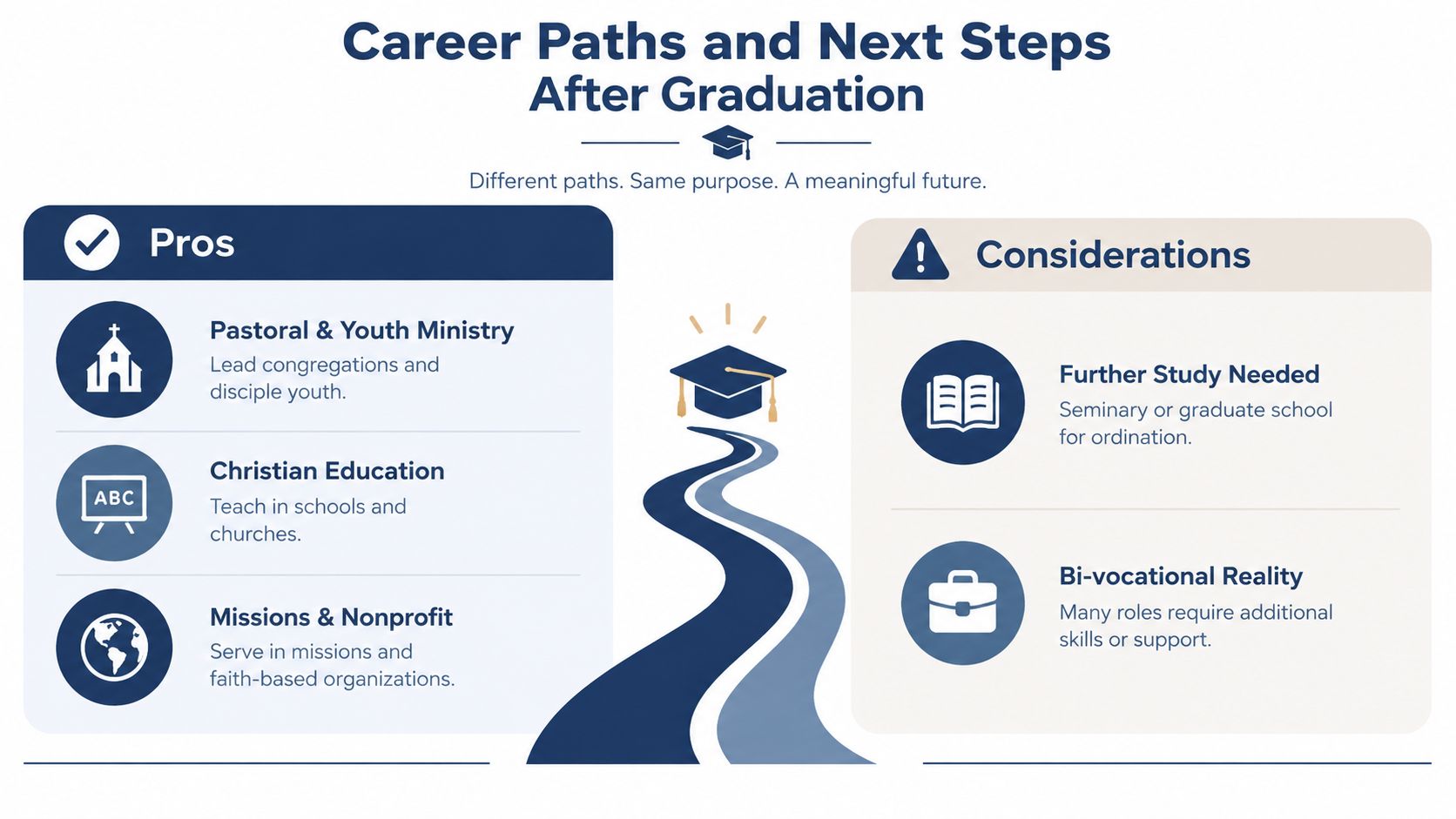
Pastoral and youth ministry: Assist with preaching, discipleship, small groups, youth formation, or congregational care while pursuing the experience and credentials your church or denomination expects.
Christian education: Develop lessons, teach in churches, support Christian schools, or coordinate religious education.
Church administration: Combine biblical understanding with organization, communication, volunteer coordination, and ministry planning.
Missions and nonprofit service: Serve with a mission agency, parachurch organization, or faith-based nonprofit where Scripture, cross-cultural awareness, and relational maturity matter.
Writing and communications: Prepare curriculum, edit ministry resources, manage communications, or produce content for Christian organizations.
A career guide from Grace Christian University describes biblical studies pathways that include teaching, communications, business, nonprofit work, and other marketplace roles, while also noting that many graduates don't enter formal church staff positions (career pathways after biblical studies).
Further study can change the pathway
Graduates who want ordination, seminary teaching, advanced research, or professional chaplaincy may need further theological education. Chaplaincy also involves requirements set by the employer, endorsing body, and ministry setting. Biblical counseling can require additional counseling preparation or certification, especially when the role involves clinical care.
That doesn't make the degree a dead end. It can function as a foundation for graduate study because you arrive with experience in biblical interpretation, research, and languages. The Association of Theological Schools reported that 74,283 people pursued graduate theological degrees in the United States and Canada last year, the largest total since tracking began in 1969, according to the verified reporting summarized in this guide. Coverage also points to a part-time pivot and regional changes in enrollment patterns (ATS-related reporting and theological education context).
For a fuller discussion of possible directions, see career options after a biblical studies degree. Then compare those possibilities with your current experience, local opportunities, and the credentials attached to your desired role.
How to Choose and Prepare for the Right Program
Choosing a program begins with your calling, but it shouldn't end there. Pray, seek counsel from mature believers, speak with pastors who understand your context, and ask schools direct questions about curriculum, faculty, delivery format, and outcomes.
Use this evaluation checklist
Accreditation and accountability: Confirm which accrediting body evaluates the institution and whether the program has clear student outcomes and regular curricular review.
Bible and theology depth: Ask how many courses focus on Scripture and theology, not merely general religious studies.
Sequencing: Look for a progression from biblical foundations to interpretation, languages, research, and advanced synthesis.
Faculty expertise: Read faculty biographies and learn whether instructors bring academic preparation and meaningful ministry experience. The faculty information at The Bible Seminary can help you see how an institution presents its academic community.
Language offerings: Ask whether Greek and Hebrew are available, how they're taught, and how language study connects to exegesis.
Ministry practice: Find out whether students receive opportunities for teaching, church service, internships, field education, or mentoring.
Archaeology and historical study: If you want to explore how archaeology and Scripture relate, review the institution's archaeology resources and ask how archaeological evidence is handled responsibly.
Format and access: Consider campus study, online courses, auditing, certificates, or on-demand seminars in light of your work, family, and ministry responsibilities.
Community life: Ask how students interact with professors, churches, classmates, and ministry leaders. Formation rarely happens through isolated content alone.
Prepare before classes begin
Start reading Scripture consistently in context. Practice observing repeated words, literary structure, historical setting, and the author's argument. Keep a notebook of questions rather than rushing to conclusions.
You can also speak with admissions about transfer work, scheduling, language preparation, financial planning, and the difference between a certificate, a degree, and an MDiv. The right advisor won't pressure you into a program. They'll help you identify the training that matches your convictions, responsibilities, and calling.
At The Bible Seminary in Katy, Texas, students and ministry professionals can explore Bible-centered graduate education, including biblical studies and MDiv pathways, alongside archaeology resources and practical ministry formation. We exist to equip leaders to impact the world for Christ by uniting scholarship, spiritual formation, and hands-on ministry.
Visit The Bible Seminary to explore Bible-centered degree programs, certificates, archaeology resources, and ministry training designed to prepare hearts and minds for kingdom service. Contact the seminary to discuss your calling, your current ministry responsibilities, and the next faithful step in your biblical studies journey.