
New Testament Survey Course Guide for Ministry Leaders

You're leading a Bible study, preparing a sermon, or sensing a call to ministry, and you keep running into the same question: how do these 27 New Testament books fit together? You may know familiar passages from the Gospels or Paul's letters, yet still feel uncertain about the historical world, literary differences, and theological connections that shape responsible interpretation. A New Testament survey course gives you a guided way to move from scattered familiarity to a coherent, ministry-ready understanding of Scripture.

Why a New Testament Survey Course Matters for Your Ministry
A pastor might open 1 Corinthians to address division in a congregation, then turn to Acts to explain the church's mission, and finally teach from one of the Gospels about the kingdom of God. Those passages don't stand alone. They belong to a larger story, and ministry leaders serve people better when they can locate each book within that story.
A survey course helps you see the New Testament as a unified Christian canon without flattening its diversity. The Gospels present the life and ministry of Jesus through distinct literary witnesses. Acts narrates the spread of the gospel. The letters address churches and leaders facing concrete questions, and Revelation gives the church a vision of faithful hope under pressure. The course builds a framework for reading each passage in context.
That framework matters in ordinary ministry. A small-group leader needs more than a memorable verse. A youth teacher needs to explain why a Gospel passage is shaped differently from a Pauline letter. A pastor needs to connect salvation, discipleship, church life, suffering, mission, and hope without treating every book as if it made the same argument in the same way.
Ministry insight: You don't study the New Testament merely to remember more information. You study it so you can handle Scripture faithfully and help others follow Christ with understanding.
At The Bible Seminary, we value the union of scholarship, spiritual formation, and hands-on ministry. Academic study should deepen worship, humility, obedience, and service. As Jesus teaches in John 17:17, “Sanctify them by the truth. Your word is truth” (CSB). The aim is not intellectual pride, but training hearts and minds for kingdom service.
Busy leaders can also use practical study tools to capture insights while reading or listening to lectures. For those who prefer spoken notes, Voice Dictation iScribe for iPad can help record observations for later organization and review. Used wisely, a tool like this supports disciplined reflection without replacing careful reading of the biblical text.
A strong survey course can become a gateway to deeper study. It gives you the vocabulary, historical orientation, and canonical map needed for advanced theology, preaching, biblical interpretation, and ministry leadership. It also helps you identify where you need further growth, whether in the Gospels, Paul's letters, early-church history, or biblical theology.
What a New Testament Survey Course Covers at Its Core
At its simplest, a New Testament survey course is a foundational overview of all 27 books. That description sounds straightforward, but a serious course does much more than summarize one book after another. It introduces the content of the New Testament while placing it within the historical, literary, cultural, and theological worlds that shaped its composition and reception.
The New Testament is commonly dated to a writing span of roughly A.D. 45–95, a period of about 50 years (Loyola University Maryland course descriptions). That writing window makes context essential. The authors addressed real communities within the world of Second Temple Judaism and the Greco-Roman world, not an abstract audience removed from politics, geography, worship, economics, or social life.
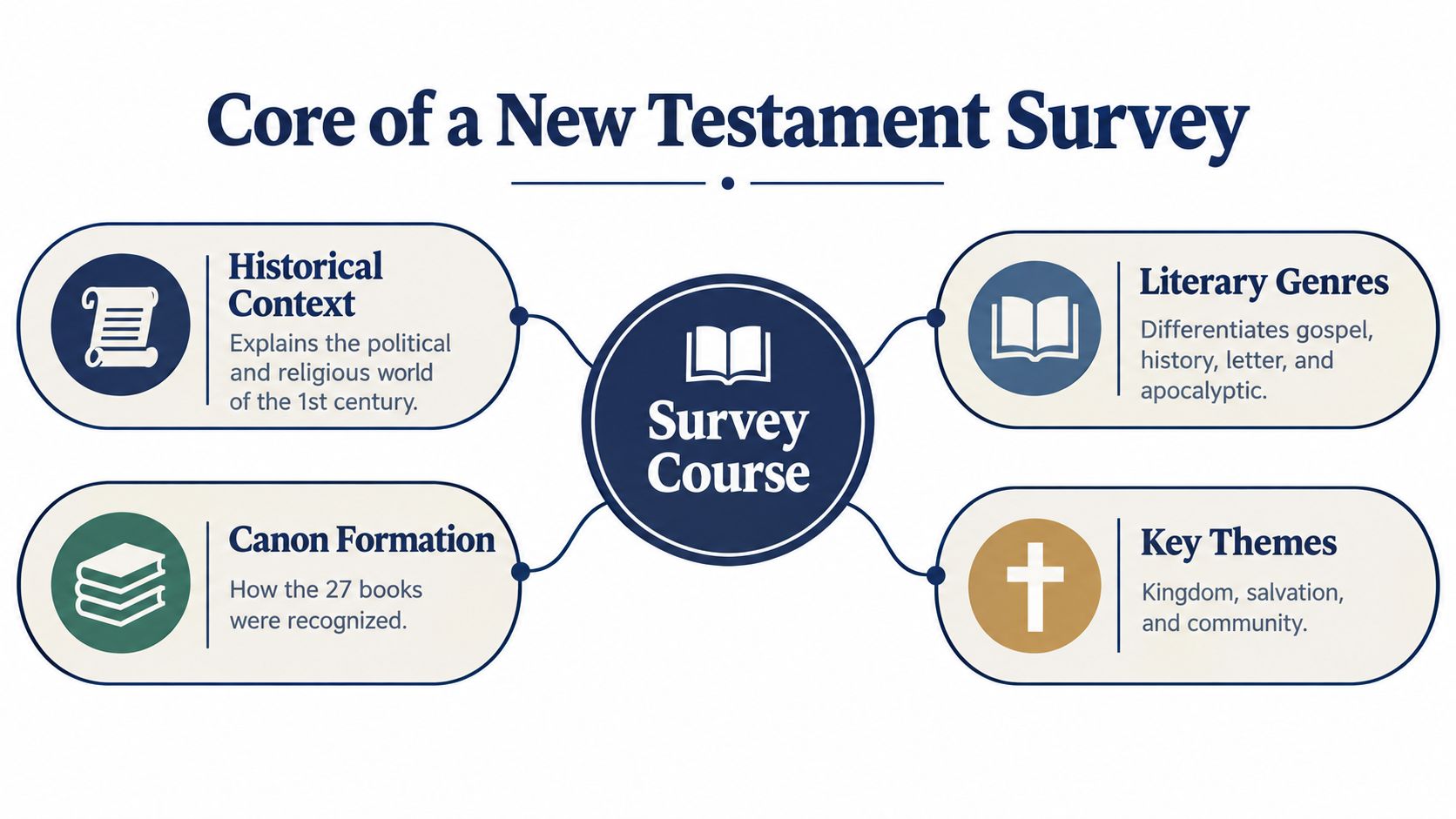
Four questions guide the survey
A useful course repeatedly asks four kinds of questions:
What does the text say? Students learn the content, structure, themes, and important passages of each book.
What world shaped the text? Historical, social, religious, economic, and geographical background clarifies the problems and hopes addressed by early Christians.
How does the book function in the canon? The course considers how individual writings contribute to the larger witness of Scripture and how the New Testament canon developed.
How should we read it responsibly? Genre, context, authorship questions, literary features, and major scholarly debates help students avoid careless interpretation.
The course may address the intertestamental background, the political and religious setting of the first century, the synoptic problem, the spread of Christianity in Acts, and the background and themes of every New Testament book (The Bridge Bible sample course material). These topics aren't academic decorations. They help explain why words such as kingdom, temple, law, exile, empire, and salvation carry such weight in the New Testament.
Many institutions use a 3-credit survey format, and multiple courses require students to read the entire New Testament (Oral Roberts University syllabus materials). That reading requirement distinguishes a canonical survey from a topical Bible study. You aren't sampling a few famous passages. You're learning to recognize the movement and relationships of the whole corpus.
A topical study may ask what the Bible says about prayer. A survey asks how Matthew, Luke, Acts, Paul, James, Peter, and Revelation each contribute to the church's understanding of faithful life with God. Both approaches have value, but they serve different purposes.
How the Syllabus Moves Through the 27 Books and Their World
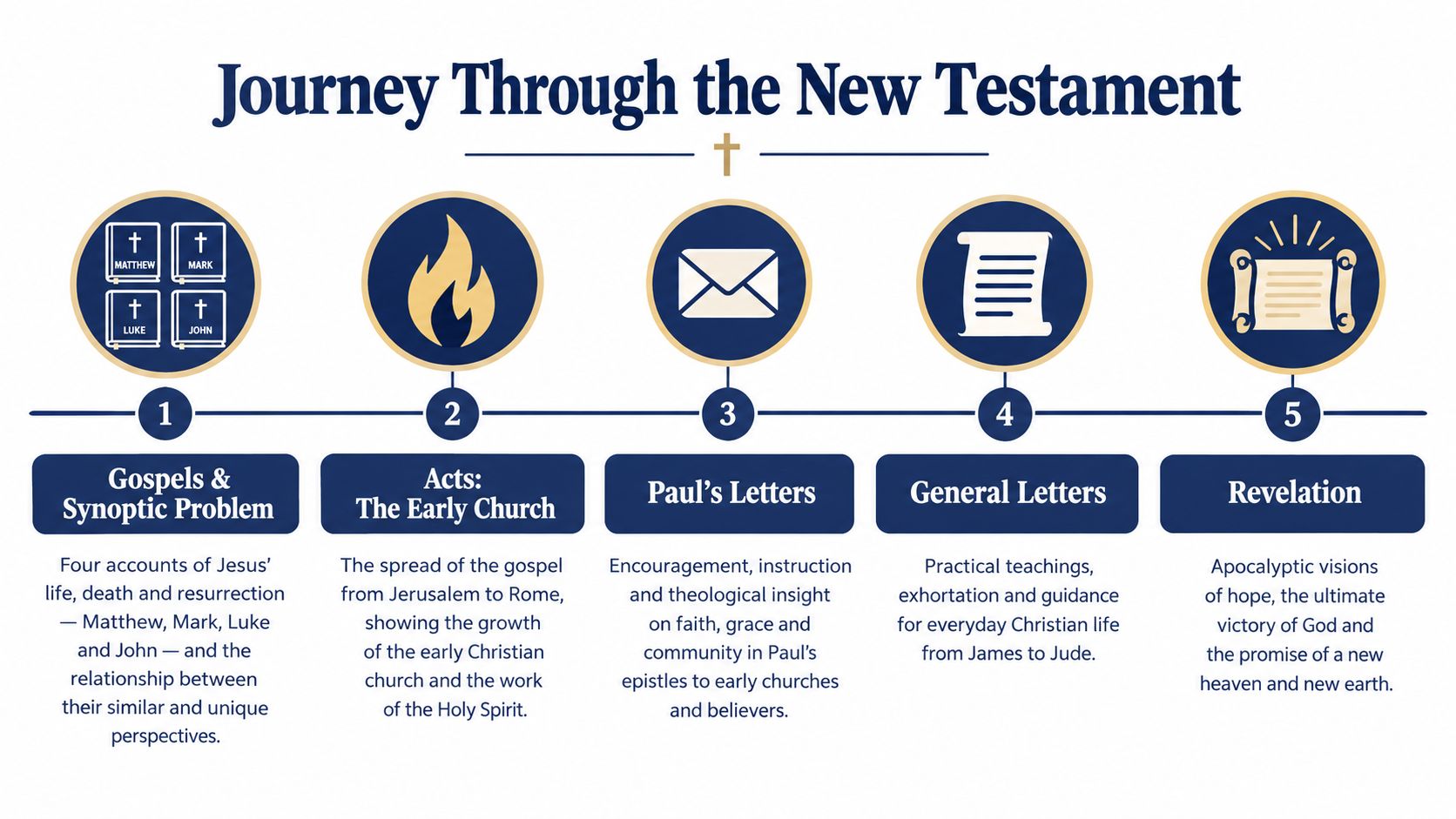
A well-designed syllabus usually follows the New Testament's literary groupings while keeping the historical setting in view. The journey begins with the Gospels, where students compare Matthew, Mark, Luke, and John and consider the synoptic problem, the question of how Matthew, Mark, and Luke relate to one another as literary witnesses.
The Gospels require careful attention to both unity and distinction. Students examine Jesus' proclamation of the kingdom, his identity, teaching, miracles, conflict, death, and resurrection. They also learn that each Gospel communicates through its own arrangement, emphasis, and narrative purpose. This guards against treating the four accounts as interchangeable copies or using one Gospel to erase the voice of another.
From Jerusalem to the wider world
Acts follows as the account of the early church's witness and growth. A survey traces the movement from Jerusalem outward, paying attention to the work of the Holy Spirit, apostolic preaching, opposition, community life, and the gospel's crossing cultural and geographical boundaries. The book connects the resurrection message to the formation of Christian communities.
Paul's letters then receive attention as occasional writings addressed to churches and individuals. Students examine recurring concerns such as faith, salvation, holiness, unity, leadership, suffering, spiritual gifts, and Christian hope. The letters make more sense when students understand that Paul writes into particular situations rather than offering detached theological essays.
The General Epistles broaden the picture. James, Peter, John, Jude, and Hebrews address Christian perseverance, wisdom, suffering, holiness, false teaching, love, and the supremacy of Christ. Revelation closes the canon with apocalyptic imagery and a call to faithful endurance. Its symbolism requires careful reading, humility, and attention to its original pastoral purpose.
The historical world behind the books
The intertestamental period deserves more than a brief footnote. Persian, Hellenistic, and Roman rule formed the political and cultural background in which Jewish communities and early Christians lived. Those transitions shaped questions about identity, authority, worship, language, power, and hope. Accessible teaching on this period remains a valuable need for pastors and lay leaders because many study guides emphasize book facts while giving less attention to the historical interval that makes those facts intelligible.
A helpful organizing method is to examine each book through recurring lenses:
Background: Who receives the writing, and what setting frames it?
Theme: What central theological burden organizes the book?
Key passages: Which chapters reveal its argument or pastoral purpose?
Key terms: Which repeated words help readers follow its thought?
Canonical role: How does the book contribute to the New Testament's unified witness?
This approach reflects a canonical, covenantal, and redemptive-historical perspective while remaining attentive to original historical and literary context (Reformed Theological Seminary NT601 course description).
Learning Objectives That Build Confidence Beyond Recall
A survey course should leave you able to do something with what you've learned. Memorizing authors, themes, and sequences can help, but ministry requires more. You need to explain the New Testament's storyline, interpret passages with care, and connect biblical truth to the people sitting in front of you.
Independent syllabus material identifies outcomes such as charting New Testament events on a timeline, summarizing major books, explaining the development of the canon, and transferring New Testament themes into church or disciple-making contexts (Southeastern University syllabus material). These are practical competencies. They turn information into teachable understanding.
Three kinds of growth
Interpretive confidence begins with orientation. When you know where a passage sits in a book, where the book sits in the canon, and what historical circumstances surround it, you have stronger tools for resisting proof-texting. Context doesn't remove every interpretive difficulty, but it helps you ask better questions before drawing conclusions.
Theological synthesis enables you to connect themes across books. You can trace how the New Testament speaks about salvation, the people of God, mission, suffering, holiness, and hope while still honoring the distinctive contribution of each author and genre.
Ministry communication means explaining those truths clearly to others. A course may ask you to summarize a book in your own words, organize events on a timeline, or articulate the significance of early-church growth. Each task trains you to teach rather than merely repeat classroom language.
A useful test: If you can explain a book's purpose, setting, main themes, and ministry significance in language a new believer can understand, you're moving beyond recall.
You can strengthen this work through resources on New Testament interpretation. The interpretive questions raised in survey study become especially important when you prepare sermons, lead discipleship groups, counsel church members, or answer sincere questions about Scripture.
A Christ-centered course also treats learning as formation. The New Testament calls believers to know truth and live faithfully, not to collect information for its own sake. As Paul reminds Timothy, Scripture equips God's servant “for every good work” (2 Timothy 3:16–17, ESV). Academic rigor and spiritual maturity should reinforce each other.
Sample Reading List and Assignments You Can Expect
Expect the Bible itself to remain central. Multiple academic courses require students to read the entire New Testament, because a survey cannot responsibly map the canon from isolated excerpts. Full reading exposes you to familiar passages, overlooked books, repeated themes, literary contrasts, and the cumulative force of the New Testament's witness.
A structured course may also assign background material on the intertestamental period, canon development, early Christianity, authorship, historical setting, and major interpretive questions. The purpose isn't to bury you under secondary literature. It's to give you enough context to read the biblical text with greater care.
Assignments that serve ministry
A 12-week New Testament survey student guide uses questions throughout the study and asks students to write a one-sentence summary of each New Testament book (Bible Study Fellowship student guide). That kind of assignment looks simple, but it forces you to identify the book's center rather than retell every detail.
You might also encounter tasks such as:
Timeline work: Arrange major New Testament events so the relationship between Jesus' ministry, the early church, and apostolic mission becomes easier to explain.
Book profiles: Record each book's background, theme, key verse, key words, and principal content. A Calvary University syllabus explicitly uses these categories and includes a survey of the intertestamental period (Calvary University syllabus).
Canonical synthesis: Describe how a book contributes to the whole New Testament rather than treating it as an isolated unit.
Ministry application: Translate a theological theme into a sermon idea, discipleship conversation, or small-group question without forcing the passage to answer a question it wasn't addressing.
The study process should include prayer, observation, interpretation, and application. Read the passage before consulting a summary. Mark repeated words. Note changes in audience, setting, genre, or argument. Then ask how the truth should shape the church's worship, witness, relationships, and obedience.
Liberty University describes its survey as an introduction to New Testament authorship and contents, with special attention to important persons, places, events, and key chapters (Liberty University BIBL 110). That emphasis offers a helpful standard for your own notes. Don't record only abstract themes. Build a mental map populated by real people, locations, events, and textual landmarks.
How This Course Fits Into Graduate Programs at TBS
A New Testament survey course can stand alone as continuing education, or it can serve as part of a larger graduate pathway. Your best route depends on your calling, schedule, previous education, and desired ministry responsibility.
Path | Fits learners who | Main value |
|---|---|---|
Full degree program | Want sustained theological and ministry preparation | Builds a broader academic and practical foundation |
Certificate program | Need focused training without pursuing a complete degree | Offers a defined area of study for ministry development |
Audit or seminar option | Want structured learning for personal or professional growth | Provides access to course content with a more flexible commitment |
The Bible Seminary in Katy, Texas, offers graduate education through nine graduate majors, including Master of Arts and Master of Divinity degrees. Its academic model brings biblical study into conversation with historical, theological, and practical disciplines. You can review the broader academic offerings and compare available degree programs as you discern your next step.
A foundational survey also pairs naturally with study beyond the classroom. TBS connects biblical education with archaeology through its archaeology resources, reflecting the conviction that where the Bible comes alive, archaeology and Scripture belong in responsible conversation. Archaeology can illuminate historical and cultural settings, but it should never be used to exaggerate conclusions or replace the authority of the biblical text.
Choosing a route with wisdom
Choose a full degree if you need sustained preparation for pastoral, teaching, counseling, missions, or other leadership responsibilities. Choose a certificate if you want focused development that fits alongside current ministry. Consider auditing or an on-demand seminar if you're testing a field of study or need a flexible format.
Community matters in every route. Faculty expertise, spiritual formation, local church involvement, and relationships with fellow learners help keep theological study connected to Christian service. TBS also provides opportunities to engage biblical history through the 3J Museum and broader community initiatives, while graduates serve churches and Christian communities in varied settings.
Your decision doesn't need to be rushed. Pray, speak with faculty, examine the curriculum, and consider how the course fits your present ministry. Scholarship should lead to faithful action, and faithful action should send you back to Scripture with deeper questions and greater dependence on Christ.
Your Next Step Toward Deeper New Testament Training
You're ready to consider a New Testament survey course when you want more than scattered Bible knowledge. Perhaps you're preparing for graduate study. Perhaps you're already serving in a church and need a stronger framework for preaching, teaching, or discipleship. Perhaps you want to understand the New Testament's witness to Jesus Christ with greater clarity and confidence.
Use these questions as a simple discernment guide:
Can you commit to reading the whole New Testament carefully?
Do you want to understand historical and literary context, not only memorable verses?
Would structured assignments help you turn knowledge into teachable ministry?
Are you looking for a course that joins biblical scholarship with spiritual formation?
Would a degree, certificate, audit, or seminar best serve your current calling?
A survey course won't answer every question you'll encounter in theology. It will give you a map, a vocabulary, and habits of reading that support continued growth. It can help you explain why the Gospels differ in presentation, how Acts connects to the mission of the church, why letters address specific communities, and how the New Testament directs believers toward faithful hope in Christ.
We believe theological education should form the whole person. At The Bible Seminary, that means being Bible-based, Christ-centered, Spirit-led, and ministry-focused. It means uniting scholarship with prayer, community, service, and a vision for leaders who impact the world for Christ.
You don't have to begin with perfect confidence. Begin with a teachable heart, a willingness to work carefully, and a desire to serve God's people well. Faculty and fellow students can help you take the next faithful step in Katy, Texas, and through flexible opportunities available to learners beyond the Greater Houston area.
The Bible Seminary offers graduate degree programs, certificates, and flexible learning options that can help you build a stronger foundation in the New Testament and prepare for faithful ministry. Visit The Bible Seminary to explore your options, connect your study with your calling, and begin training your heart and mind for kingdom service.