
How to Study Revelation Faithfully Without Getting Lost

If you've ever opened Revelation with a notebook in hand and a sinking feeling in your stomach, you're not alone. One person sees beasts and bowls and assumes the book is only about the end of the world, another has a chart with arrows and dates, and a third just closes the Bible because it all feels too easy to misread. The better question isn't, “How do I decode everything?” It's, How do we read Revelation faithfully so it leads us to worship, endurance, and obedience?
Revelation was given to strengthen real believers under pressure, and that matters for us too. The book speaks to seven real churches in Asia Minor, it carries the shape of a letter, and it calls the church to faithfulness in the middle of opposition, not panic. When we study it well, we don't get lost in symbols, we learn to see Jesus Christ more clearly.
Why Revelation Feels Overwhelming and How to Approach It Well
A lot of readers come to Revelation carrying fatigue from bad experiences. Someone in a small group once heard a teacher turn every symbol into a date, another was told not to ask questions, and a third has seen enough conflicting charts to assume the whole book is a puzzle with no stable answer. That pressure is real, and it helps explain why many people feel cautious before they ever begin.
Revelation is better read as a pastoral resistance letter than as a codebook. It speaks to churches that needed courage, worship, and endurance, and it still does that work now. In that sense, the book is less about feeding speculation and more about forming faithful people who can stand under pressure with clear eyes and steady hope.
Start with humility, not control
The safest posture is simple. We begin by admitting that Scripture is authoritative, and we are not. That humility keeps us from forcing a scheme onto the text before we've heard what the text is saying.
Practical rule: if your reading of Revelation makes you more obsessed with charts than with Christ, you've probably moved too fast.
That's why a Christ-centered, church-serving approach matters. At The Bible Seminary, we treat Scripture as the foundation for training hearts and minds for kingdom service, and Revelation deserves that same reverent patience. We study it with confidence, but not with arrogance.
A small group leader can model this well. Instead of asking, “What hidden code can I crack tonight?” ask, “What does this vision call believers to believe, fear, reject, or endure?” That simple shift turns anxiety into discipleship.
Understanding Genre History and Literary Shape Before You Interpret
Revelation becomes much clearer when we first name what kind of book it is. Many academic treatments describe it as apocalypse, prophecy, and letter, and all three matter. It is apocalyptic because it uses symbolic vision language, prophetic because it speaks God's word to the church, and a letter because it is addressed to specific congregations with real needs in the first century academic reference on Revelation as apocalypse, prophecy, and letter.
The historical setting matters too. New Testament scholarship commonly dates Revelation to the late first century, and Irenaeus' testimony places John's vision toward the end of Domitian's reign. Since Domitian died in AD 96, many scholars date the book to the mid-90s SAET on Revelation's date and historical context. That doesn't solve every interpretive question, but it gives us the right historical floor under our reading.
The canon story also matters. The recognition of the 27-book New Testament canon was confirmed at the Council of Hippo in AD 393 and the Council of Carthage in AD 397. Historical summaries also note that some Christian authorities accepted 26 of the 27 New Testament books while omitting Revelation as late as AD 380–389, which shows that the church wrestled with reception over time rather than instantly and uniformly canon recognition summary.
Read the book in units, not as a flat timeline
Revelation has a strong seven-part literary pattern, including the seven churches, seven seals, seven trumpets, and seven bowl plagues. Scholarship also describes a prologue, a main body organized around those sevens, and an epilogue, which helps us read in meaningful units instead of flattening everything into one timeline structure overview.
That structure gives us guardrails. When we see repeated motifs and numbered cycles, we should ask how the visions connect rather than assuming every scene must move in strict chronological order. A careful reader notices how the imagery echoes earlier biblical scenes and how the book's own markers guide the pace of interpretation.
Read the opening like a letter, the visions like prophecy, and the symbols like apocalyptic imagery rooted in Scripture.
That's why the original audience matters so much. Revelation's opening letters are addressed to seven churches in Asia Minor, and the symbolism is tied to concrete geography, not abstract fantasy edited volume on the original audience and symbolism. When we keep those churches in view, the book stops feeling detached from real life and starts sounding like the Lord's word to suffering believers.
Comparing Four Lenses for Reading Revelation Faithfully
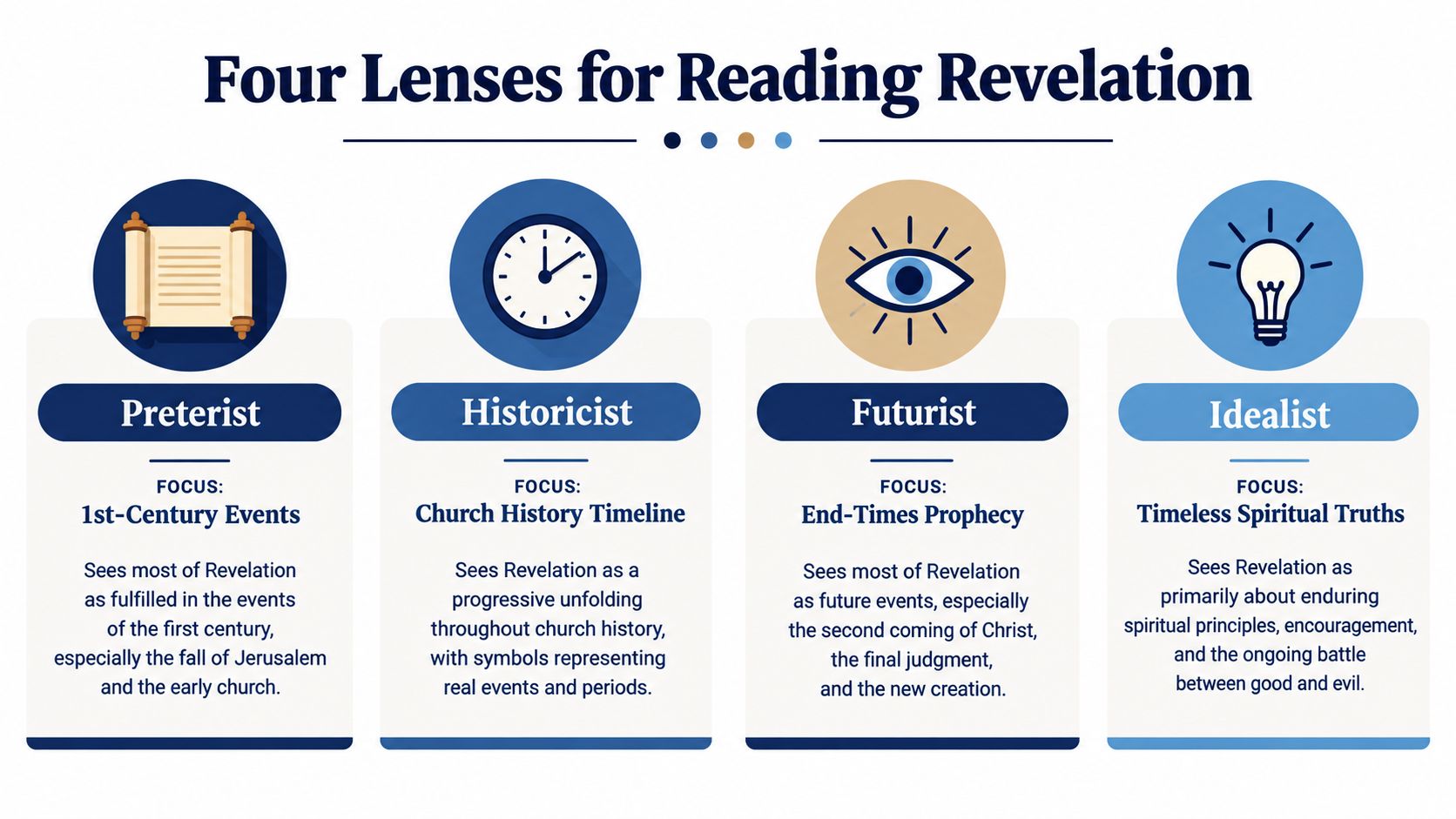
A healthy study of Revelation doesn't require us to pretend all interpreters agree. It does require us to compare approaches carefully, hold our conclusions humbly, and avoid the impulse to force the text into a single prediction scheme. The four broad lenses are preterist, historicist, futurist, and idealist, and each one answers some questions better than others interpretive frameworks overview.
What each lens emphasizes
The preterist lens reads much of Revelation in relation to the first-century world and the pressure on the early church. It helps readers stay close to the original audience and the historical setting, which is a real strength. Its risk is narrowing the book so tightly to the past that present and future hope get muted.
The historicist lens sees Revelation as unfolding across church history. It can encourage readers to think seriously about the sweep of Christian history, but it can also tempt people to map every headline onto a symbol and speak with more certainty than the text allows.
The futurist lens expects much of the book to point toward events still ahead. That approach takes seriously the book's forward-looking hope, but it can drift into date-setting if it forgets the seven churches, the original audience, and the symbolic texture of the visions.
The idealist lens focuses on timeless spiritual conflict, worship, and endurance. It often helps believers apply Revelation pastorally, but it can become too general if it minimizes the book's historical roots and concrete promises.
Four Interpretive Lenses at a Glance
Framework | Core Emphasis | Best Use | Common Pitfall to Avoid |
|---|---|---|---|
Preterist | First-century setting and early church pressure | Grounding the book in its original audience | Shrinking Revelation into only the past |
Historicist | Church history as a broad unfolding pattern | Thinking long-term about Christian history | Turning symbols into speculative timelines |
Futurist | Events still ahead in redemptive history | Keeping future hope in view | Date-setting and rigid chronologies |
Idealist | Timeless spiritual truths and conflict | Pastoral application and endurance | Losing the book's historical particularity |
A wise leader doesn't treat these as weapons in a debate. A wiser leader asks which lens fits the passage best, then tests that choice against the text's context, its Old Testament allusions, and its own explanations of symbols. That posture keeps our study grounded and charitable.
A Repeatable Workflow for Exegeting Revelation Passage by Passage
When you're ready to study a specific passage, don't start by chasing the most dramatic symbol. Start by observing what's on the page. The first step is to notice repeated words, structural markers, contrast, and any shift in scene or speaker, because those details show you how the book is moving.
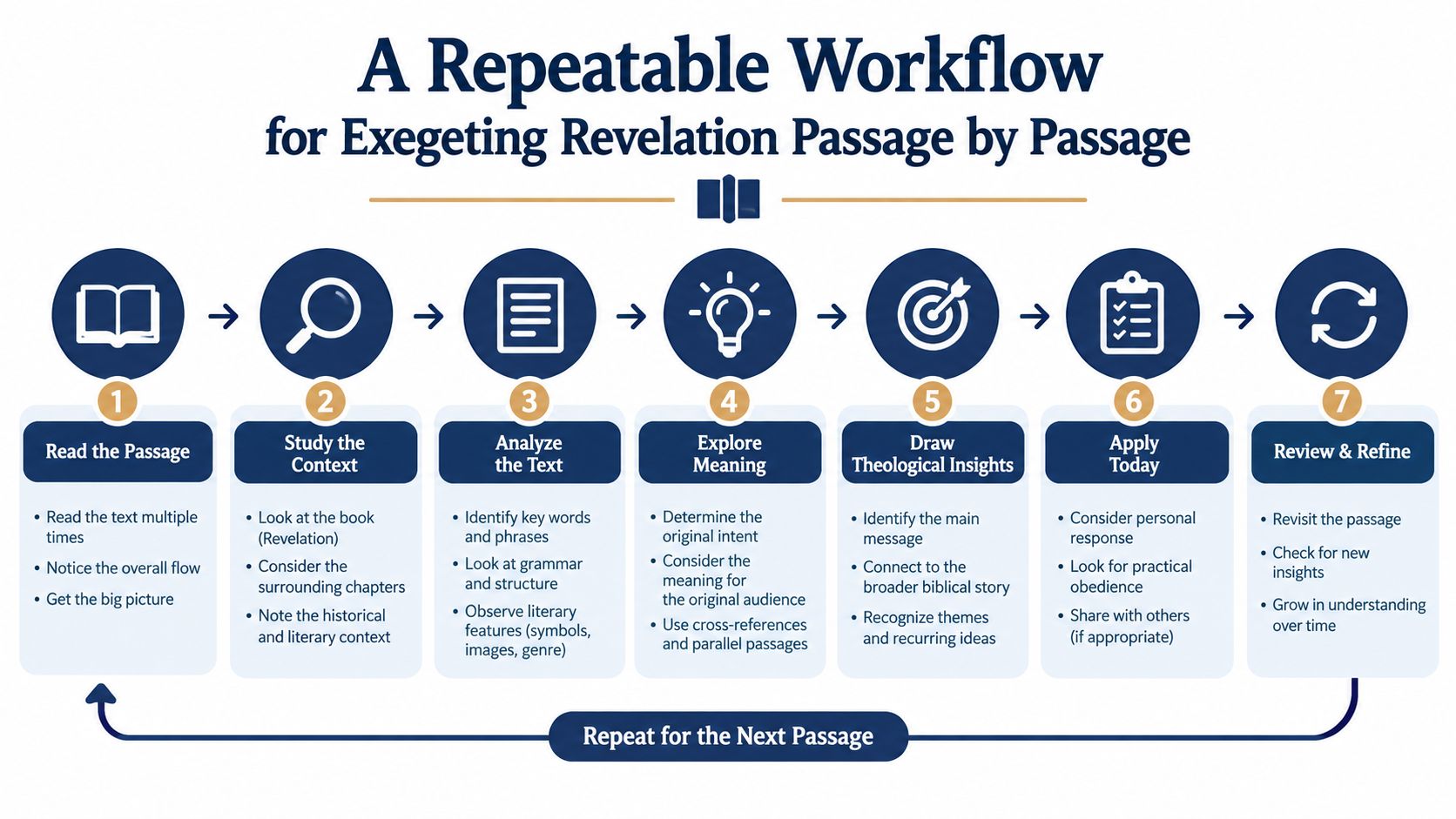
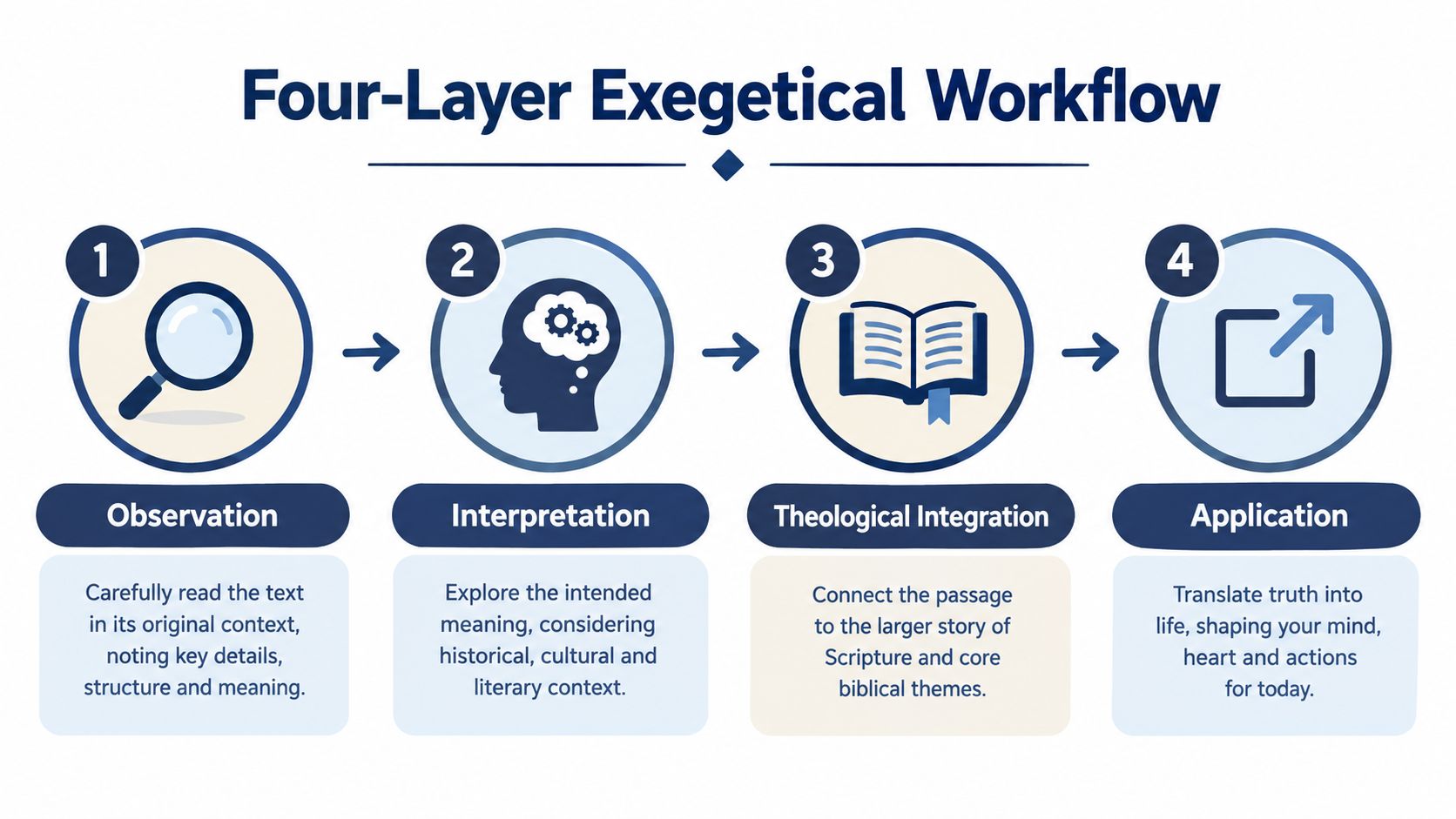
Move from observation to confirmation
The next step is interpretation. Ask what the symbols would have meant to the first readers, what Old Testament images may be echoing here, and whether the passage is presenting events in sequence or in overlapping cycles. Scholarly discussion often frames that as a choice between sequential reading and recapitulation, where the visions revisit the same realities from different angles recapitulation discussion.
Then compare Scripture with Scripture. Revelation is saturated with biblical echoes, so we shouldn't read it in isolation. If a passage reminds you of Daniel, Ezekiel, Exodus, Isaiah, or the Psalms, follow that trail instead of inventing a private meaning.
Finally, consult commentaries for confirmation. That's not a sign of weakness, it's a sign of discipline. A solid study method is to observe, interpret, integrate the theology, and then apply the passage, rather than jumping straight from symbol to sermon.
Practical rule: if a symbol seems obvious before you've checked the context, it's probably too early to trust your first impression.
For readers who want a broader New Testament interpretive foundation, this New Testament interpretation guide is a useful companion. It pairs well with Revelation because the same habits matter, clear observation, biblical cross-references, and patient attention to genre.
Sample questions to ask every time
What is repeated here? Repetition often signals emphasis and structure.
What Old Testament scene or image does this recall? Revelation rarely starts from nowhere.
What would the original churches hear first? That keeps us from making ourselves the first audience.
Does this passage move forward or revisit a previous scene? That question helps us avoid forcing a rigid timeline.
What truth about Jesus is being revealed? Revelation always points us back to the Lamb.
The goal is not to become clever. The goal is to become careful.
Reading Plans Themes and Tools for Groups and Preaching
A group can begin Revelation with a simple scenario: the church gathers under pressure, hears a message from the risen Christ, and must decide whom it will worship and obey. A reading plan should preserve that pastoral setting. Rather than forcing the book into a neat chronology, move through its major sevenfold movements and pause after each unit. Ask how the passage calls believers to worship, endurance, holiness, and faithful witness.
Build around themes, not just symbols
Worship, endurance, holiness, and loyalty to Christ under pressure provide a stable framework for group study. These themes keep discussion connected to the seven churches and the book's pastoral resistance to compromise. They also help participants compare interpretive lenses without turning every meeting into a debate about dates. A six to eight week plan can follow these themes while allowing time for careful reading.
A sermon series can use the same approach. Preach each passage in its literary and historical setting, identify its symbolic echoes, and apply its central claim to the church. Revelation then sounds like a living word from Christ, not a prediction board. When a passage confronts false worship or calls for patient faithfulness, let that command shape the sermon before addressing questions about the end times.
Leaders may combine a commentary, a study Bible, and a seminary-level resource. The Bible Seminary offers Revelation materials, academic programs, and ministry training for readers seeking a structured path into deeper biblical study. Its archaeology resources and faculty guidance can also support careful work at The Bible Seminary.
Simple tools for group leaders
Discussion starters: Ask what the passage reveals about Christ, the church, and faithful witness.
Symbol drills: Trace one image through its Old Testament background before proposing an interpretation.
Theme tracking: Mark references to worship, witness, judgment, and perseverance as the group reads.
Plain-language notes: Explain terms such as apocalypse and prophecy in everyday language before discussing their implications.
Sermon guardrails: Keep current events from becoming the sermon's center when the passage emphasizes Christ's authority.
A leader's posture matters as much as the plan. If participants disagree about a verse, return to what the text clearly says and what it clearly asks the churches to do. Some questions require continued study. A faithful group can leave one unresolved while still worshiping Christ, encouraging one another, and practicing patient obedience.
Keep Studying with Confidence and Take Your Next Step
A small group leader opens Revelation to a difficult vision. Before offering a prediction, the leader asks what Christ says to the seven churches and how those first hearers were called to worship, endure, and bear faithful witness. That order gives the group a steady foundation.
Read Revelation in a deliberate sequence. Begin with genre and historical setting. Then compare interpretive lenses without setting dates. Use a repeatable workflow for each passage, and let the book's themes of worship, endurance, and faithfulness guide application. This approach will not settle every disagreement, but it guards against speculation and avoidance.
Use this checklist:
Begin with the original churches and their first-century setting.
Trace the structure and recurring sevenfold patterns.
Compare lenses carefully and test each one against the text.
Examine Old Testament echoes before drawing conclusions.
Keep Jesus central and let Revelation's ending shape Christian hope.
For example, if a symbol seems to describe a future event, first ask how it would have challenged one of the seven churches. Then examine its biblical echoes and compare how preterist, futurist, idealist, and historicist readings account for the passage. Choose the interpretation that best respects the text's context, claims, and pastoral purpose. No lens gives permission for date-setting.
This work serves pastors, small group leaders, and students. It joins careful scholarship with prayer, spiritual formation, and practical service.
The Bible Seminary trains leaders through Bible-centered study and ministry preparation. If you want deeper training in Revelation, theology, and ministry, visit The Bible Seminary and explore how that preparation may support your next step in serving Christ.