
Gospel of John Study Guide for Growing Christians

A small-group leader sits with the Gospel of John open, twenty-one chapters marked in different colors, several commentaries stacked nearby, and a calendar already crowded with Sundays. A new believer may feel the same pressure from a different angle. John sounds simple at first, yet its conversations, signs, symbols, and claims about Jesus invite careful thought.
This Gospel of John study guide offers a calm path through that richness. We'll move from the opening words about the Word made flesh to the resurrection appearances and Peter's restoration. Along the way, you'll find historical context, a literary map, teachable units, discussion questions, and practical guidance for pastors, educators, families, and small groups.
You don't need to solve every interpretive question before you begin. Read attentively, pray humbly, and keep John's stated purpose before you:
“These are written so that you may believe that Jesus is the Christ, the Son of God, and that by believing you may have life in his name.” (John 20:31, CSB)
If you're learning basic Bible study habits, a helpful companion is this guide to studying the Bible for school, which introduces observation, interpretation, and application in accessible language. Those same habits will serve you well in John.
Beginning Your Journey Through John
John isn't a daunting textbook waiting for you to master it. It's more like a sanctuary filled with conversations. Jesus meets a confused teacher at night, a thirsty Samaritan woman at a well, grieving sisters outside a tomb, frightened disciples behind locked doors, and a doubting Thomas who needs to see the wounds.
That variety makes John especially valuable for growing Christians. You'll encounter theology in motion. Jesus doesn't merely announce ideas about life, light, truth, and glory. He embodies them in encounters that expose fear, pride, longing, and faith.
Start with the book's stated destination
A useful first step is to read John once without trying to explain every difficult verse. Notice what repeatedly draws your attention:
Witness: Who testifies about Jesus?
Belief: Who trusts him, and what kind of belief appears shallow?
Signs: What does each miracle reveal beyond the event itself?
Life and light: How do these themes describe Jesus' mission?
Glory: How does John connect glory with the cross?
The Gospel contains 21 chapters and 879 verses, so a guide can follow a substantial narrative and theological arc without treating every passage as an isolated devotional thought. That structure also gives pastors freedom. You might teach one chapter at a time, group related scenes together, or build a sermon series around John's repeated themes.
Let the text meet you where you are
If you're a new believer, begin with John 1, John 3, John 4, John 10, John 11, John 15, and John 20. If you're leading a group, ask participants to mark repeated words before anyone offers an interpretation. If you're preparing sermons, identify the passage's central claim about Jesus before developing an application.
Practical rule: Let John tell you what a sign means before you assign it a meaning.
The journey ahead will examine John's historical setting, literary architecture, high Christology, anchor passages, a seven-week plan, and pastoral questions. We'll also address textual variants and apparent tensions with the Synoptic Gospels. The aim isn't to make you anxious about interpretation. It's to help you read with confidence, reverence, and hope.
John's Gospel is walkable. Bring your questions, your doubts, and your ordinary responsibilities. Christ's invitation is not reserved for specialists. He gives life to those who come to him.
Authorship, Dating, and Historical Setting
John emerged in a world that had changed dramatically since Jesus' earthly ministry. Most modern scholars date the Gospel to about AD 90–100, and it's generally regarded as the last of the four canonical Gospels to be written (Gospel of John historical overview). That places its composition near the end of the first century, after the Jerusalem temple's destruction in AD 70, a setting that helps readers consider John's emphasis on belief, witness, Jesus' identity, and the meaning of worship.
The Gospel itself points toward a community shaped by testimony. John refers to an unnamed disciple whom Jesus loved, presents precise details about Jerusalem locations, and records the high priestly context surrounding Jesus' trial. These features don't settle every question about authorship, but they show why readers have long taken the Gospel's witness seriously.
Early manuscript evidence confirms that John circulated widely soon after its likely composition. Papyrus 52, containing John 18:31–33, is commonly dated to around AD 125, making it one of the earliest surviving New Testament manuscript fragments (earliest New Testament fragment). Papyrus 66, which preserves most of John, is often dated around AD 175, while Papyrus 75, containing much of Luke and John, is dated to about AD 200 or slightly later.
Read the historical soil carefully
These manuscripts don't answer every question about the Gospel's origin, but they do establish an important point. John was being copied and transmitted early, within roughly 25–100 years of its likely composition, which makes its manuscript history central to discussions of early transmission and textual stability (manuscript evidence for John).
The late-first-century audience also lived amid religious and political pressures. John 9:22 and 16:2 refer to exclusion from the synagogue, while the Gospel's language about “the world” reflects a community discerning loyalty to Jesus within a pluralistic Roman environment. We should handle these passages with care. John's sharp conflict language must never become an excuse for hostility toward Jewish people. Jesus, his disciples, and the earliest Christian witnesses were Jewish, and Christian teaching must reject anti-Jewish interpretations.
John's distinct chronology and selection of events have led scholars to ask whether it functions mainly as history, theology, or both. A responsible reader doesn't force the Gospel into a modern category. John presents remembered events through a deliberate theological lens, inviting readers to see what those events reveal about Jesus.
That combination of testimony, historical setting, and theological reflection explains why John continues to serve both the church and the academy. It gives us a Gospel rooted in place and memory, yet written to awaken faith.
Tracing the Literary Structure of John
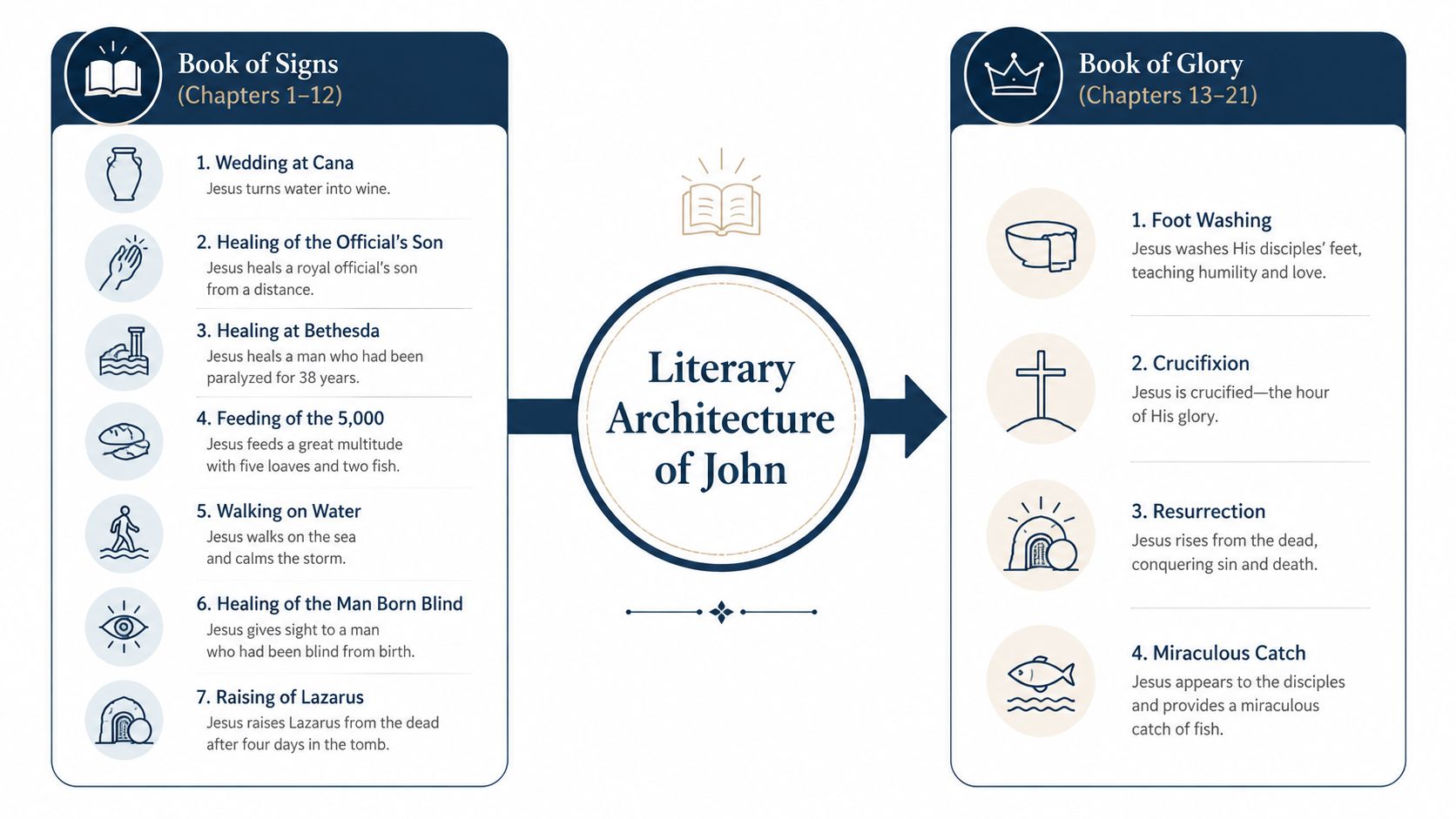
John's Gospel isn't a flat timeline. It's a carefully shaped argument in which events, conversations, and signs accumulate toward a confession about Jesus. A commonly used structure divides the book into the Book of Signs, John 1:19–12:50, and the Book of Glory, John 13:1–20:31, followed by an epilogue in chapter 21 (literary structure and themes in John).
The Book of Signs
John 1:19–12:50 introduces Jesus through selected signs and escalating responses. The familiar sequence includes Cana, the official's son, Bethesda, the feeding of the crowd, walking on the sea, the man born blind, and Lazarus. John doesn't present these miracles as spectacles detached from meaning. Each sign presses the question, Who is Jesus?
The raising of Lazarus forms a major climax. Jesus doesn't merely restore health. He declares, “I am the resurrection and the life” (John 11:25), then calls a dead man from the tomb. The sign intensifies both belief and opposition, moving the story toward Jerusalem and the cross.
The Book of Glory
John 13:1–20:31 turns toward the final meal, the Farewell Discourse, betrayal, trial, crucifixion, burial, and resurrection. The cross is not an interruption in Jesus' mission. John presents it as the supreme revelation of glory, where the Son accomplishes the Father's purpose through self-giving love.
Repeated vocabulary ties the two halves together. Words such as believe, sign, light, life, glory, and world recur across the narrative. John's use of repetition works like musical themes in a hymn. Each appearance adds depth until the reader hears the full confession.
Chapter 21 as pastoral epilogue
Chapter 21 returns to the disciples beside the sea and focuses on Peter's restoration. The risen Jesus doesn't discard a disciple who failed publicly. He asks Peter whether he loves him and commissions him to care for the sheep.
The epilogue also points beyond the written account toward the church's continuing witness. John's Gospel closes not with private spiritual comfort, but with restored discipleship and a renewed mission.
The Signs, the I AMs, and John's High Christology
John's portrait of Jesus begins before Bethlehem. The Prologue identifies him as the Word, or Logos, who was with God and was God, and who became flesh (John 1:1–18). This isn't an abstract opening poem. It establishes the identity that every later sign and saying will unfold.
The signs reveal Jesus through action. The “I am” sayings reveal him through direct self-description. Together, they create a portrait of the eternal Son who gives life, reveals the Father, shepherds his people, and lays down his life.
The Gospel highlights seven “I am” sayings, including “I am the bread of life” in John 6:35, “I am the light of the world” in John 8:12, and “I am the good shepherd” in John 10:11 (seven I am sayings in John). The language also recalls God's self-identification in Exodus 3:14, though each saying must be read within its immediate context.
A comparison for teachers and groups
Sign (Chapter) | Event | Resulting Confession |
|---|---|---|
John 2 | Water becomes wine at Cana | Jesus manifests glory and strengthens belief |
John 4 | The official's son is healed | Jesus gives life beyond physical distance |
John 5 | The man at Bethesda is healed | Jesus works with the Father and gives life |
John 6 | The crowd is fed | Jesus is the bread of life |
John 6 | Jesus walks on the sea | Jesus' presence brings courage in fear |
John 9 | The man born blind receives sight | Jesus is the light of the world |
John 11 | Lazarus is raised | Jesus is the resurrection and the life |
The table isn't a formula that forces one saying onto one miracle. It's a teaching aid. John's literary design lets readers notice how concrete events point beyond themselves to Jesus' identity and mission.
For group leaders: Ask, “What does this sign reveal about Jesus that the event alone doesn't explain?”
The seven sayings also guide personal formation. “I am the bread of life” confronts spiritual self-sufficiency. “I am the good shepherd” challenges leaders who use people for status. “I am the true vine” calls disciples to remain in Christ rather than measure faithfulness by visible success.
High Christology means John presents Jesus as fully divine and fully sent. He comes from the Father, speaks the Father's words, does the Father's works, and returns to the Father. Yet he also washes feet, weeps at a tomb, suffers, and dies. John holds divine glory and humble service together.
Walking Through Anchor Passages
John becomes especially vivid when we slow down and watch theology emerge through conversation. Three passages offer excellent training grounds because each places a human question beside a revealing claim about Jesus.
Nicodemus and new birth
Read John 3:1–21 in one sitting. First, observe the setting. Nicodemus comes at night, recognizes Jesus' signs, and still struggles to understand what Jesus means by being born “again” or “from above.” The Greek word anōthen can carry both senses, which helps explain the conversation's layered misunderstanding.
Next, trace Spirit, born, lifted up, believe, and life. Jesus connects new birth with the Spirit's work, then connects the lifted-up Son with healing and belief. An interpretive question for a group is: Where does Nicodemus rely on religious knowledge, and where does Jesus call him to receive God's work?
The Samaritan woman and mission
John 4:1–42 moves from water to worship to witness. Observe how Jesus crosses social and religious boundaries without minimizing truth. He knows the woman's life, offers living water, explains worship in Spirit and truth, and receives a village's attention through her testimony.
Look for water, worship, Messiah, food, harvest, and testimony. Consider Old Testament associations with wells, Jacob, and promised worship. Ask: How does Jesus turn a personal encounter into a community witness without making the woman the center of the story?
The Farewell Discourse
John 13–17 requires slower reading. Notice the movement from foot washing to the new commandment, from the vine and branches to the promise of the Advocate, and from Jesus' teaching to his prayer for unity.
Mark love, remain, commandments, Spirit, peace, glory, and unity. Jesus' prayer in John 17 connects discipleship with witness, not merely private devotion. Ask: What kind of visible love would make the church's unity credible in our setting?
For each passage, keep four columns in your notes: observation, repeated vocabulary, biblical echoes, and interpretive question. That simple method helps you distinguish what the text says from what you hope it says.
A Seven-Week Study Plan with Discussion Questions
A seven-week plan works well for a small group because each meeting has a clear center without pretending to exhaust the Gospel. The units below can support a 60-minute meeting or expand naturally to 90 minutes.
The weekly units
Week 1, Prologue and John 1: Read John 1:1–51. Central truth: Jesus is the eternal Word who became flesh. Observe repeated references to witness, light, and seeing. Interpret: What does “the Word became flesh” reveal about God's self-disclosure? Apply: Where do you need to receive Christ's light rather than manage your own darkness?
Week 2, Nicodemus and John 3: Read John 3:1–21. Central truth: Entrance into God's kingdom requires new birth from the Spirit. Observe night, birth, Spirit, lifted up, and belief. Interpret: Why does Jesus challenge Nicodemus before offering the promise of life? Apply: What would humble dependence on the Spirit look like this week?
Week 3, The woman at the well and John 4: Read John 4:1–42. Central truth: Jesus gives living water and gathers worshipers from every people. Observe water, worship, Messiah, and testimony. Interpret: How does Jesus hold personal truth and gracious welcome together? Apply: Who might God be inviting you to engage with patient honesty?
Week 4, Bread of life and John 6: Read John 6:1–71. Central truth: Jesus, not temporary provision, is the lasting source of life. Observe bread, hunger, signs, work, and life. Interpret: Why do some people welcome Jesus' provision but resist Jesus himself? Apply: What temporary source of security competes for your trust?
Week 5, Light and blindness in John 9: Read John 9:1–41. Central truth: Jesus gives sight while exposing spiritual blindness. Observe seeing, blindness, testimony, and worship. Interpret: How do the healed man and the religious leaders respond differently to evidence? Apply: Where do you need teachability?
Week 6, Lazarus and resurrection in John 11: Read John 11:1–57. Central truth: Jesus is the resurrection and the life. Observe love, delay, glory, belief, and death. Interpret: How does Jesus' delay serve revelation rather than indifference? Apply: How can you bring your grief to the One who gives life?
Week 7, Passion, resurrection, and epilogue in John 18–21: Central truth: The crucified and risen Jesus sends, restores, and shepherds his people. Observe witness, finished work, peace, love, and follow. Interpret: How does Peter's restoration shape Christian leadership? Apply: Where is Jesus calling you to faithful service after failure?
Make the meetings manageable
For a 60-minute meeting, spend ten minutes welcoming people, ten minutes reviewing the passage, twenty-five minutes discussing, and fifteen minutes praying and applying. For a 90-minute meeting, add time for reading the passage aloud, historical context, and paired discussion.
A facilitator's checklist can stay simple:
Prepare: Read the passage several times and identify its central claim.
Observe: Write down repeated words and surprising details.
Guide: Ask open questions before offering your explanation.
Protect: Keep discussion from becoming speculation about minor details.
Apply: End with one concrete act of obedience and prayer.
A sermon-ready outline can follow John's own movement: the sign, the response, the revelation, and the call to believe. For example, John 11 can become “The Delay of Love,” “The Tears of Compassion,” and “The Voice That Gives Life,” with John 11:25 as the theological center.
Common Questions and Honest Interpretive Cautions
John rewards confidence, but not carelessness. Several passages require us to explain what we know, what remains debated, and how uncertainty should shape responsible teaching.
Textual variation
John 7:53–8:11, the story of the woman caught in adultery, is one of the best-known textual variants. John 5:3–4 and chapter 21 also receive special scrutiny in textual criticism, which compares manuscript evidence to establish the earliest recoverable wording (New Testament textual criticism).
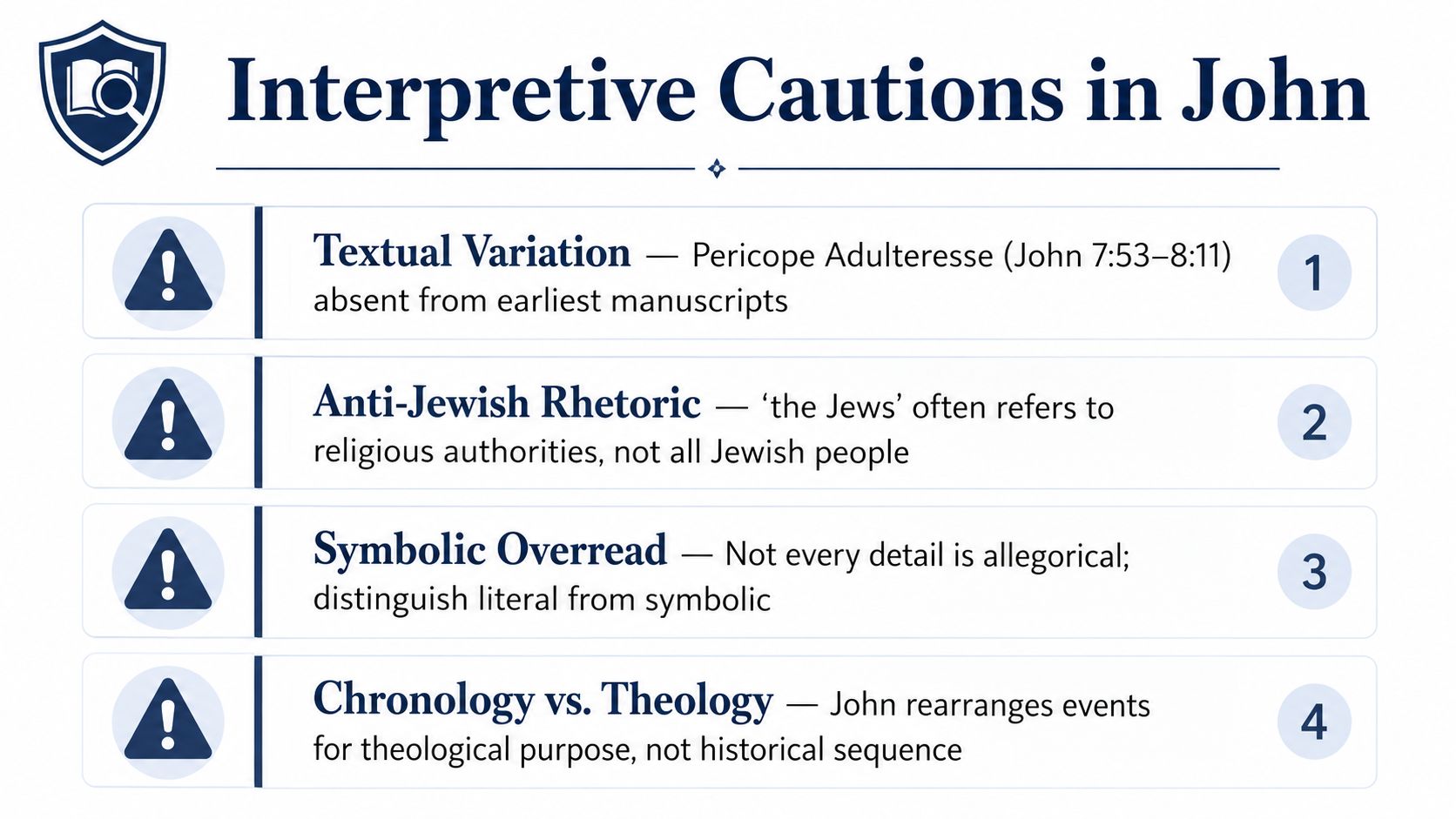
Many Christians continue to value the adulterous woman's story for its witness to mercy, but teachers should explain its manuscript history rather than present the passage without qualification.
Chronology and theology
John places the temple cleansing near the beginning of his Gospel, while the Synoptics place it near the end. John may be arranging material for theological emphasis rather than offering a chronological sequence identical to the other accounts. Apparent differences should lead us to compare passages carefully, not to assume that one Gospel must be careless.
Avoid isolating “I am the way, the truth, and the life” from its setting in the Farewell Discourse. Likewise, John 6 should be read with attention to incarnation, covenant imagery, nourishment, and the church's historic reflection on the Lord's Supper, not reduced to a vague metaphor.
Language and interpretation
Terms such as Logos and koinonia can illuminate a study, but Greek words don't function as magic keys. Explain the word in its sentence, paragraph, and biblical context. A sound teacher welcomes careful questions without claiming that one lexical detail settles every theological debate.
Going Deeper and Frequently Asked Questions
After completing the seven-week plan, choose one avenue for deeper work. D. A. Carson's commentary, Leon Morris's theological exposition, and Andreas Köstenberger's studies can help readers move from group discussion toward sustained interpretation. Use them after reading the biblical text so the commentary serves your observation rather than replacing it.
You can also pair the plan with a one-chapter-per-day reading of John during Advent or Lent. Keep a journal with three prompts: What does Jesus reveal? How do people respond? Where does this call me to faithful love? Pastors may adapt the same practice for devotional emails, sermon preparation, or leader training.
For further grounding in responsible interpretation, explore New Testament interpretation.
Frequently asked questions
Why doesn't John include the Synoptic parables?John uses extended dialogues, metaphors, signs, and symbolic scenes in different proportions. He still teaches through images such as bread, shepherding, vines, water, and light, but his literary strategy differs from Matthew, Mark, and Luke.
How should Christians apply the “I am” sayings today?Begin with the original setting. Then ask what each saying reveals about Christ's character and what kind of discipleship it produces. “I am the good shepherd” calls us to trust Jesus and to reject leadership that exploits people.
Which translation works best for a group?The ESV, NIV, and NRSV can all serve group study. Choose one translation everyone can follow, encourage participants to compare wording when it affects interpretation, and keep the discussion centered on the passage rather than translation preferences.
The Bible Seminary offers Bible-centered graduate education, flexible certificates, ministry training, and opportunities to connect biblical studies with archaeology and practical service. Visit The Bible Seminary to explore programs and resources that unite scholarship, spiritual formation, and hands-on ministry for leaders serving Christ's church.