
Difference Between Theology and Biblical Studies Explained

You're comparing seminary catalogs, and two program names keep appearing: Theology and Biblical Studies. One emphasizes doctrine, the other emphasizes Scripture, yet both seem to promise deeper faith, stronger ministry, and serious academic preparation. The difference between theology and biblical studies matters because the field you choose will shape the questions you ask, the methods you practice, and the kind of ministry preparation you receive.
Neither discipline is a substitute for faithful discipleship. Both should help you handle God's Word carefully, love Christ more, and serve the church with wisdom. The right choice depends on your calling, learning style, and intended ministry.
Where the Confusion Starts and What Each Field Is
The choice often becomes unclear while you compare seminary catalogs. A theology degree may include biblical interpretation, original languages, and exegesis. A biblical studies degree may include theology, church history, and ministry courses. The labels overlap because both disciplines treat Scripture as their central source, yet they train students to pursue different primary tasks.
Theology asks larger questions about God and Christian belief. It examines doctrines such as the nature of God, the person and work of Christ, salvation, the church, Christian ethics, and the hope of final redemption. Theology brings teaching from across Scripture into a coherent account of Christian faith, then asks how those convictions should shape life, worship, and ministry. Oxford scholarship describes theology as developing a doctrinal or confessional position rather than observing religion only from the outside. This academic discussion of biblical studies and theology also explains that biblical scholars commonly use historical, sociological, and philosophical methods.
Biblical studies investigates the biblical texts themselves. Students examine language, literary form, historical setting, authorship questions, textual transmission, and the ways communities have received the Bible. The discipline first seeks to understand what texts communicate in their ancient contexts. That work gives students the foundation for responsible interpretation before they draw broader theological conclusions.
Use this working distinction when you compare programs:
Biblical studies asks, “What does this text say and mean?” Theology asks, “What should the church believe and do because of the whole biblical witness?”
The distinction concerns the primary task, not the spiritual value of the work. Biblical studies in a Christian seminary should honor Scripture as authoritative and inspired. Theology should remain accountable to Scripture rather than treating doctrine as independent speculation. Both fields can serve faithful discipleship, but their assignments, questions, and forms of preparation differ.
A useful way to frame the choice
Biblical studies is generally text-centered and expository. Theology is generally synthesis-oriented and doctrinal. Biblical studies may focus on a passage in Romans, the composition of Isaiah, or the narrative structure of Samuel. Theology may ask how the Bible presents justification, the covenant, the church, or the relationship between divine sovereignty and human responsibility.
An academic comparison from the University of San Diego describes biblical studies through exegesis, original-language analysis, authorship, dating, and reception history, while theology arranges scriptural data into doctrinal and philosophical frameworks. Choose biblical studies if you want sustained, detailed work with texts, languages, and historical questions. Choose theology if your academic or ministry goal requires organizing biblical teaching into a coherent account of Christian faith. The program that fits your calling should determine which set of questions becomes the center of your training.
How Two Disciplines Became One Split Conversation
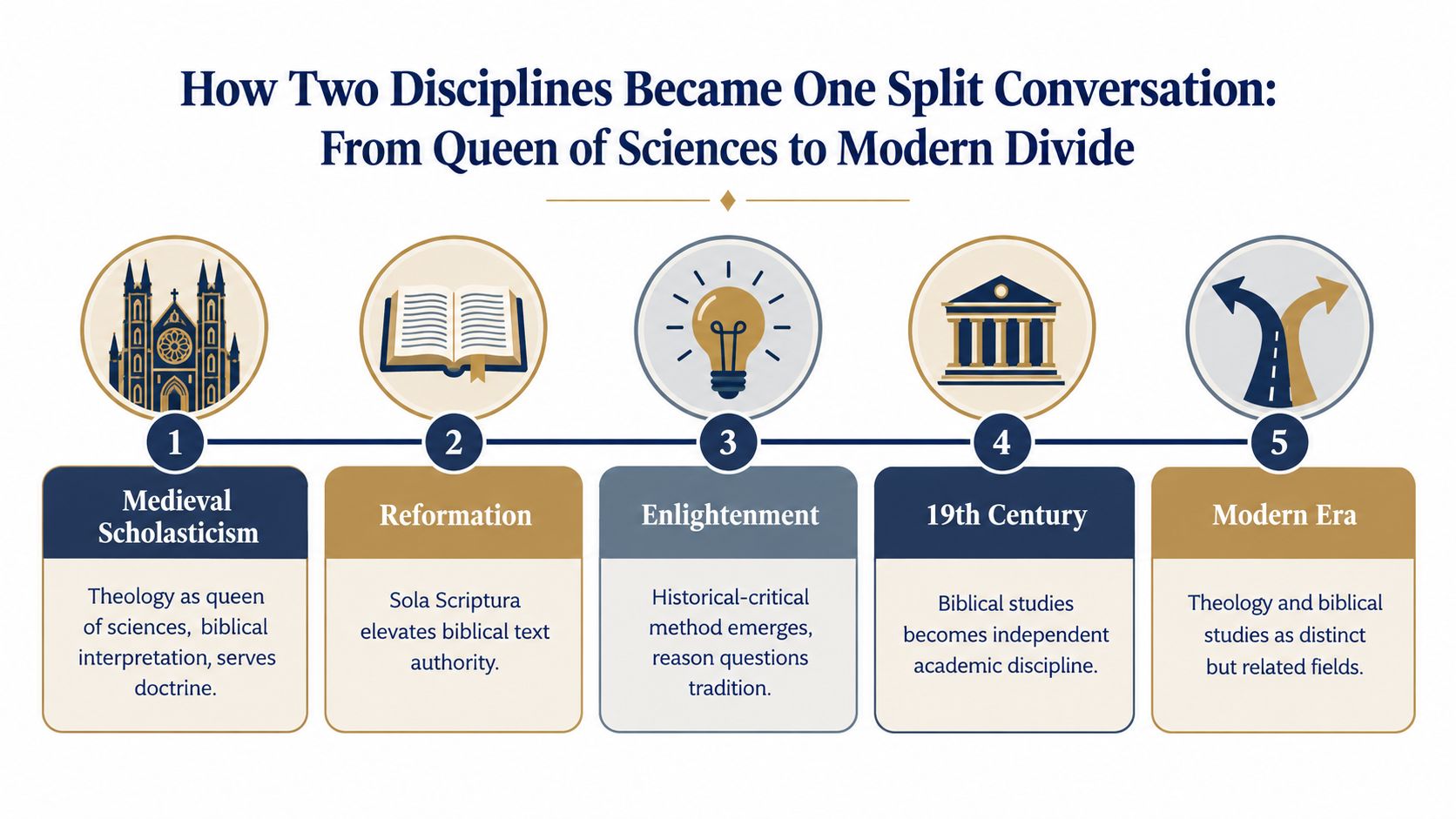
The modern divide emerged as universities changed how scholars organized knowledge. Christians did not suddenly lose interest in Scripture. Academic structures gradually separated the study of biblical texts from the work of articulating Christian doctrine.
In medieval scholastic settings, theology held a commanding place in intellectual life. Biblical interpretation generally served the church's doctrinal and theological work. Scripture remained foundational, while scholars commonly interpreted it within established ecclesial and theological frameworks.
The Reformation intensified attention to the biblical text and its authority. The sharper academic separation developed later, during the Enlightenment, especially the 18th century. Historical biblical exegesis increasingly operated in conscious opposition to established ecclesial theology, and research universities made that distinction more visible from the 1700s onward. Oxford scholarship traces this development.
Why the university shaped the distinction
As historical and philological methods expanded, scholars examined biblical books with tools also used for other ancient writings. They studied languages, manuscripts, literary development, social settings, and historical reconstruction. Biblical studies increasingly presented itself as a discipline centered on interpreting ancient texts, while theology focused on doctrinal and confessional claims.
European university models gave this arrangement lasting influence. Institutions organized the fields differently, and seminaries adapted those patterns to denominational commitments, Catholic traditions, evangelical convictions, and research priorities. Some schools kept separate departments. Others combined the disciplines under titles such as theological studies, biblical and theological studies, or Scripture and ministry.
The boundary remains porous because the subjects cannot be isolated. Theology depends on responsible interpretation of Scripture. Biblical studies raises theological questions when it examines the Bible's claims about God, covenant, sin, redemption, and hope. Biblical theology often connects the two by tracing theological themes through the unfolding canon, while remaining distinct from systematic theology.
For prospective students, this history gives practical guidance. Program titles reflect institutional choices, not fixed definitions. Read the course descriptions, faculty profiles, language requirements, and ministry components before choosing a degree. A theology program may provide substantial biblical training, while a biblical studies program may include serious doctrinal work. Choose the program whose actual curriculum serves your ministry calling and academic goals, not the title alone.
Side by Side on Scope Methods and Core Questions
The cleanest way to understand the difference between theology and biblical studies is to compare their scope, methods, and expected output. Both disciplines study Scripture, but they organize their work around different primary questions.
Dimension | Theology | Biblical Studies |
|---|---|---|
Primary focus | Christian doctrine and the coherence of belief | Biblical texts, contexts, languages, and interpretation |
Central question | What does the whole biblical witness teach about God and Christian faith? | What did the biblical author communicate in this text and setting? |
Typical scope | God, Christ, salvation, church, ethics, humanity, and Christian hope | Individual books, passages, genres, manuscripts, languages, and historical contexts |
Core methods | Systematic synthesis, philosophical reasoning, historical theology, and engagement with Christian tradition | Exegesis, philology, textual criticism, historical reconstruction, literary analysis, and hermeneutics |
Common output | A doctrinal framework or theological argument | An interpretation of a text, book, theme, or historical question |
Useful ministry contribution | Helps leaders teach doctrine and apply Christian truth coherently | Helps leaders interpret passages accurately and responsibly |
What theology does with the canon
Theology gathers biblical teaching across the canon. A theologian studying Christology won't remain in one Gospel passage. The work may involve the incarnation narratives, Pauline teaching, Hebrews, Old Testament hopes, early Christian confession, and later doctrinal debates. The aim is not merely to list verses, but to explain how Christian claims fit together.
Systematic theology also asks how doctrine speaks to contemporary life. Questions about human dignity, suffering, justice, worship, pastoral care, and public witness require careful reasoning grounded in Scripture and informed by the church's theological inheritance.
What biblical studies does with the text
Biblical studies slows down. A student may examine a Greek verb, compare manuscript readings, trace a repeated narrative pattern, investigate an ancient social custom, or evaluate how a prophetic oracle functions within a book. The discipline often prioritizes precision before synthesis.
That precision serves preaching and teaching. Before applying a passage, you need to understand its genre, argument, audience, and canonical location. The United Theological Seminary comparison of the fields describes biblical studies as attention to the Bible's historical and cultural context, while theology uses Christian faith traditions to evaluate beliefs and practices.
Neither approach is more faithful by default. A preacher who develops doctrine without careful exegesis can misrepresent Scripture. A scholar who analyzes texts without considering their theological significance can leave the church with information but little wisdom. The strongest ministry work respects both tasks.
What a Typical Week Looks Like in Each Program
Catalog descriptions stay abstract until you compare the work they require. The practical difference appears in weekly reading, classroom discussion, assignments, and the habits each program builds. Choose based on the work you want to repeat for years, not on the degree title alone.
A theology student may begin the week reading a doctrinal text alongside Scripture. The material could involve Augustine, Aquinas, Karl Barth, or contemporary dogmatics, followed by a seminar on the doctrine of God, Christology, salvation, or ethics. Assignments commonly ask students to compare positions, defend a theological argument, or explain how doctrine shapes pastoral practice.
A biblical studies student may spend the same week working through a Hebrew or Greek passage, examining textual evidence, studying genre, and tracing the passage's historical setting. A paper might focus on a pericope, a repeated literary motif, a translation decision, or an authorship and dating question. The scope is narrower, while the work demands exact attention to sentences, words, and textual evidence.
Day Block | Theology Program | Biblical Studies Program |
|---|---|---|
Early week reading | Scripture, historical theology, and systematic theology | Biblical text, language resources, commentary, and historical background |
Class discussion | Doctrinal coherence, theological traditions, and ministry implications | Exegesis, genre, context, textual issues, and interpretive options |
Independent study | Compare theological positions and develop a constructive argument | Parse language forms and analyze a passage's structure and meaning |
Writing assignment | Defend a position on doctrine or Christian ethics | Produce a focused interpretation of a biblical text or book |
Community rhythm | Chapel, prayer, and conversations about faith and practice | Chapel, prayer, and conversations about faithful interpretation |
Assessment style | Integrative essays, position papers, and theological synthesis | Exegesis papers, language exercises, textual analysis, and research |
The classroom temperament differs
Theology seminars usually move toward questions of coherence. Students may ask whether a doctrine accounts for the whole counsel of God, how a historical confession addresses a modern issue, or how a pastor should teach a difficult doctrine. Expect discussion that connects biblical material, historical theology, and constructive argument.
Biblical studies seminars usually move toward questions of evidence. Students may debate the meaning of a Hebrew construction, the function of a literary unit, or the relationship between a passage and its ancient cultural setting. Study groups may spend more time discussing soteriology in theology and more time parsing verbal forms in biblical studies.
Neither workload is automatically lighter. Theology develops synthesis and argument. Biblical studies develops patience, technical accuracy, and close attention to detail. Your decision should follow your calling: choose theology if you want to construct and teach doctrine, and choose biblical studies if you want sustained work with texts, languages, and interpretation.
Advisor's rule: Choose the program whose ordinary assignments resemble the work you want to keep doing, not merely the title that sounds most familiar.
Career Paths and Outcomes for Theology and Biblical Studies
Your intended role should shape your degree choice from the start. Academic interest matters, but so do ministry credentials, denominational requirements, language preparation, field experience, and prerequisites for doctoral study. A seminary program should lead toward a specific kind of service, not merely provide a familiar title.
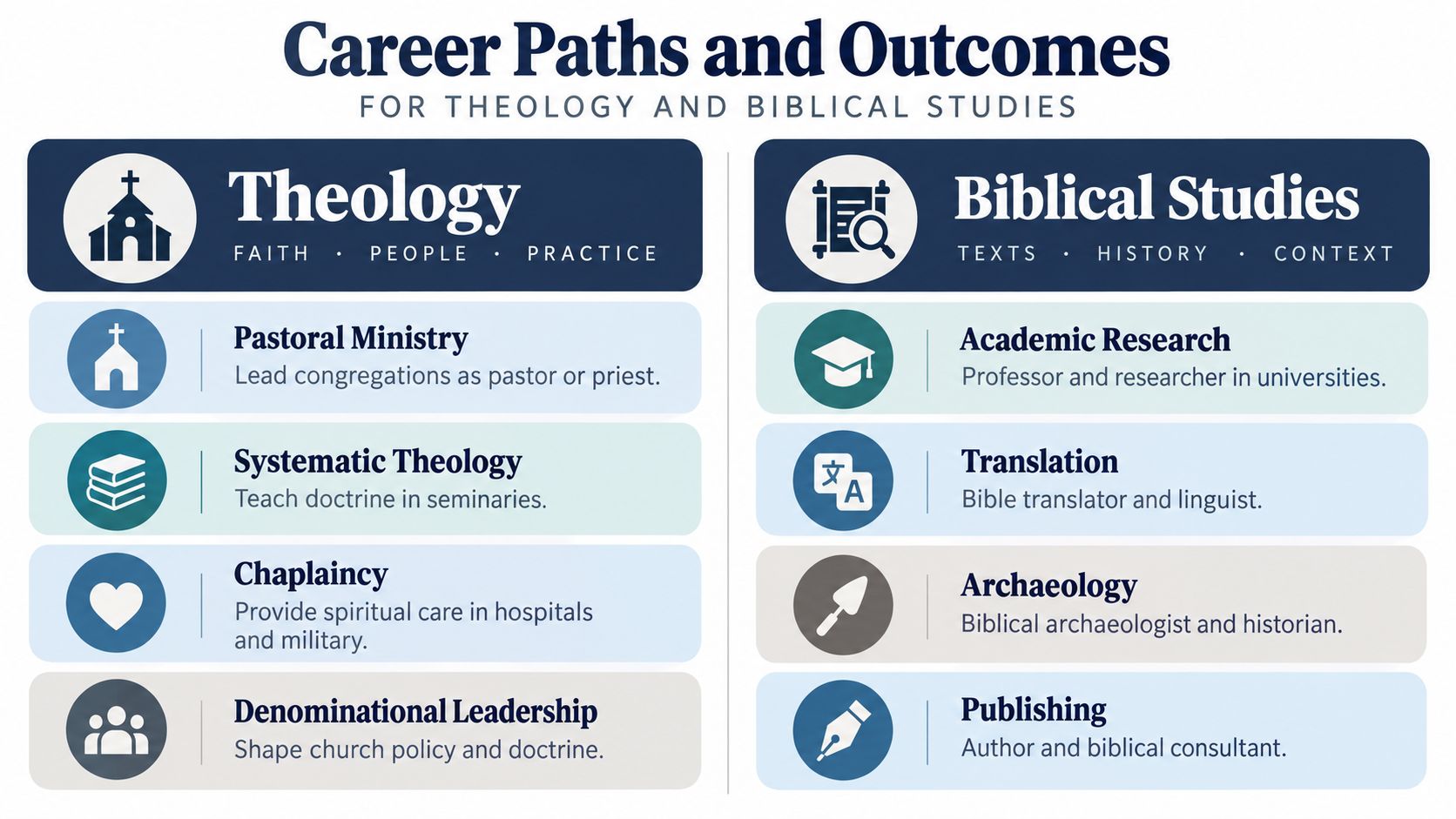
Theology commonly supports pastoral ministry, denominational leadership, church planting, chaplaincy, nonprofit leadership, teaching in faith-based institutions, and doctoral study in systematic or historical theology. If ordination is part of your plan, check your tradition's requirements before enrolling. The Master of Divinity remains the largest theological degree, although ATS data show enrollment declining from 29,100 students in 2021 to 26,082 in 2024. The seminary enrollment information summarized in the academic discussion provides those figures and notes that the program's share of theological-school enrollment fell from 43% about a decade ago to 35% in fall 2022.
Where biblical studies tends to lead
Biblical studies often prepares students for academic research, doctoral work, textual scholarship, publishing, curriculum development, Bible translation, specialized teaching, and archaeological or historical study. It also serves pastors, missionaries, educators, and church leaders who need stronger skills in interpretation.
Review what you can do with a biblical studies degree before choosing a program. The credential signals focused preparation to admissions committees and ministry employers, especially when the transcript includes language study, research writing, exegesis, and experience teaching Scripture.
Read the credential in context
Employers rarely evaluate a degree title by itself. A church search committee may prioritize ministry experience, preaching ability, pastoral care, denominational recognition, and the credential required for ordination. A doctoral admissions panel may focus on research languages, writing samples, faculty recommendations, and preparation in the proposed area of study.
Some students combine the fields through a theological studies program, a biblical and theological concentration, a second degree, or carefully chosen electives. This approach fits work that requires both close interpretation and doctrinal communication. Ask each school how graduates use the credential, which prerequisites apply to your next step, and whether the curriculum includes supervised ministry or research preparation.
Career advice: Start with the role you hope to serve, then work backward to the degree, courses, languages, experience, and relationships that role requires.
Which Path Fits Your Calling and Ministry Goals
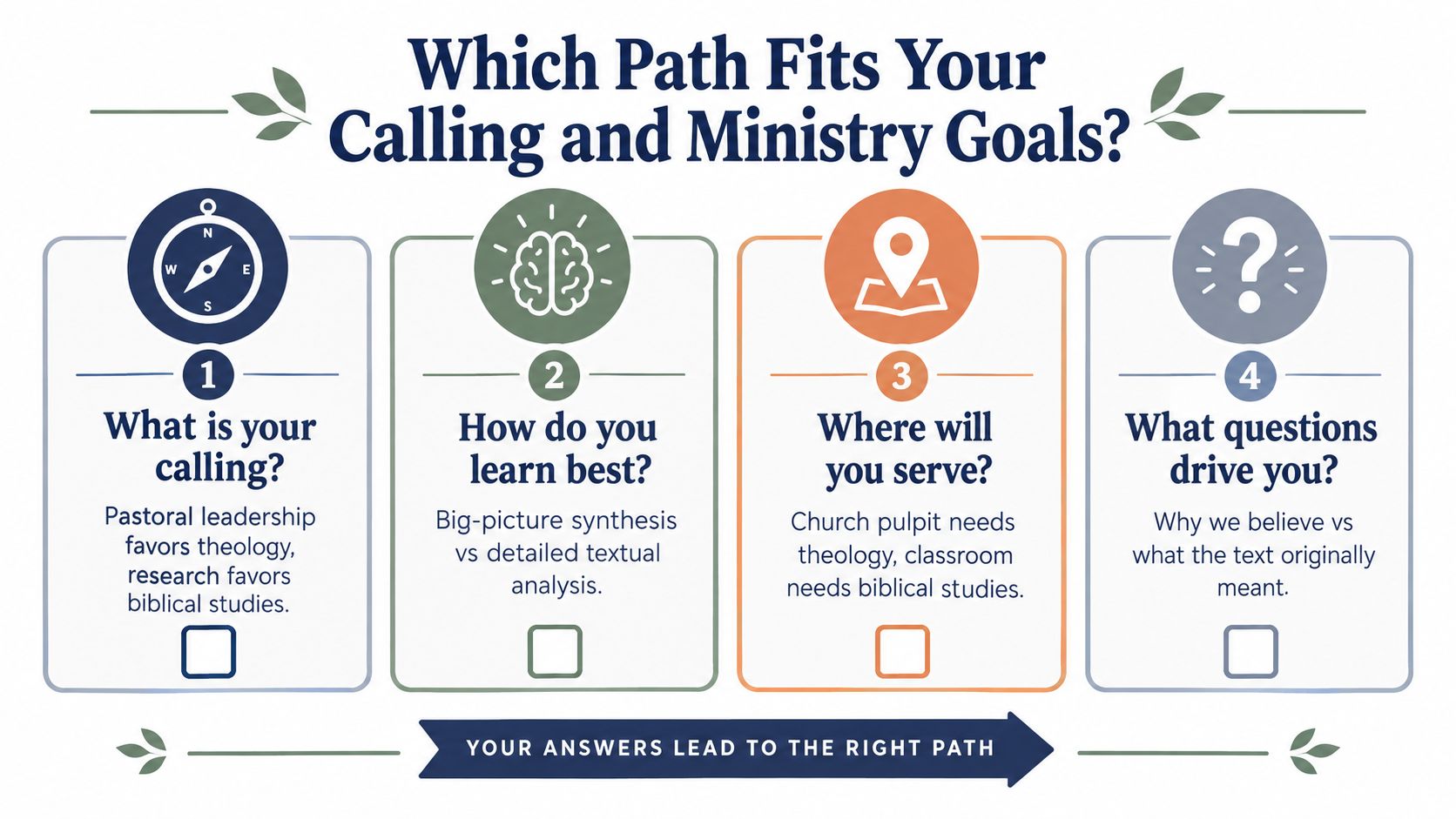
A calling won't always arrive with a job description. You may know that you want to serve Christ through teaching, pastoral leadership, missions, or scholarship, yet still feel uncertain about the academic path. Use four questions to make the decision concrete.
Start with your destination
Do you want to pastor a congregation or teach in a classroom? Pastoral leadership usually requires breadth. You'll need doctrine, church history, preaching, pastoral care, ethics, leadership, and practical ministry formation. Theology often provides the integrative framework, though a strong pastoral program should also include substantial biblical studies.
Are you drawn to doctrinal frameworks or close readings? If you naturally ask how Christian beliefs fit together, theology may be your best primary field. If you become absorbed in language, genre, manuscript evidence, and historical context, biblical studies may sustain your attention more effectively.
Do you envision ordination or research? Ordination requirements should guide your degree research from the start. A research vocation requires a different preparation, often including language study, methodological training, and a writing sample that demonstrates scholarly control of a specific question.
Will your ministry demand breadth or specialization? A missionary, church planter, or bi-vocational leader may benefit from a blended path. A shorter graduate program or certificate can provide focused preparation while leaving room for work and ministry responsibilities.
A recommendation ladder
Pastoral ministry and ordination: Begin with a ministry-centered theological degree, often an MDiv, and confirm your tradition's requirements.
Bible teaching and exposition: Choose biblical studies if you want sustained training in interpretation, languages, and passage-level analysis.
Seminary teaching or doctoral research: Prioritize biblical studies for text-focused research or theology for systematic and historical theological research.
Missions and cross-cultural leadership: Combine both through a program with biblical, theological, historical, and practical disciplines.
Continuing education while serving: Consider certificates, audited courses, or a focused master's pathway that addresses your immediate ministry need.
Don't choose from fear. Choose the field that will strengthen the work God has placed before you and form you into a more faithful servant of Christ.
Where the Two Fields Overlap and What to Do About It
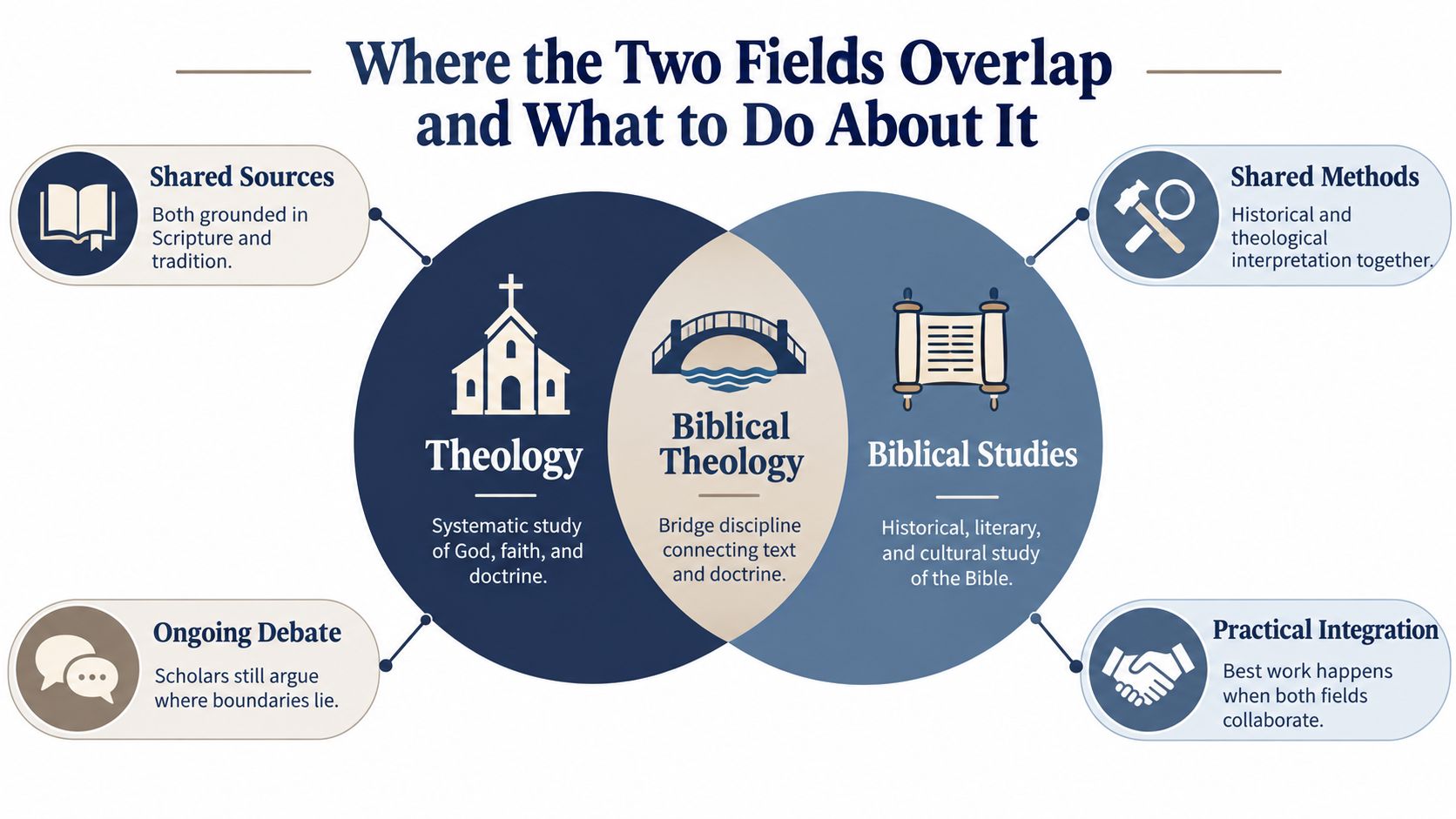
If you are choosing between theology and biblical studies, do not treat them as rival camps. They divide the work, but ministry and serious Christian scholarship require both. The better question is which program will prepare you for the work you intend to do, and whether its curriculum gives you enough exposure to the other field.
Biblical theology often connects the two. It traces revelation across Scripture and examines how themes develop through the canon's story. A published survey identifies four common approaches: Classic, Central-Themes, Single-Center, and Story of Metanarrative. This overview of biblical theology methodologies shows how the field joins close biblical interpretation to broader theological reflection.
The overlap appears in ordinary ministry
A pastor preparing a sermon interprets a passage, locates it within the canon, and explains its theological significance. A professor teaching doctrine must show how biblical texts support that doctrine and how the church has articulated it through history. A thesis may require historical reconstruction, literary analysis, doctrinal synthesis, and practical application in one project.
Use that overlap to build a degree that serves your destination:
Choose electives across fields: Pair exegesis and biblical languages with systematic theology and church history.
Ask about integrated programs: Look for curricula connecting all 66 books of Scripture with historical, theological, and practical disciplines.
Build a purposeful transcript: Select courses that support your ministry or doctoral direction instead of collecting unrelated subjects.
Explain the combination clearly: On a ministry application, show how textual competence strengthens preaching or teaching, while theological training strengthens leadership.
The Bible Seminary offers graduate study in biblical studies, theology, archaeology, and ministry preparation, including an M.A. in Biblical Studies, theological studies, and ministry-focused degree options. Its integrated approach reflects the conviction that training hearts and minds for kingdom service requires scholarship, spiritual formation, and hands-on ministry together.
Choose a program that strengthens your calling rather than forcing a permanent separation between the fields. Pastors, teachers, missionaries, and Christian scholars draw on both throughout their work. Study the text carefully, confess the faith faithfully, and serve the church humbly.
Explore The Bible Seminary to compare graduate programs, certificates, Bible-centered academics, archaeology resources, and ministry training. Speak with an advisor about whether biblical studies, theology, or an integrated pathway fits your calling to equip leaders to impact the world for Christ.