
Continuing Education and Professional Development for 2026

A pastor closes the office door after a long day. Sunday's sermon is prepared, counseling notes are waiting, a staff member needs guidance, and a congregation member has asked a difficult question about Scripture. The pastor knows growth matters, yet finding time for another course can feel impossible.
That tension is familiar to many ministry leaders, Christian educators, and church workers. Continuing education and professional development can easily become a transactional requirement, something recorded on a transcript or checked off for a credential. Yet ministry formation reaches deeper. It involves the mind that studies truth, the heart that loves Christ, the hands that serve people, and the health that sustains faithful work over time.
Why Ministry Growth Never Stops
A weary pastor may not need another burden. They may need a wiser pattern of growth.
Consider a pastor who has served faithfully for years but now feels stagnant. Sermon preparation has become repetitive, leadership decisions feel heavier, and pastoral conversations expose areas where practical training would help. The pastor hasn't stopped loving Christ or the church. They have reached a place where yesterday's preparation no longer answers today's responsibilities.
That moment can become an invitation rather than a condemnation. Lifelong learning is part of lifelong discipleship, not a sign that a minister has failed. Paul urged Timothy to remain devoted to teaching, character, and faithful service, while Proverbs commends the humility of receiving instruction. Growth keeps a leader teachable before God and useful to others.
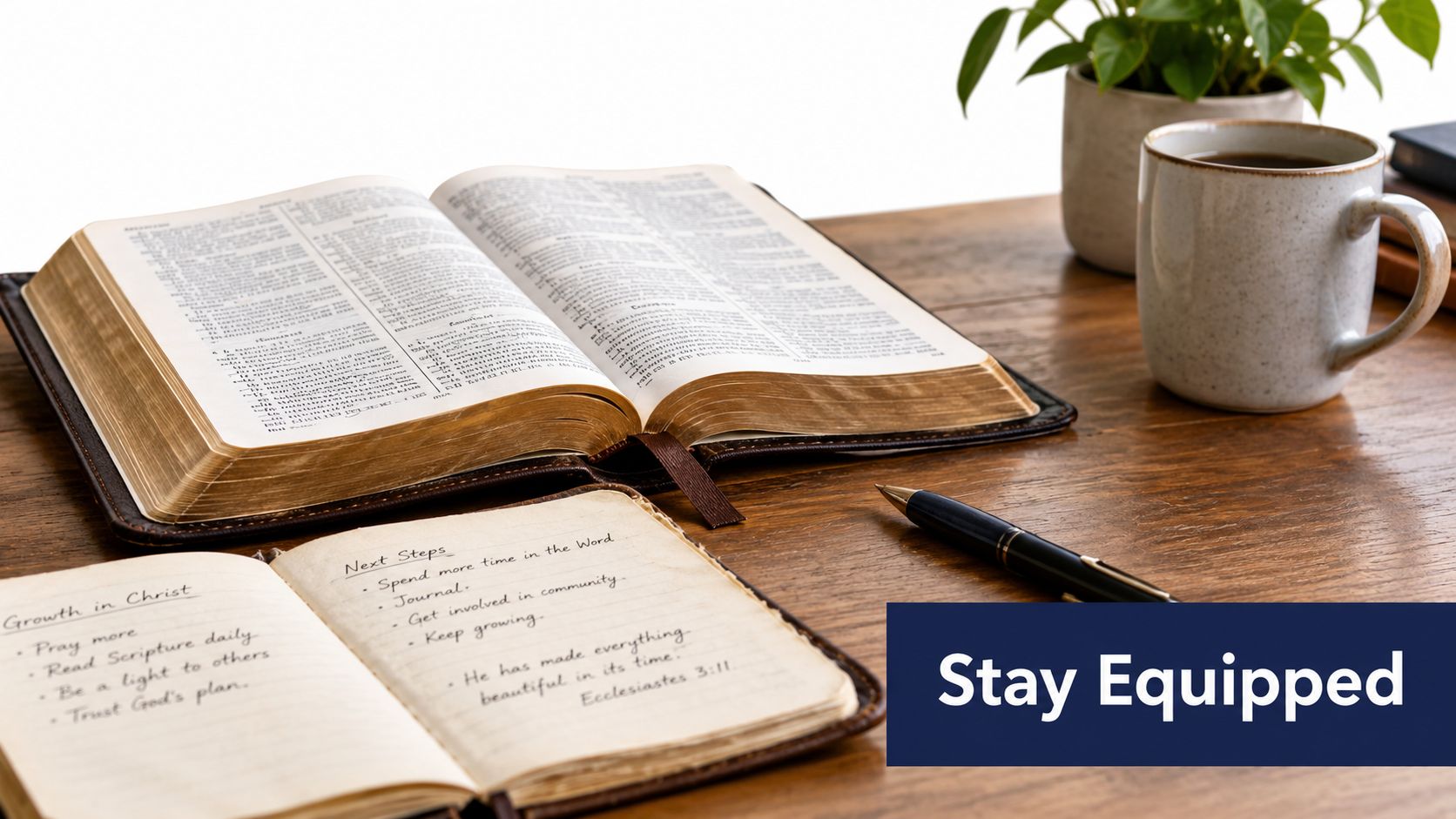
Four dimensions of ministry formation
A healthy development plan brings four areas together:
Head: Deeper biblical knowledge, theological reasoning, historical understanding, and the ability to interpret Scripture carefully.
Heart: Prayer, humility, repentance, love for Christ, and a growing capacity to shepherd people with patience.
Hands: Preaching, counseling, teaching, administration, evangelism, discipleship, and practical leadership.
Health: Rhythms of rest, wise boundaries, emotional resilience, physical care, and relationships that help ministry remain sustainable.
These dimensions belong together. A leader may understand doctrine but struggle to communicate it with compassion. Another may possess strong relational gifts but need greater confidence in biblical interpretation. A third may know what faithful leadership requires but lack the rhythms needed to continue serving without exhaustion.
A useful question: What kind of growth would help you love God and serve people more faithfully in your present assignment?
The International Labour Organization reports that 16% of working-age people ages 15 to 64 participated in formal or non-formal education and training during the previous 12 months, while adult learning remains under-resourced in many national systems (International Labour Organization analysis of SDG 4.3.1). For ministry leaders, this broader picture reinforces the value of intentionally seeking formation rather than assuming it will happen automatically.
Spiritual formation is a marathon, not a sprint. A prayerful course, a carefully chosen seminar, or a season of guided study can refresh both vocation and vision. When scholarship, spiritual formation, and hands-on ministry remain connected, continuing education becomes an act of stewardship.
Choosing the Right Path for Your Calling
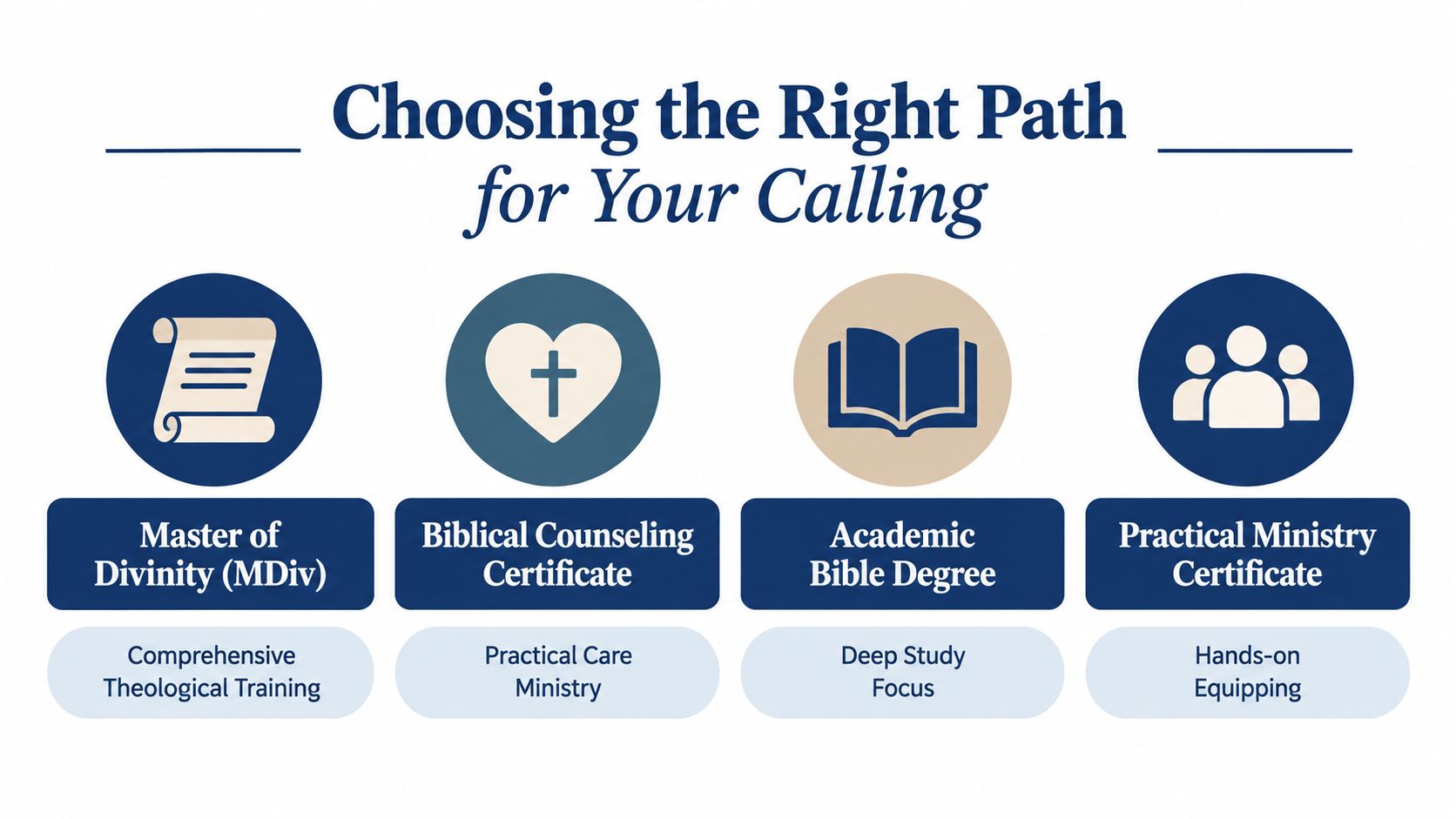
Not every ministry leader needs the same educational route. A pastor preparing for long-term congregational leadership may need full-scope theological training. A chaplain may need focused pastoral care preparation. A Sunday school coordinator may benefit from a targeted Bible course or seminar that addresses an immediate teaching need.
The first question isn't, “Which program is most impressive?” It's, “What kind of preparation will help me obey Christ more faithfully in my present and future calling?”
Four common pathways
Path | Best fit | Main value | Questions to ask |
|---|---|---|---|
Credit-bearing degree | Leaders seeking broad preparation or advanced study | Structured theological depth and an academic record | Does it fit my calling, schedule, and credential goals? |
Non-credit certificate | Ministry workers needing focused formation | Targeted learning with practical application | Is the certificate recognized by the church or organization that matters to me? |
Audited course | Learners who want classroom access without pursuing credit | Direct engagement with course material and faculty | Can I participate consistently and complete the expected work? |
Seminar or workshop | Leaders needing a focused tool or timely topic | Short, accessible instruction for immediate use | Will I receive resources and follow-up support for application? |
A degree often provides the broadest framework. It can help students place biblical languages, theology, church history, ministry practice, and leadership within a coherent whole. A certificate may be more appropriate when your need is narrower, such as counseling, Christian education, or a specific ministry responsibility.
Auditing can serve a learner who wants serious instruction without adding a full credential. Seminars and on-demand courses may work well for busy leaders who need a flexible starting point, especially when the learning can be applied directly in a church, classroom, or small group.
The history of professional continuing education shows that ministry-related fields have long recognized the need to extend learning beyond initial preparation. A U.S. medical history source records the first continuing nursing education course in 1894, notes the development of a physician credit system by 1960, and reports that by the mid-1970s 38 states required proof of continued professional development for physician relicensure (National Center for Biotechnology Information). The lesson is not that every ministry leader needs a medical model. It's that initial training was never intended to be the final word.
For readers weighing a larger academic commitment, a practical graduate school decision guide can help clarify questions about fit, timing, workload, and long-term purpose. Bring those questions into prayer and conversation with trusted mentors.
The right path should honor both your calling and your capacity. A faithful choice may be a degree, a certificate, an audited class, or a single seminar. Wisdom chooses the pathway that produces faithful service, not merely a fuller résumé.
Building Your Personal Development Roadmap
Good intentions don't automatically create wise formation. Without a plan, a ministry leader may collect interesting courses while leaving the most important areas of growth untouched.
A personal roadmap turns scattered interest into purposeful preparation. It should be realistic enough for your current responsibilities and flexible enough to change as God opens new opportunities.
Start with an honest assessment
Set aside quiet time to examine four questions:
What am I doing well? List strengths that bless your church, school, or ministry team.
Where am I repeatedly struggling? Notice patterns in counseling, preaching, administration, conflict, teaching, or personal rhythms.
What does my ministry context require next? Your congregation's needs may point toward leadership, discipleship, biblical counseling, or community engagement.
What kind of servant is Christ forming me to become? This keeps development from becoming merely career-centered.
You can organize the answers in a simple strengths, weaknesses, opportunities, and threats exercise. Treat it as a prayerful tool, not a verdict. Ask a trusted pastor, elder, faculty member, or ministry colleague to identify blind spots you may miss.
Turn needs into goals
A strong goal names the action and its purpose. “Learn more theology” is too broad. “Complete a guided study in biblical interpretation and use the approach in a teaching series” gives you a direction and a way to observe application.
Use the SMART framework:
Specific: Name the subject or ministry skill.
Measurable: Identify an assignment, project, conversation, or ministry practice that will show progress.
Achievable: Respect your family, church, work, and energy.
Relevant: Connect study to an actual calling or ministry responsibility.
Time-bound: Set a review date rather than waiting indefinitely.
Build the calendar around ministry reality
Map your priorities across the coming seasons. One season may be suited to a demanding course, while another may require a seminar or on-demand format because of church events, family responsibilities, or travel.
Keep a simple record of course descriptions, assignments, certificates, transcripts, and ministry applications. Resources such as these ideas for education students may also prompt useful reflection about study habits, educational goals, and support systems.
Roadmap principle: Choose the next faithful step, then review its fruit before adding more.
Your plan should leave room for prayer and providence. A three-to-five-year vision can provide direction, but it shouldn't become a rigid promise that ignores changing ministry needs. Ask not only what you want to complete, but what kind of person and servant your learning is helping you become.
Understanding Credits, Accreditation, and Requirements
Educational language can feel unnecessarily complicated. Credit hours, certificates, continuing education units, accreditation, transcripts, and denominational requirements all describe different parts of the learning process, and confusing them can create costly disappointment.
A credit-bearing course normally belongs to an academic program and appears on an official transcript. It may contribute toward a degree, depending on institutional policy. A non-credit course may still offer excellent instruction, but it doesn't automatically carry the same academic value or transferability.
A certificate can document completion of a defined learning pathway. It may be useful for ministry development, employer records, or organizational expectations, yet its acceptance depends on the institution or church body reviewing it. Ask before enrolling, especially if you need the learning to satisfy a formal requirement.
Accreditation and recognition
Accreditation signals that an institution or program has been evaluated against stated standards by an appropriate accrediting body. It doesn't answer every question about theological fit or teaching quality, but it can matter when you apply for further study, seek denominational recognition, or submit academic records to an organization.
Do your own verification. Look for the institution's published accreditation information, ask which credits are transferable, and request written clarification when a program makes a recognition claim. Avoid assuming that a certificate, CEU, and academic credit are interchangeable.
Requirements vary by calling
Professional systems often establish a fixed learning amount within a defined reporting cycle, sometimes with required subject areas. For example, CFP® professionals must complete 30 hours of continuing education during each reporting period, including 2 hours of ethics and 28 hours covering CFP Board principal topics, according to the CFP recertification guide. This illustrates why the course title alone isn't enough. Topic, provider, documentation, and timing can all matter.
Ministry requirements differ across denominations, networks, and local churches. Before you register, ask:
Who recognizes this learning? Confirm with your denomination, church board, or supervisor.
What documentation is required? Clarify whether you need a transcript, certificate, syllabus, or attendance record.
Which subjects qualify? Ethics, counseling, preaching, leadership, and biblical studies may be treated differently.
What happens after completion? Keep digital and printed records in a place you can retrieve easily.
Administrative clarity protects your time and honors the stewardship of the resources entrusted to you.
Overcoming Barriers of Time and Cost
A ministry leader may want further training and still struggle to begin. Sermons, visitation, staff meetings, family commitments, and unexpected crises can fill every available hour. Cost adds another layer of concern, particularly for bivocational pastors, small churches, and ministry workers serving without extensive institutional support.
The answer isn't to pretend those barriers don't exist. It's to make the pathway visible and discuss it openly with the people who share responsibility for the ministry.

Make time a ministry conversation
Begin with your church leadership. Explain what you hope to learn, how the training connects to the congregation's needs, and what support would make completion realistic. A church may be able to provide protected study hours, adjust a ministry responsibility temporarily, or establish a study leave arrangement.
You can also create smaller, dependable rhythms:
Reserve a weekly study block: Protect it as carefully as a leadership meeting.
Use travel wisely: Listen to assigned material during appropriate commutes or trips.
Plan around ministry seasons: Choose lighter formats during intense congregational periods.
Share the learning: Turn a course insight into a staff discussion, sermon illustration, or Bible study resource.
The goal isn't to squeeze education into every spare moment. It's to give learning a rightful place in the ministry ecosystem. Practical guidance on balancing work and study can help you think through boundaries, scheduling, and competing responsibilities.
Treat cost as stewardship, not shame
Scripture presents stewardship as careful, faithful management. That includes money, time, energy, and opportunities. Investing in preparation can bless future congregations, students, families, and ministry teams, but the investment should still be evaluated wisely.
Ask your church about a professional development fund. Explore scholarships, ministry grants, payment plans, denominational assistance, and partnerships with other congregations. A church could also sponsor a leader's course in exchange for a defined ministry project that serves the congregation.
Instructional design matters as much as attendance. An evidence synthesis found limited proof that accumulating hours alone improves practice, while learning that uses multiple methods, responds to learner needs, and receives workplace support is more likely to change practice and improve patient safety (European Journal of Education evidence synthesis). The principle applies to ministry: choose learning that changes how you interpret, lead, teach, counsel, and serve.
You don't need to solve every financial or scheduling question before taking the next step. Pray, speak candidly with your leaders, and choose a format that respects both your calling and your responsibilities.
Flexible Options at The Bible Seminary
The Bible Seminary in Katy, Texas, offers one example of a seminary context designed to connect rigorous study with the realities of ministry life. Its academic pathway includes nine graduate majors, with study across all 66 books of Scripture alongside historical, theological, and practical disciplines. Students can pursue Master of Arts and Master of Divinity degrees, while non-degree learners can explore certificates, auditing, dual-degree completion, and on-demand seminars.
That range matters because ministry schedules rarely look alike. One learner may need a structured graduate program for long-term pastoral preparation. Another may need a focused certificate or audited course that strengthens current service without immediately pursuing a full degree. A working adult may begin with an on-demand seminar, then discern whether deeper study is appropriate.
The seminary's approach also brings archaeology into conversation with Scripture and theology. The 3J Museum offers visitors an opportunity to engage biblical history through nearly 200 artifacts, with more than 90% described as authentic, drawn from Khirbet el-Maqatir near Jerusalem. Responsible archaeological study doesn't replace faith or settle every interpretive question. It can, however, help learners ask better historical questions and see how the Bible speaks within real places, cultures, and communities.
Spiritual formation remains part of the educational vision. Public Reading of Scripture, the Just Show Up Book Club, podcasts, Nehemiah Press publications, and global partnerships create additional settings for learning and community. These forms of engagement can support the Bible-based, Christ-centered, Spirit-led, ministry-focused character of professional development.
A learning plan becomes more sustainable when students have access to faculty expertise, a supportive community, and practical ways to connect coursework with ministry. The right environment helps unite scholarship, spiritual formation, and hands-on ministry rather than separating them into unrelated compartments.
The following resource provides another way to encounter the seminary's educational vision.
Investing in Your Ministry Legacy
Your next course may not feel dramatic. It may be a single class, a certificate, an audited lecture, or a scheduled hour with an open Bible and a trusted mentor. Yet faithful learning accumulates through ordinary obedience.
Choose a path that serves your calling. Build a roadmap that respects your responsibilities. Confirm requirements before you enroll, and seek support from your church, family, and ministry community. Above all, keep Christ at the center of the process.
Skill refreshment also deserves careful timing. A systematic review found that complex or infrequently used skills can deteriorate within 4 months to 1 year, with emergency airway management and defibrillation declining in 4 to 6 months, laparoscopic surgical skills in 6 to 8 months, and hemodialysis catheter insertion not declining until after 1 year (systematic review of skill decay). Ministry skills differ, but the broader lesson is clear: abilities that matter should be practiced, revisited, and assessed rather than assumed to remain strong forever.
Continuing education is not self-promotion. It's preparation to love your neighbor with greater wisdom, teach Scripture with greater care, and lead God's people with greater humility. This is how we keep training hearts and minds for kingdom service, equipping leaders to impact the world for Christ.
The Bible Seminary offers graduate degrees, certificates, audited courses, and on-demand seminars that connect Bible-centered scholarship with spiritual formation and practical ministry. Visit The Bible Seminary to explore a flexible next step for your continuing education and professional development.