
Biblical Studies Masters: A Complete Guide for 2026

Graduate theological education in North America reached 74,283 students, with about one-third pursuing the Master of Divinity, the field's flagship degree. That enrollment reflects sustained demand for advanced biblical training, even as students seek ministry preparation that fits many different vocational paths.
Perhaps you're serving faithfully in a church, school, nonprofit, or workplace, yet you keep returning to the same desire: to understand Scripture with greater depth and communicate it more carefully. You may also be wondering whether graduate study is practical with work, family responsibilities, finances, and an existing ministry role.
A biblical studies master's can serve more than one kind of calling. It can prepare you to teach, preach, disciple, research, counsel, lead, or pursue further study. At its best, it unites careful attention to God's Word, spiritual formation, and hands-on service.
Your Call to Deeper Study
A young ministry leader once described the decision this way: “I know I need more training, but I'm not sure I need another degree.” The concern was reasonable. Graduate study requires sacrifice, and faithful service doesn't always come with a convenient schedule. The leader had a family, a demanding job, and a growing responsibility in the local church.
Yet the desire for deeper study wasn't driven by prestige. It came from a desire to handle Scripture faithfully. That distinction matters. A master's degree shouldn't be pursued merely to collect credentials. It should help you love God with your mind, serve people with greater wisdom, and communicate the gospel with clarity.
“Be diligent to present yourself to God as one approved, a worker who has no need to be ashamed, correctly teaching the word of truth.”2 Timothy 2:15, CSB
Paul's instruction doesn't turn every believer into an academic. It does remind teachers and ministry leaders that biblical communication requires care. A biblical studies master's gives structure to that care through guided study, research, mentoring, and practice.
Study for the sake of service
Graduate education can strengthen ordinary ministry moments:
Teaching a difficult passage: You learn to examine literary context, historical setting, grammar, and the argument of a biblical book before drawing an application.
Leading a small group: You become better prepared to distinguish what the text says from what a reader assumes it says.
Serving across cultures: You gain tools for recognizing how language, history, and cultural expectations shape communication.
Training future leaders: You develop habits of research and explanation that can be passed on to others.
North American graduate theological education reached 74,283 students, the largest total since recordkeeping began in 1969, and about one-third were pursuing the Master of Divinity. The same enrollment report counted 7,081 students in credit-bearing non-degree offerings, a 51% increase over three years, showing that interest in Bible and theology extends beyond traditional degree seekers. The enrollment analysis from In Trust also reports that students age 50 and older represented 25.6% of enrollments in 2025, compared with 9.6% in 1989, while students under 25 represented 9% of the total.
That profile should encourage you if you're beginning graduate study later in life. The classroom includes recent graduates, pastors, parents, missionaries, educators, and mid-career professionals. Further study isn't reserved for one age group or one ministry title. It can be a faithful response to God's calling in the season where He has placed you.
What a Master's in Biblical Studies Entails
A master's in biblical studies is disciplined preparation to interpret Scripture accurately and teach it responsibly. It's more than reading additional books or collecting devotional insights. You'll learn to ask better questions of the biblical text and to support your conclusions through sound observation, interpretation, and application.
A strong curriculum commonly brings several kinds of study together:
The biblical text
Courses in the Old Testament and New Testament introduce the structure, message, genres, historical settings, and theological themes of Scripture. You may study narrative, poetry, wisdom literature, prophecy, the Gospels, epistles, and apocalyptic writing, learning why each genre should be read according to its own communicative purpose.
The aim isn't to reduce Scripture to an academic object. It's to read the Bible in context so that application grows from meaning rather than replacing it.
Original languages and exegesis
Master's-level biblical studies programs often emphasize original-language exegesis. For example, curricula may specify the ability to apply biblical Hebrew to exegesis and to use Greek and Hebrew study aids for word studies and grammatical analysis. United Theological Seminary's biblical studies curriculum illustrates how language work supports careful interpretation.
You don't study Hebrew or Greek to impress people with technical vocabulary. You study them because translation decisions sometimes depend on grammar, syntax, word usage, and the relationship between clauses. These tools help you examine ambiguity instead of rushing past it.
Interpretation and theology
Hermeneutics gives you principles for interpreting Scripture. Historical and cultural studies help you understand the world behind the text. Biblical theology traces themes through the unfolding story of redemption, while theological study helps you synthesize what Scripture teaches about God, humanity, salvation, the church, and Christian hope.
The disciplines overlap, but they aren't identical. Biblical studies asks, “What does this passage mean in its context?” Theology asks, “What does the whole counsel of Scripture teach about this subject?” Healthy ministry needs both.
Ministry application
A graduate program should connect learning to people. Research papers, teaching assignments, ministry projects, field experiences, and conversations with experienced faculty can help you move from observation to faithful communication.
Before enrolling, ask whether the program includes the areas you need:
Language preparation: Does it offer Hebrew, Greek, or effective use of language tools?
Research training: Will you learn to locate, assess, and cite scholarly sources?
Theological integration: Does the curriculum connect biblical interpretation with historic Christian doctrine?
Ministry practice: Can you apply classroom learning in a church, school, nonprofit, chaplaincy, or other setting?
Institutional recognition: Is the school accredited by a reputable theological or regional accreditor?
Accreditation provides an important quality reference because it relates to faculty qualifications, curriculum standards, and the portability of a degree. Accredited graduate biblical studies programs are commonly housed in institutions recognized by the ATS Commission on Accrediting or regional accreditors such as SACSCOC. A representative biblical studies program description from Grand Canyon University shows how learning outcomes can include research writing, hermeneutics, and ministry application alongside textual knowledge.
Online Versus On-Campus Learning Options
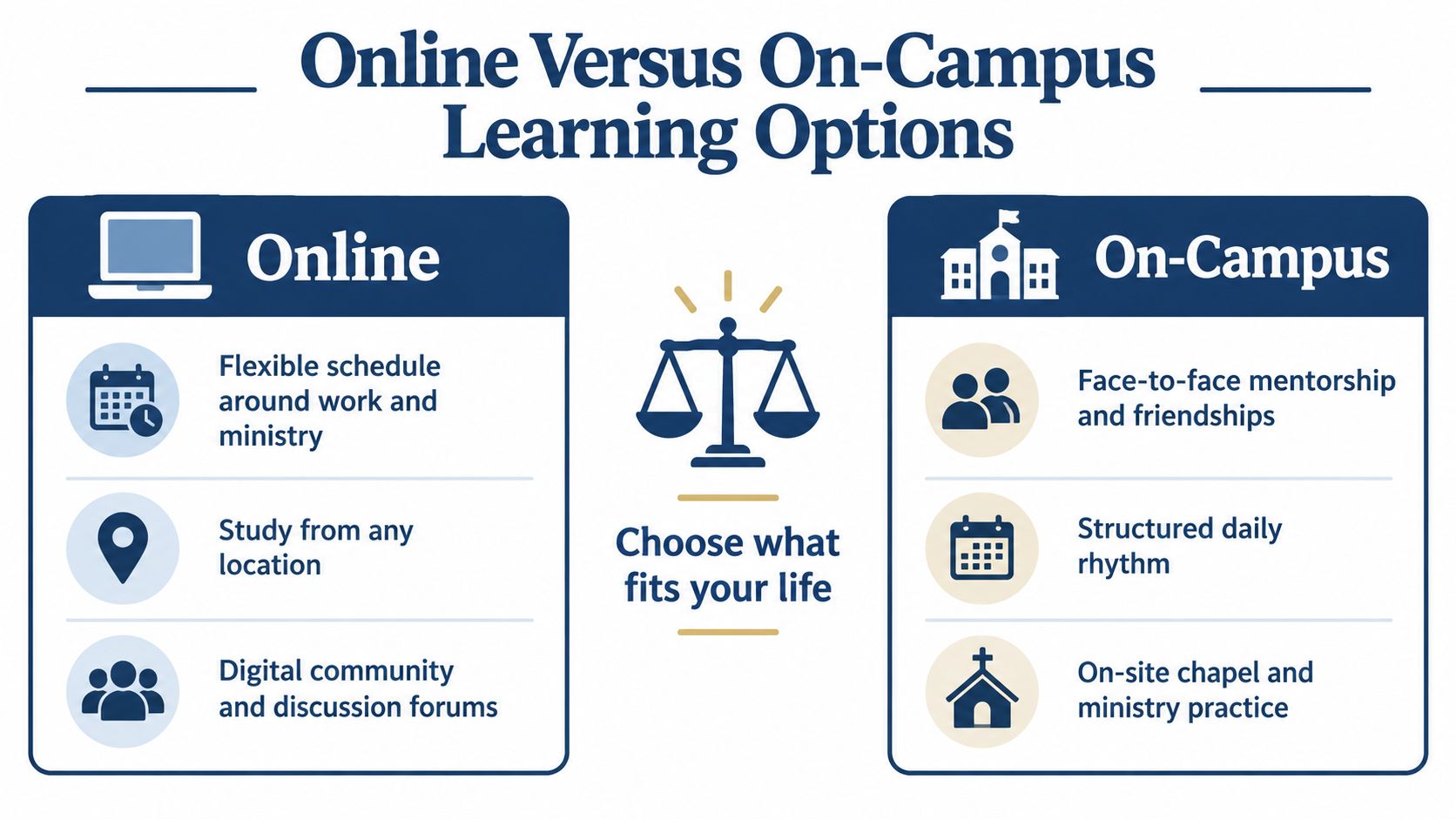
The right format depends less on which option sounds ideal and more on which environment will help you remain faithful, engaged, and teachable. Online study can serve a pastor with a full ministry calendar. Campus study can serve a student who needs daily rhythms, close mentoring, and a community of peers.
Online learning often works well when you need to remain in your current location. You may be able to study around employment, family responsibilities, and local church service. It also lets you learn with people who live in different regions, which can broaden classroom discussion and expose you to ministry contexts beyond your own.
The trade-off is that flexibility requires initiative. You'll need a dependable study rhythm, timely communication, and the discipline to participate when no professor is physically nearby. Ask how the program handles discussion, advising, library access, language instruction, group work, and practical ministry.
On-campus education offers a different kind of formation. Regular face-to-face contact can make it easier to build friendships, receive informal mentoring, worship with classmates, and develop habits of study. A residential setting may also provide access to chapel, libraries, ministry organizations, museums, and faculty conversations that continue beyond scheduled class time.
Questions for your decision
Consideration | Online study | On-campus study |
|---|---|---|
Schedule | More adaptable to work and ministry | More structured around class rhythms |
Community | Built through digital discussion and intentional contact | Developed through daily, face-to-face relationships |
Location | Useful for students who need to remain where they serve | Useful for students who can relocate or commute |
Formation | Requires self-directed routines | Offers a built-in academic and communal rhythm |
Ministry practice | May connect learning to your existing context | May provide nearby institutional opportunities |
One format isn't automatically more spiritual or more rigorous. The important question is whether the program offers meaningful interaction, qualified faculty, clear expectations, and opportunities to put learning into practice. For an example of how online graduate study can fit ministry responsibilities, explore this resource on an online religious studies master's degree.
A visual comparison can help you name the practical differences, but prayerful discernment still matters. Speak with current students, ask to review a course syllabus, and consider how you learn best when life becomes demanding.
Career Paths and Ministry Outcomes
“What can I do with this degree?” is a wise question, especially if you're considering a significant investment of time and energy. The answer isn't limited to “become a pastor.” Biblical studies develops portable abilities, including interpretation, research, writing, teaching, listening, and communicating complex ideas clearly.
A 2026 graduate outcomes survey covering theology and ministry programs reported that 82% of 1,083 graduates found employment or ministry placement within nine months. The placements included several vocational settings, as shown below. The graduate outcomes data provides a more nuanced picture than a simple list of ministry job titles.
Graduate Placement Outcomes by Vocation
Vocation | Percentage |
|---|---|
Pastoral ministry | 28% |
Christian education | 18% |
Chaplaincy | 15% |
Missions | 12% |
Counseling | 10% |
Nonprofit leadership | 8% |
Academia | 6% |
Apologetics and research | 3% |
The distribution reveals why vocational discernment should begin before you choose a program. Someone drawn to preaching and congregational leadership may need the broader ministry preparation of an MDiv. Someone focused on research, teaching, Bible education, or a specialized ministry may prefer a biblical studies master's with room for concentrated study.
Matching gifts to a setting
A graduate who enjoys explaining Scripture may serve in Christian education, curriculum development, discipleship, or teaching. A person drawn to presence and compassionate care may explore chaplaincy or counseling-adjacent work, while someone with cross-cultural gifts may pursue missions.
A degree doesn't guarantee a particular position. Churches, hospitals, schools, nonprofits, and academic institutions each have their own requirements. Some roles may require additional professional credentials, supervised experience, denominational approval, or further graduate study.
The long-term direction of theological education also deserves attention. The ATS annual data series has been published every year since 1969 and is described as the only longitudinal dataset of its kind for accredited graduate theological education in North America. Its historical record shows a shift from MDiv-centered enrollment toward greater interest in professional MA programs. The Association of Theological Schools annual data tables report that professional MA enrollment reached 11,752 students and graduations reached 3,013, with increases of 7% and 15% since 2009, respectively, in the analysis summarized there.
That movement doesn't make the MDiv less valuable. It shows that students increasingly seek different kinds of preparation. A recent graduate may enter pastoral ministry, while an experienced educator may pursue advanced biblical training to serve more effectively without changing careers.
Graduate Christian studies has remained comparatively stable even as undergraduate religion enrollment has softened, and Protestant graduate enrollment rose 4.6% from fall 2019 to fall 2021, according to the trend summary from Candler School of Theology's educational effectiveness information. The practical lesson is simple: choose your program according to your intended outcome, not according to a generic promise about the degree.
Admissions and Cost Considerations
Admissions can feel more mysterious than the coursework. In most cases, schools want to understand your academic preparation, spiritual maturity, calling, and readiness to complete graduate-level work.
Prepare a working file before you begin an application. It may include:
Academic records: Gather transcripts from prior institutions and check whether prerequisite Bible or theology courses are expected.
References: Identify people who can speak about your character, teachability, ministry service, and ability to follow through.
Personal statement: Explain why you're pursuing biblical studies, how you hope to serve, and what questions you want to explore.
Doctrinal or faith materials: Read the institution's statement of faith carefully and be prepared to describe your convictions sincerely.
Ministry context: Clarify where you currently serve and how graduate study could strengthen that work.
The admissions conversation should work both ways. You're not only asking whether the school will accept you. You're also discerning whether its theological commitments, faculty, curriculum, delivery format, and community will help you grow.
Plan the investment carefully
Tuition is only one part of the cost. Consider books, technology, transportation, housing, reduced work hours, travel, and the time required for reading and writing. Ask each institution for a complete cost explanation rather than relying on a general estimate.
Then explore available support. Schools may provide scholarships, grants, payment plans, work opportunities, denominational assistance, or employer support. Churches sometimes help members who are preparing for ministry, especially when the student has a clear service plan.
Practical rule: Don't choose a program because its advertised price is the only figure you've compared. Ask what the full course sequence requires, which fees apply, and what financial support is actually available to students in your situation.
A useful planning exercise is to map one ordinary week. Mark work, family care, church service, commuting, sleep, and current commitments. Then identify realistic study blocks. If the schedule has no margin, a flexible format or a slower course load may protect both your family and your formation.
Also compare the degree you need with the degree you're considering. ATS standards state that an accredited Master of Divinity must require at least 72 semester credits or equivalent units, and that the degree prepares students for religious leadership or service and for advanced degrees. The ATS Standards of Accreditation can help you understand why an MDiv often carries a broader ministry curriculum than a more focused biblical studies degree.
Prior biblical or theological study may affect the pathway. ATS permits advanced standing in an MDiv for qualifying prior study, and one catalog example reduces the program to 78 hours after 18 hours of advanced standing. The ATS academic catalog example illustrates why prospective students should ask for an individualized transcript review.
The Bible Seminary Pathway
The Bible Seminary brings together three commitments that should remain connected: scholarship, spiritual formation, and ministry practice. Students need more than information about the Bible. They need habits of prayer, humility, careful interpretation, and faithful service.
Its graduate offerings include a Master of Arts in Biblical Studies and a Master of Divinity, along with certificates and other flexible learning options. Programs are designed around sustained engagement with all 66 books of Scripture, while also connecting biblical study with historical, theological, and practical disciplines.
Where scholarship meets the real world
Biblical archaeology can help students ask historically responsible questions about the world of Scripture. It doesn't replace the authority of the biblical text, and artifacts shouldn't be forced to prove conclusions they can't establish. Used carefully, archaeology gives learners a richer setting for understanding places, practices, material culture, and historical questions.
You can explore the seminary's archaeology resources and learn about the 3J Museum, where biblical history, artifacts, and educational engagement meet. The result is a setting where the Bible comes alive through archaeology and Scripture together, without treating archaeology as a substitute for reading the Word.
Community also matters. Faculty expertise, conversation with fellow students, public reading of Scripture, ministry partnerships, and opportunities to serve can shape the kind of leader you become. The question isn't merely whether you can finish assignments. It's whether your education is forming you into someone who can teach truth with patience and serve people with integrity.
A pathway for different seasons
Some students need a full graduate degree. Others may begin with a certificate, audit selected courses, or attend an on-demand seminar before making a larger commitment. You can review The Bible Seminary's degree programs and compare the academic path with your ministry goals.
Faculty relationships are part of that discernment. Reading faculty biographies can help you identify areas of expertise and formulate questions before you apply. You may also explore museum and events information to see how learning extends beyond the classroom.
The broader mission is equipping leaders to impact the world for Christ. That means training hearts and minds for kingdom service, whether a graduate leads a congregation, teaches children, serves in chaplaincy, contributes to nonprofit work, supports missions, or pursues further research. Spiritual formation isn't an accessory to academic excellence. It's part of faithful preparation.
Your Next Step in Biblical Training
A biblical studies master's is a serious commitment, but it doesn't have to be an intimidating one. Begin by naming your vocational direction, comparing curriculum and accreditation, choosing a learning format that fits your season, and asking how the program will connect study with ministry.
You may discover that your next step is a full degree. You may begin with a certificate or a conversation with an admissions team. Either way, studying Scripture at the graduate level can become an act of worship when it leads you toward faithful teaching, humble leadership, and loving service.
Frequently Asked Questions
Is a biblical studies master's only for pastors?No. Graduates may serve in education, chaplaincy, missions, counseling-related settings, nonprofit leadership, academia, or research, depending on their preparation and additional requirements.
Should I choose an MDiv or a biblical studies master's?Choose the MDiv when you need broad preparation for congregational or religious leadership. Choose a biblical studies master's when focused study of Scripture, interpretation, research, or teaching better matches your goals.
Can experienced ministry professionals pursue this degree?Yes. Graduate theological education includes learners from different ages and ministry backgrounds, including people preparing for a new role and people strengthening long-standing service.
The Bible Seminary offers Bible-centered graduate degrees, certificates, archaeological resources, and ministry-focused formation for students seeking deeper preparation in Scripture. Visit The Bible Seminary to explore the available pathways and begin discerning how advanced biblical training can equip you for faithful kingdom service.