
Biblical Parenting Principles That Shape a Godly Home

A mother kneels beside her seven-year-old at bedtime. Earlier, the child shouted at a sibling, and the evening ended with tears, correction, and a door closing too firmly. Now the mother prays over the conflict, asking God to soften both hearts. She wonders whether anything she says is taking root, or whether tomorrow will bring the same argument in a different form.
Many Christian parents know that question. We read Bible stories, attend church, pray before meals, and try to correct behavior with patience. Yet religious activity and lasting faith formation aren't identical. A child may know the words of a prayer without yet understanding the God to whom the family prays.
Biblical parenting principles give us a steadier hope than perfectly executed routines. They call us to the slow, relational work of pointing children toward God through instruction, affection, correction, repentance, worship, and ordinary faithfulness. The home becomes a place where children see what trust in Christ looks like when someone is tired, disappointed, tempted, or wrong.
The need is significant. A 2022 American Worldview Inventory release found that only 2% of parents of children under 13 had a biblical worldview, while 65% believed they had a unique, God-given purpose and calling. The same release reported that only 5% held consistently biblical perspectives across key domains, including the Bible, truth, morals, human nature, lifestyle, and faith practices (American Worldview Inventory 2022 release). These findings don't call us to panic. They call us to examine how faith is formed.
A Familiar Moment Every Christian Parent Faces
The mother at the bedside isn't failing because her child had a difficult day. Nor is she succeeding merely because she managed to finish a devotional. She faces the ordinary tension of Christian parenting: How do we move from teaching Christian information to cultivating a life oriented toward God?
A seven-year-old may need help naming sin without believing that sin makes them unlovable. The parent might say, “You were wrong to hit your brother. You need to tell the truth, ask forgiveness, and make things right. God is kind to us when we confess, and I'm here to help you practice kindness.” That conversation includes moral clarity, relational security, and gospel hope.
The parent also needs to receive that gospel. A mother who asks her child to confess but never admits her own impatience teaches that Christianity belongs to the person with authority. A father who speaks about prayer but never turns to God in weakness teaches that prayer is a children's exercise rather than a lifeline for adults.
Practical rule: Your child needs more than a parent who can explain faith. Your child needs a parent who is learning to live by faith.
Biblical parenting isn't a project for producing impressive children. It is a discipleship calling carried out through thousands of small interactions. Some moments involve direct instruction. Others involve listening in the car, apologizing after an angry outburst, welcoming a difficult question, or choosing generosity when no one is watching.
This article offers a framework rather than a checklist. We'll consider what Scripture says, how three relationships support the parenting task, how biblical principles change as children mature, and why faithful modeling may communicate more powerfully than polished routines. The goal isn't control over outcomes. The goal is faithful formation under the grace of God.
What Scripture Actually Says About Raising Children
Scripture presents parenting as a whole-life vocation. Its key passages don't describe a technique for managing children. They describe parents whose own lives, relationships, words, and habits make God's character visible.
Faith begins in the parent's own heart
Deuteronomy 6:4–9 places instruction inside a larger command to love the Lord wholeheartedly. Moses first tells Israel that God's words must be on their hearts, and then commands parents to teach those words diligently to their children. The teaching occurs while sitting at home, walking along the road, lying down, and rising.
That setting matters. The passage assumes that parents pass on what they themselves are taking seriously. It envisions a home where faith is woven into ordinary life, not restricted to a formal lesson. A parent might connect God's command to tell the truth with a lost toy, discuss gratitude while preparing dinner, or pray for a neighbor during a walk.
Discipline must not become provocation
Ephesians 6:4 tells fathers not to provoke their children to anger, but to bring them up in the discipline and instruction of the Lord. The command includes both restraint and active formation. Biblical parenting therefore rejects passive neglect and harsh control alike.
The parent's posture should be firm without being humiliating. A child who breaks a rule still needs correction, but correction should serve restoration rather than the adult's desire to discharge frustration. Ephesians assumes that authority can either nurture or embitter, depending on how the parent uses it. The parallel warning in Colossians 3:21 says parents shouldn't stir up their children, so they won't become discouraged.
Training points toward a way of life
Proverbs 22:6 says to train a child in the way he should go, with a long-term view of formation (an explanation of Proverbs 22:6). The proverb presents direction, repetition, and early formation. It doesn't give parents a mechanical guarantee that removes the child's responsibility or God's sovereign work.
Proverbs also connects discipline with wisdom and hope. Proverbs 13:24 describes diligent discipline as an expression of loving parental concern. Proverbs 19:18 urges discipline because there is hope, and Proverbs 29:15 connects correction with wisdom (a discussion of biblical discipline). These texts must be read alongside Ephesians 6:4. Discipline without love can provoke; love without guidance can abandon.
Faith must be remembered and declared
Psalm 78:4–8 calls one generation to tell the next about the Lord's praiseworthy deeds, power, and wonders. The purpose isn't merely to preserve family tradition. It is to help children set their hope in God, remember his works, and avoid repeating the faithlessness of earlier generations.
A family may tell God's story after reading a Gospel passage, recount how the Lord sustained them through a difficult season, or speak about Christ's mercy after a child confesses sin. The parent doesn't present a flawless family history. The parent bears witness to a faithful God.
The Three Relationships Behind Biblical Parenting
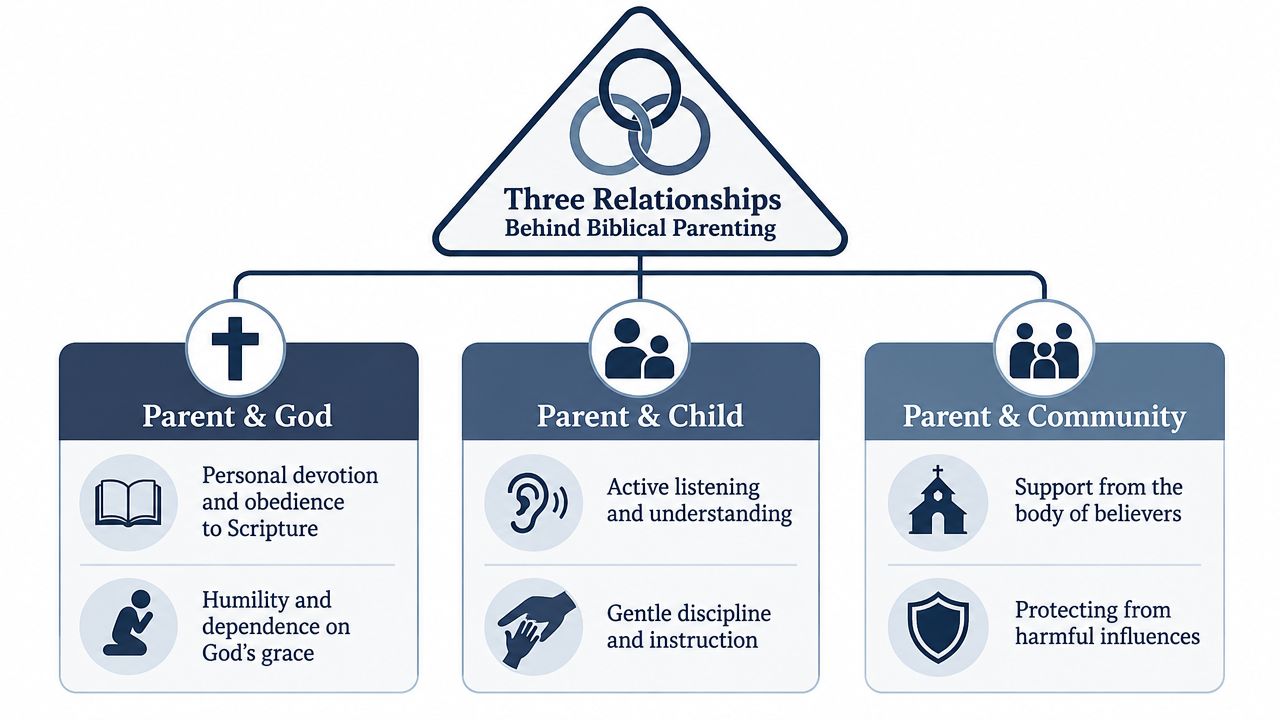
A Delphi study on biblical parenting competence organized the task around three connected relationships: the parent's relationship with God, the parent-child relationship, and the parent's relationship with the broader community (Delphi study on biblical parenting competence). Its practical aim was to raise children in God's Word so they can respond in faith, develop mature Christian character, and live faithfully in the world.
This structure helps us diagnose problems without reducing parenting to isolated techniques.
Parent and God
The vertical relationship comes first. Parents need prayer, Scripture, repentance, and dependence on the Holy Spirit. This isn't a claim that parents must reach spiritual maturity before they can serve their children. It means that biblical instruction flows most honestly from a parent who is also being instructed by God.
A parent who has sinned against a child can say, “I spoke harshly, and that was wrong. Will you forgive me? I need Jesus' mercy too.” That confession teaches theology through relationship. It shows that authority doesn't exempt anyone from repentance.
Parent and child
The second relationship includes warmth, affection, truthful correction, listening, and patient communication. A child isn't a discipleship assignment. A child is a person made in God's image, entrusted to a parent who must learn that particular child's strengths, fears, sensitivities, questions, and stage of development.
A critical review of 16 empirical studies concluded that adequate nurturance is associated with healthier, better-adjusted, more competent, and more confident children, while authoritative discipline and role modeling support adjustment (critical review of parenting research). This evidence aligns with the biblical pattern of secure affection joined to clear expectations.
Parent and community
The third relationship reaches beyond the household. Churches, older believers, extended family, Christian friends, and ministry leaders help children encounter a wider body of Christ. Psalm 78 assumes that faith is handed down through generations, not kept within one isolated nuclear family.
Community also supplies accountability for parents. Families need people who can pray with them, speak wisely, help during exhaustion, and model Christian life across different seasons. Resources that help families think carefully about care, birth, and support can broaden that vision, including Bornbir's faith-based doula guide.
A weakness in one relationship strains the others. Private devotion without warmth can make faith feel cold. Warmth without truth can leave children morally confused. Church involvement without home practice can make Christianity appear confined to a building.
Putting Principles Into Practice at Every Stage
The same biblical commitments take different forms as children mature. A toddler doesn't need a teenager's theological conversation, and a teenager shouldn't be treated as though faith can be sustained through only simplified answers.
Early childhood
Young children learn through repetition, affection, imitation, and embodied routines. Keep prayer short and concrete. Read a Bible story, name one truth about God, and connect it to the child's world.
Suppose a four-year-old refuses to share a toy. Instead of offering only a command, a parent might kneel, identify the selfish desire, set a boundary, and practice generosity: “You want the truck for yourself. It belongs to your brother right now. We can ask God to help us love him, and then you can choose another toy.”
Bedtime prayer, a blessing before school, Bible story cards, songs, and joyful participation in church can give young children a sense that belonging to God's people is good. The aim isn't to force adult comprehension. It is to establish a loving atmosphere in which God's name, Word, and people are familiar.
School-age years
School-age children can ask increasingly thoughtful questions. Use those questions as invitations rather than interruptions. After a Sunday sermon, ask what the child remembers, what seemed confusing, and where the teaching touches family life.
If siblings quarrel, help them practice confession and forgiveness rather than ending the dispute with a quick command to say “sorry.” A parent might ask, “What did you want? What did you do? How did that affect your sister? What would repentance look like now?” The conversation connects Scripture to motives, consequences, and repaired relationships.
Memory verses can fit naturally into car rides, meal preparation, or transitions. Deuteronomy 6 encourages this ordinary-life pattern, where biblical truth becomes part of the family's language rather than a detached academic exercise.
Teenage years
Teenagers need honest dialogue about identity, doubt, suffering, sexuality, vocation, justice, technology, and competing visions of the good life. Parents should give clear biblical teaching while making room for questions that don't resolve in one conversation.
A teenager who says, “I'm not sure I believe this anymore,” needs neither panic nor indifference. A parent might respond, “I'm glad you told me. I love you, and I want to understand what you're wrestling with. Let's talk, pray, and seek wise help together.” Hospitality can also become discipleship when friends are welcomed into the home and adults model thoughtful, gracious Christian life.
Families facing serious emotional or relational challenges shouldn't assume that spiritual language replaces skilled care. When a young person needs specialized support, Kelowna adolescent counselling services offer an example of the kind of professional resource families may consider alongside pastoral care and prayer.
Why Modeling Often Matters More Than Routines
A family can complete every planned devotional and still fail to communicate a believable faith if the parents' daily lives contradict their words. This doesn't make routines unimportant. It clarifies their purpose. A routine should support relationship and practice, not conceal emotional distance or spiritual inconsistency.
Recent research on faith transmission gives this concern measurable shape. A 2025 study found that parental modeling explained 39% of the variance in adolescent religiousness, while shared practices nearly tripled the odds of deep personal commitment, and warm parent-child closeness mediated 28% of transmission effectiveness (2025 study on intergenerational faith transmission). These findings suggest that shared practices matter, but they work within a relational environment.
The question isn't whether your family worship is impressive. Ask what your child sees when faith becomes costly.
Prayer: Do children see you bring fear, gratitude, and uncertainty to God?
Repentance: Do they hear you ask forgiveness without defending yourself?
Generosity: Do they observe money, time, and attention offered for the good of others?
Rest: Do your habits communicate that your worth doesn't depend on constant achievement?
Truthfulness: Do you tell the truth when a convenient half-truth would be easier?
A child may forget the outline of a devotional while remembering whether a parent became gentler after praying.
Deuteronomy 6:6–7 joins the parent's heart to the parent's teaching. Paul tells Timothy to let his conduct, love, faith, and purity set an example, and he calls believers to imitate faithful Christian life. Those texts don't celebrate performance. They call parents to integrity.
If your routines have become a source of shame, simplify them. Read one paragraph of Scripture. Pray. Ask one good question. If the family misses a night, begin again without announcing failure. For guidance on how faith and marriage shape the home together, consider biblical marriage principles as part of the larger work of household discipleship.
Honest Answers to Common Parenting Questions
Christian parents often feel trapped between two opposite errors. Scripture gives us a wiser path, one that protects both authority and grace.
Tension | Biblical Direction | Balanced Practice |
|---|---|---|
Discipline and grace | Proverbs connects discipline with hope, while Ephesians 6:4 forbids provoking children. | Correct the behavior, address the heart, explain the consequence, and move toward restoration without humiliation. |
Screen time and freedom | Philippians 4:8 calls believers to attend to what is true, honorable, just, pure, lovely, and commendable. | Evaluate content, timing, posture, and effect. Build household habits that include conversation, service, sleep, worship, and embodied community. |
Church attendance and burnout | Christian life includes the body of believers, but attendance alone doesn't create discipleship. | Seek a sustainable church connection where children are known, parents receive care, and the family participates rather than only consumes. |
Parental responsibility and spiritual results | Parents teach, guide, pray, and model, but God alone changes the heart. | Practice faithfulness without claiming control over a child's response. Keep loving and telling the truth. |
Screen questions deserve more than a list of forbidden platforms. A child may encounter biblical content online and still remain spiritually passive. Ask what the child is watching, what desires it encourages, and whether digital habits are crowding out sleep, relationships, Scripture, or service.
Church disappointment also requires patience and honesty. Some families need rest, pastoral conversation, or help processing harm. Yet isolation leaves parents without the intergenerational support Scripture envisions. Look for a congregation where leaders take both doctrine and pastoral care seriously.
Fear about a child walking away from Christ can become controlling behavior. Faithful parents shouldn't confuse their calling with the Spirit's work. Pray, teach, listen, correct, welcome honest questions, and keep the door open for truthful conversation.
A 2025 survey in the State Biblical Fatherhood report found that more than 75% of Christian dads said they don't regularly or intentionally read or discuss the Bible with their children, and 83% said they didn't regularly pray together with their families (State of Biblical Fatherhood report). The answer isn't guilt-driven intensity. It is a humble return to simple, repeatable practices supported by genuine relationship.
Growing Further as a Christ-Centered Parent
Biblical parenting is lifelong discipleship. You aren't mastering a checklist. You're learning to love God, love your child, and receive help from Christ's body while your child grows through changing seasons.
Keep the framework simple:
Walk with God: Read Scripture, pray, repent, and depend on grace.
Know your child: Combine affection with truthful instruction and attentive listening.
Stay connected: Invite the church and mature believers into the work.
Model the faith: Let your child see Christianity practiced in weakness, work, conflict, generosity, and joy.
Choose one next step for the coming week. Read Deuteronomy 6 with your spouse or a trusted friend. Ask your child one open question about faith and listen without rushing to correct. Or establish a brief family prayer that you can repeat without turning it into a performance.
Parents can also gather resources suited to their family's needs, including studies of Deuteronomy 6, Ephesians 6, and Psalm 78, age-appropriate catechisms, family worship guides, pastoral counsel, and carefully chosen Christian books. Families seeking support for children with developmental differences may find the Christian parenting autism guide useful as they adapt communication and routines with patience.
The Bible Seminary offers Bible-centered education, graduate majors, certificate programs, audited courses, and on-demand seminars for people preparing for ministry or pursuing deeper theological formation. Its resources and training connect Scripture, spiritual formation, and practical service, helping equip leaders to impact the world for Christ.
Explore The Bible Seminary to find Bible-centered programs and practical ministry training that can strengthen your understanding of Scripture and family discipleship. Whether you're preparing for formal ministry or serving your church as an educator, pastor, or parent, begin training your heart and mind for kingdom service through a community that unites scholarship, spiritual formation, and hands-on ministry.