
Auditing Graduate Courses How to Enroll and Learn Well

You may be a pastor with a full preaching calendar, a Bible teacher hungry for deeper study, or a ministry professional wondering whether graduate-level learning fits this season. You see a course that could strengthen your teaching and service, but you aren't sure whether you need academic credit, whether the work will fit your schedule, or what auditing will cost.
Auditing graduate courses can provide a focused way to learn without immediately pursuing a degree requirement. Yet it isn't sitting in the back of a classroom. Auditing is a formal enrollment pathway with expectations, permissions, transcript rules, and financial policies that vary by institution. For ministry-minded learners, it can also become a thoughtful form of spiritual and vocational formation.
Why Auditing Graduate Courses Makes Sense for Ministry Learners
A bivocational pastor notices an advanced biblical studies course in the catalog. The subject connects directly to a sermon series, but graded papers and exams would be difficult during a demanding ministry season. A retired missionary wants to return to serious theological study, though not necessarily to complete another degree. A church leader senses a call to seminary but wants to experience graduate learning before committing to a full program.
For learners like these, auditing can be an intentional choice rather than a lesser one. It may allow you to explore a subject, refresh biblical knowledge, test a developing calling, or receive structured guidance without making GPA or degree progress the immediate goal.

Formation beyond the transcript
At The Bible Seminary, graduate learning is connected to more than information transfer. The seminary's stated mission is to equip leaders to impact the world for Christ by training hearts and minds for kingdom service. That kind of preparation brings together Bible-based scholarship, Christ-centered spiritual formation, Spirit-led discernment, and hands-on ministry application.
An audited course can serve that formation when you approach it with a clear purpose. You might study biblical archaeology to better explain Scripture's historical setting, explore theology to strengthen discipleship, or join a ministry-focused course to sharpen leadership in your church. TBS also connects academic study with archaeology and Scripture through resources such as its archaeology offerings, helping learners see how careful scholarship can serve faithful ministry.
A helpful question: What kind of obedience, service, or ministry responsibility could this learning strengthen?
Auditing also requires honest discernment. If you need a course to count toward a degree, satisfy a credential, establish financial-aid enrollment, or qualify for another academic requirement, credit enrollment may be the better path. If your priority is guided learning during a demanding season, auditing may fit more naturally.
A practical learning pathway
Before registering, identify your purpose, available time, desired participation, and long-term plans. Then ask the school about course access, faculty approval, fees, assignments, and whether an audited status could later change. For churches building structured development pathways, a resource such as LearnStream's ministry training LMS guide can also help leaders think about how formal learning, discussion, and ministry practice fit together.
The right decision isn't merely academic. It should support faithful stewardship of your time, calling, relationships, and responsibilities before God.
What Auditing Means and How It Differs From Credit Enrollment
The central distinction is simple: credit enrollment measures academic completion, while auditing prioritizes learning without academic credit. A credit student normally completes assigned work, participates according to course requirements, takes examinations when required, and receives a grade. An auditor attends under the institution's audit rules and generally observes without completing graded assignments or exams.
A graduate policy at the University of Wisconsin describes audit enrollment as being “for no grade and no credit” and requires instructor permission. The policy also explains that an auditor attends as an observer rather than participating in assessed coursework. That example illustrates why you should read the specific policy before assuming that auditing means full access to every course activity.
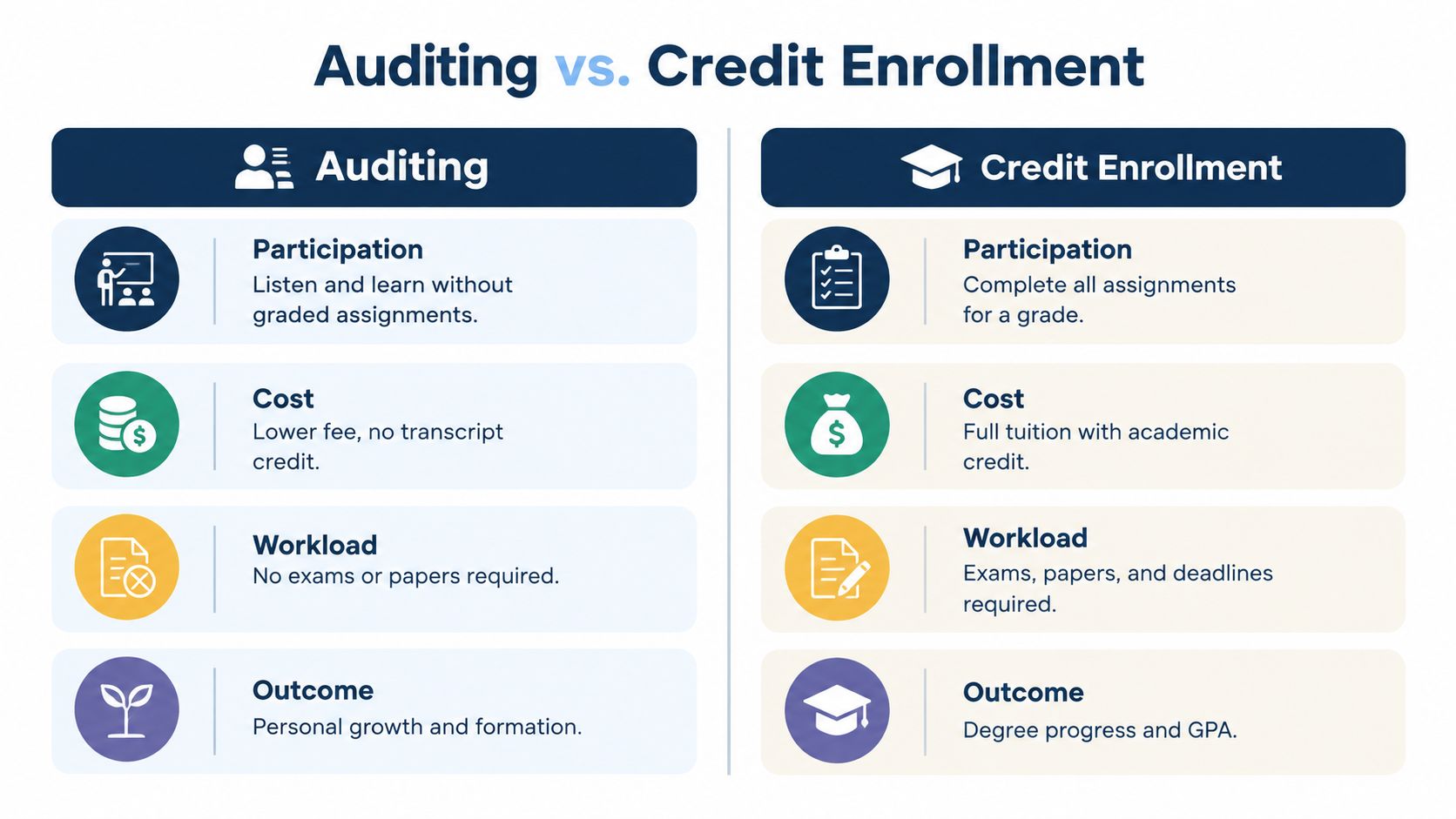
Auditing vs Credit Enrollment at a Glance
Feature | Auditing | Credit Enrollment |
|---|---|---|
Participation | Attend as an observer and learn within the approved boundaries | Participate in the full academic course |
Assignments and exams | Usually not required under the audit policy | Completed according to course requirements |
Transcript result | May receive an audit notation, such as AU, without academic credit | Receives a grade that contributes to the academic record |
Degree progress | Doesn't normally satisfy degree requirements | Can apply toward a degree when approved |
GPA and enrollment status | Doesn't normally affect GPA or full-time or half-time status | May affect GPA and enrollment status according to institutional rules |
Primary purpose | Personal growth, exploration, and guided formation | Academic progress, credentialing, and assessed learning |
The table offers a general comparison, not a universal rule. Some institutions permit auditors to complete work for possible later conversion, while others limit participation to observation. The University of Wisconsin policy cited above is more restrictive, so prospective students should ask whether a particular school allows assignments, exams, or later status changes.
Why the distinction matters
Degree auditing became a formal student-services function rather than an informal classroom arrangement. EDUCAUSE defined a degree audit in 1996 as “a formal evaluation of a student's coursework to date, in terms of the requirements for a particular degree” (EDUCAUSE's degree-audit discussion). That history helps explain why institutions carefully record whether a course applies to a program, a certificate, or no academic requirement.
The phrase “audit” can also mean something different in nonprofit and financial settings. If you're working with a church, ministry, or nonprofit and want to distinguish educational auditing from organizational review, nonprofit audit terms defined provides useful background vocabulary.
Auditing may be the right choice when you want disciplined learning without degree progress. Credit is usually the better choice when an academic result matters for your program, professional objective, or future enrollment plan.
Who Can Audit and How to Get Permission
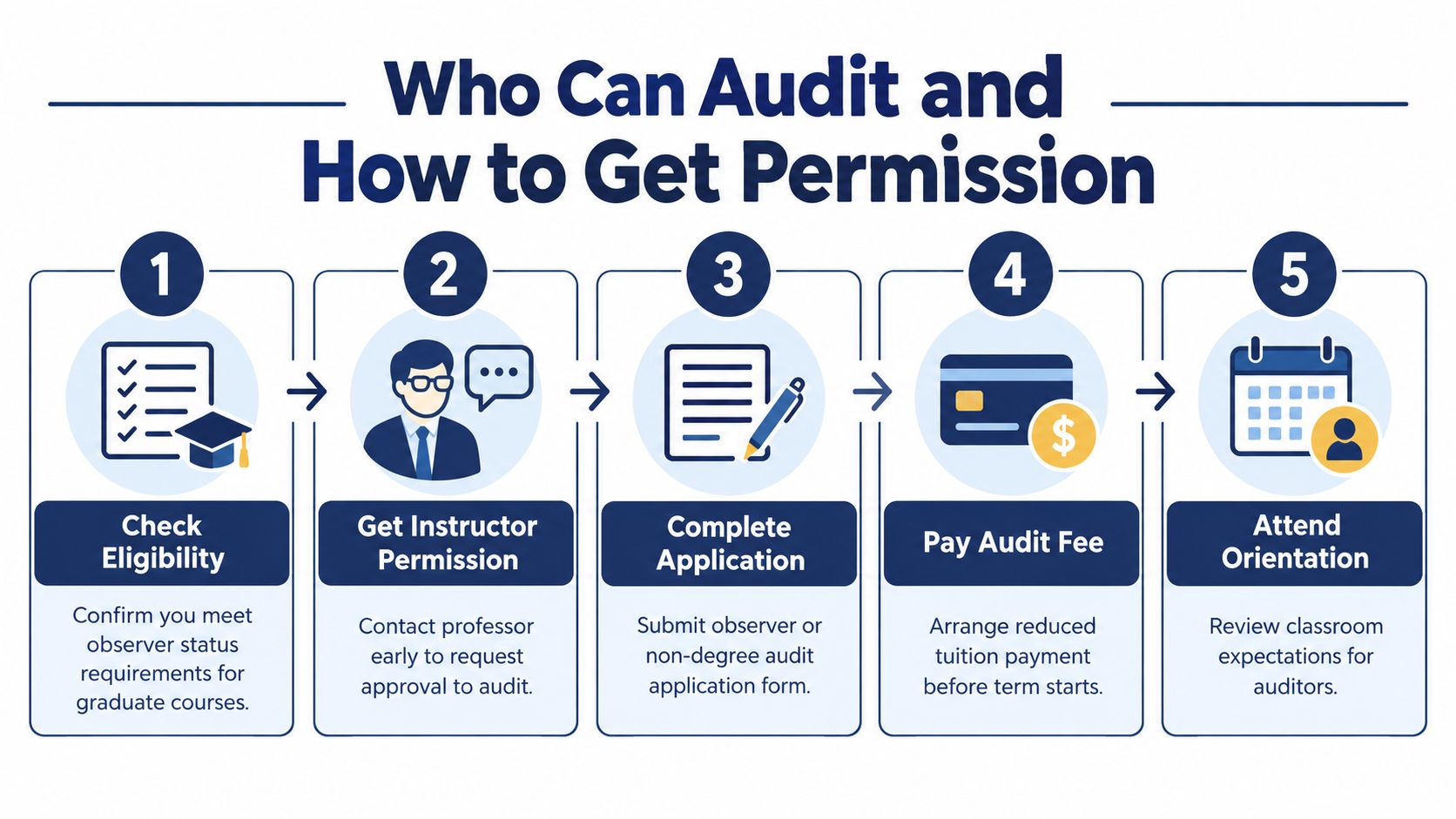
Auditing begins with eligibility, not attendance. A prospective auditor shouldn't assume that showing up to the first class creates an audit arrangement. Graduate courses may have prerequisites, limited seats, format restrictions, or program rules that affect whether an observer can enroll.
The safest approach is to contact the institution before registration and explain your purpose. Tell the academic office and instructor whether you're seeking ministry enrichment, exploring a future degree, refreshing a subject, or pursuing another learning goal. That context helps the faculty member determine whether the course is suitable for audit participation.
Ask the right questions early
Instructor permission is often explicit. The University of Wisconsin policy requires a student to request and receive permission from the instructor, and it defines the auditor's role as observation without graded assignments or examinations. That means faculty discretion matters, especially in discussion-heavy graduate courses where enrollment affects classroom interaction.
Before requesting approval, prepare a short set of questions:
Eligibility: May a ministry professional, prospective student, or non-degree learner audit this course?
Participation: Can auditors join discussions, or should they observe only?
Materials: Will auditors receive the syllabus, readings, library access, or online resources?
Assessment: Are papers, projects, quizzes, or exams unavailable to auditors?
Capacity: Is an audit seat available if the course is near its enrollment limit?
Format: Is the course offered in person, live online, asynchronously, or in a hybrid format?
Future plans: If you later seek credit, would you need to retake the course or follow another process?
The answers can differ by course and institution. A classroom built around laboratory work, practicum supervision, or confidential ministry preparation may not be appropriate for an observer.
Treat permission as a ministry conversation
A respectful request communicates that you value the professor's teaching and the learning community. You might write, “I serve in local ministry and want to strengthen my understanding of this subject. I'm seeking permission to audit and understand that the course's assessment and participation rules apply.”
That posture reflects Christian humility. James 1:19 calls believers to be “quick to listen, slow to speak, and slow to anger” (CSB). An auditor's first responsibility is to listen carefully, honor the instructor, and contribute only within the boundaries granted.
Once permission is received, complete the school's application or registration process. Keep written confirmation, review the syllabus, and clarify expectations before the term begins.
How Registration Costs and Policies Work at The Bible Seminary
Cost is one of the most common points of confusion. Many people assume that an audited course automatically costs less because it doesn't produce credit. Institutional policies show that assumption isn't safe.
One graduate catalog states that students who audit must complete the usual registration process and pay regular tuition fees, with no reduction in fees for auditing. The same policy says the audited course doesn't count toward financial-aid enrollment status or program completion (Northeastern's graduate registration policy). Another graduate policy treats an audited course at full credit value for tuition purposes, meaning the fee can be the same as credit enrollment.
Because policies vary, ask TBS for the current per-course audit fee and payment schedule before committing. Don't rely on the word “audit” to predict the price. Confirm whether the fee covers course materials, whether additional charges apply, and whether financial aid or employer support can be used.
Policies that deserve written confirmation
Policy Area | What to Verify |
|---|---|
Registration | Whether you must use the standard registration process |
Tuition and fees | The current audit fee, payment deadline, and any additional charges |
Financial aid | Whether audit enrollment counts toward aid eligibility or enrollment status |
Transcript | Whether the record shows AU, another notation, or no entry |
Academic credit | Whether the course can satisfy a degree or certificate requirement |
GPA | Whether the audit affects the GPA |
Course eligibility | Whether the course is open to auditors |
Status changes | Whether audit status can later be changed to credit |
Attendance | Required attendance or participation expectations |
Learning access | Availability of readings, digital platforms, library resources, and recordings |
Course exclusions and transcript results
Audit policies commonly exclude courses that depend on equipment, performance, supervised practice, or specialized participation. Examples listed in graduate policies include studio, performance, laboratory, internship, practicum, language, co-op, off-campus, and online courses. One policy also notes that some programs may prohibit auditing a course required for the student's degree (UMKC's graduate course-audit policy).
The transcript notation may be AU, with no academic credit and no GPA effect. Audited coursework also may not count toward full-time or half-time enrollment. Some institutions don't allow students to change audit status after the choice is made, so make the decision before registration rather than expecting to revise it later.
At TBS, the practical question is straightforward: request the current policy in writing. Clear answers protect your finances, academic plans, and ministry schedule.
How to Thrive as an Auditor and Get the Most From the Experience
Without grades, deadlines can lose their force. That freedom can serve mature learners, but it can also make attendance and preparation easier to postpone. One cited study of short-form or self-directed learning reported an overall completion rate of 13.3%, rising to 19.5% among learners who intended to finish (CollegeVine's discussion of auditing college classes). The lesson isn't that auditing cannot work. It's that clear intent and steady habits matter.
Write a personal learning covenant before the course begins. Define what you want to understand, how the subject connects to your ministry, and what consistent attendance will look like alongside work and family responsibilities.
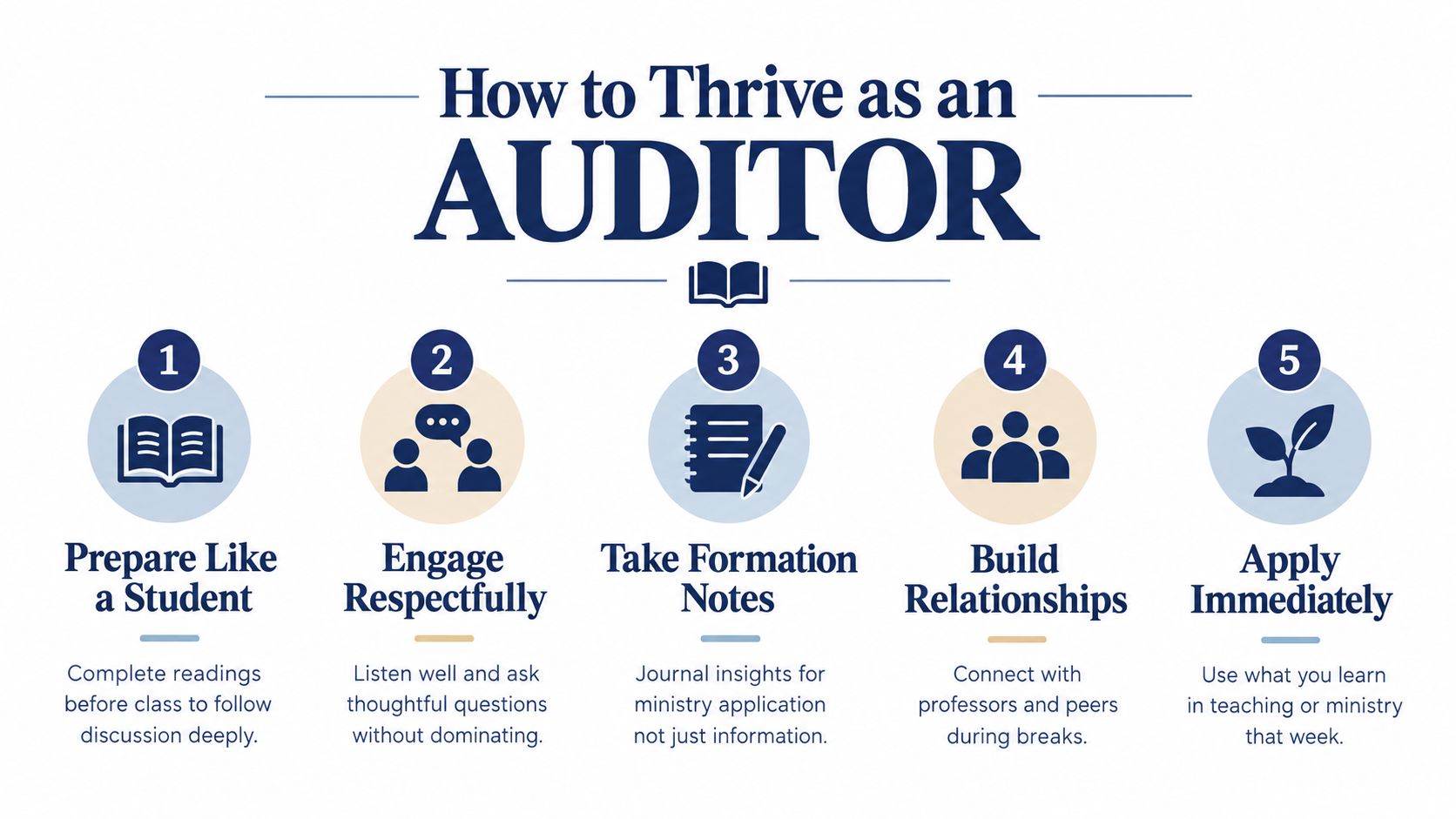
Build a rhythm that replaces grades
Prepare as if the course matters because it does. Read before class when access is provided, keep a question log, and summarize each session in your own words. If you want a structured way to organize key ideas, you can boost comprehension with guides by turning readings and lectures into concise review materials.
Use a simple weekly pattern:
Before class: Read, pray, and write one question connected to ministry practice.
During class: Listen actively, take notes, and participate only within the approved audit expectations.
After class: Record one insight, one unresolved question, and one possible application.
During the week: Use the learning in a sermon, Bible study, leadership conversation, or personal study when appropriate.
Learn in community and receive correction
Graduate learning becomes richer when you listen to faculty and fellow students with respect. Attend office hours if auditors are permitted to do so, ask for clarification rather than attention, and receive correction without defensiveness. A seminary classroom can refine not only what you know, but how you handle complexity, disagreement, evidence, and responsibility.
Some auditors encounter limits on library materials, digital platforms, or course resources. Ask about access before the course begins, then adapt by maintaining your own reading notes and organizing permitted materials carefully.
Formation practice: Don't measure the course only by how much information you retain. Ask how it is shaping your faithfulness, judgment, teaching, and service.
The value of auditing grows when learning moves into ministry. A lesson about biblical context may improve your teaching. A discussion of leadership may change how you shepherd volunteers. A study of archaeology may help you explain why Scripture deserves careful historical attention while avoiding exaggerated conclusions. This is how scholarship and spiritual formation work together.
Your Next Step Toward Deeper Training at The Bible Seminary
Auditing graduate courses can be a wise next step when you want guided learning but aren't ready to pursue academic credit. It can also reveal that you're ready for more. After experiencing the reading, discussion, faculty interaction, and ministry application of graduate study, some learners choose to pursue a certificate or degree.
Use your purpose to guide the decision. Choose audit status when personal enrichment, exploration, or focused formation is your priority. Choose credit enrollment when you need degree progress, a formal grade, or an academic credential. If you're uncertain, speak with an academic advisor before registering and describe your ministry goals plainly.
The Bible Seminary offers flexible pathways that can connect a single course with longer-term preparation. Prospective students can review degree programs, explore certificates, and learn about the seminary's biblical, theological, archaeological, and practical ministry emphasis. TBS's graduate majors study all 66 books of Scripture alongside historical, theological, and practical disciplines, providing a setting where the Bible comes alive through archaeology and Scripture together.
A certificate may provide a more defined sequence for continuing education. You can learn more about one such pathway through TBS continuing education certificate information. Those interested in the historical world of the Bible can also visit the 3J Museum and explore its educational events and resources, while ministry partners can learn about supporting the seminary's mission through the TBS giving page.
The decision doesn't have to be rushed. Pray, count the cost, ask practical questions, and consider the people God has entrusted to your care. Faithful training should strengthen your service, not distract you from it.
The Bible Seminary provides graduate courses, audit options, certificate pathways, degree programs, and ministry-focused learning that unite scholarship, spiritual formation, and hands-on service. If auditing graduate courses could help you take a faithful next step, visit The Bible Seminary to explore available programs and contact the seminary about current course policies and enrollment options.