
What is Biblical Counseling? A Guide to Christ-Centered Soul Care

So, what is biblical counseling? At its heart, it’s a ministry of Christ-centered soul care. This is a warm, relational, and hope-filled approach to helping people navigate the very real struggles of life by applying the timeless wisdom of God's Word. It is an intentional discipleship process where Scripture is the primary tool for bringing healing and transformation to the heart and mind—from anxiety and grief to relational conflict and confusion.
Defining Biblical Counseling as Christ-Centered Soul Care
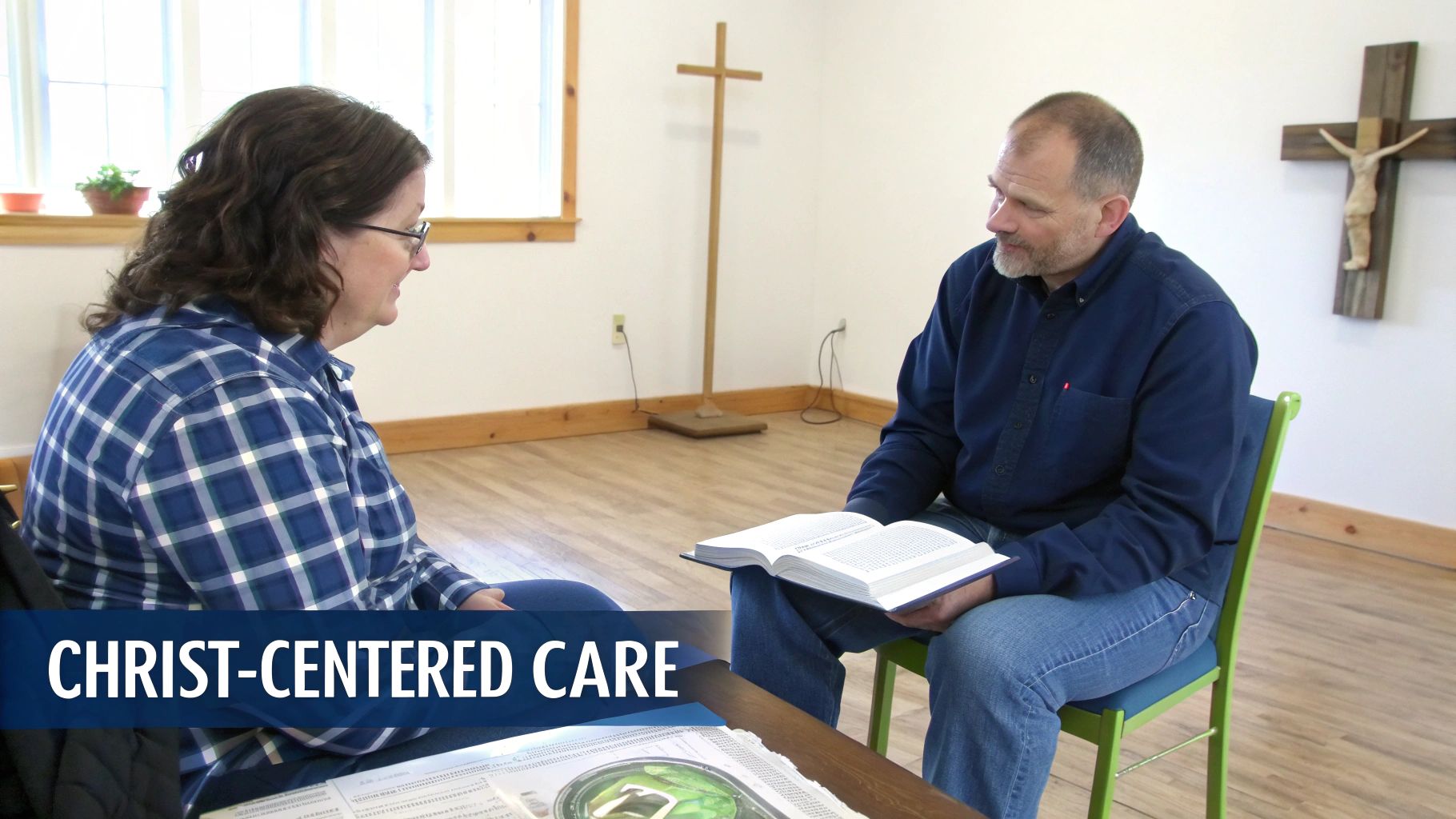
Here at The Bible Seminary, we see biblical counseling as a vital, living expression of the church's mission to care for God’s people. It is a move away from simply offering quick advice or immediately referring people to outside help. Instead, it’s about equipping believers to minister to one another with confidence and compassion, using the rich, sufficient resources found in the Bible.
This entire approach is built on the firm conviction that Scripture gives us the ultimate framework for understanding ourselves, our problems, and the only path to genuine, lasting change. It is profoundly hope-filled because it consistently points people back to the life-changing power of Jesus Christ and the ongoing work of the Holy Spirit.
The Heart of the Matter
This focus on spiritual transformation is where biblical counseling differs most from secular approaches. Its ultimate goal is not just to relieve symptoms but to see spiritual restoration and growth in Christlikeness. The aim is to help individuals like you:
Understand your identity in Christ and see how it reframes your struggles.
Repent of sin and learn to walk in righteousness through the power of the gospel.
Apply biblical wisdom to everyday thoughts, emotions, and relationships.
Grow in your love for God and dependence on Him through prayer and His Word.
This is a deeply personal and relational process. It's about walking alongside someone, listening with empathy, and gently guiding them back to the truth and grace that overflow from the Scriptures.
“The aim of biblical counseling is not to solve every problem but to shepherd a person’s heart toward a deeper reliance on Christ, who is the answer to every ultimate problem.”
A Ministry for the Whole Church
For too long, many churches have felt unequipped to handle the deep hurts within their congregations. Biblical counseling helps restore the church’s God-given role as the primary community for soul care. It empowers pastors, ministry leaders, and lay members to step into meaningful, one-another ministry with confidence.
When a church embraces this responsibility, it becomes a true community of healing and discipleship. This is precisely where robust scholarship meets practical application—training hearts and minds for kingdom service. At The Bible Seminary, we are passionate about equipping leaders to build this kind of caring culture. You can learn more about how our degree programs can prepare you for this vital work.
Exploring the Theological Foundations
To truly grasp biblical counseling, you must understand the "why" behind the "what." This ministry is not a collection of techniques; it flows from core theological convictions. These doctrines are the bedrock, shaping every conversation and guiding every piece of counsel. Here at The Bible Seminary, we are convinced that effective ministry application must flow from solid theological training.
It all starts with an unshakable commitment to the authority and sufficiency of Scripture. We believe God’s Word is the final say on truth for all things related to life and faith, providing the non-negotiable framework for real, lasting change.
All Scripture is breathed out by God and is profitable for teaching, for rebuking, for correcting, for training in righteousness, so that the man of God may be complete, equipped for every good work. (2 Timothy 3:16–17, ESV)
This passage is a cornerstone. It declares that Scripture doesn’t just offer helpful hints; it fully equips God’s people for every good work—including the work of caring for souls. This means the Bible has what it takes to diagnose the real issues of the heart and to prescribe the divine remedy found only in the gospel.
A Biblical View of Humanity
From this foundation in Scripture, we gain a clear perspective on the human condition. Biblical counseling operates from a view that holds two profound truths in tension:
Created in God’s Image (Imago Dei): Every person has profound dignity, value, and purpose because they are made in the likeness of God Himself (Genesis 1:27). This truth anchors a counselor’s deep respect and compassion for every individual.
Affected by Sin (The Fall): The Bible is also honest about our fallen nature. Sin has impacted every part of who we are—our thoughts, desires, emotions, and relationships (Romans 3:23). This doctrine is crucial for explaining the root causes of our struggles, pushing past surface-level behaviors to address heart-level issues.
Grasping this dual reality—our dignity and our depravity—is essential. It allows a biblical counselor to offer both profound respect and honest assessment, seeing people as God sees them. This perspective is a key part of pastoral theology, and you can read our guide on pastoral theology to learn more.
The Transformative Power of the Gospel
Once we have a biblical view of our sin problem, we are led straight to the biblical solution: the gospel of Jesus Christ. While secular models may offer coping mechanisms, they cannot produce true heart transformation. Biblical counseling is fundamentally a gospel-centered ministry.
The good news is that Jesus’s life, death, and resurrection offer both forgiveness for the past and real power for the present. When someone places their faith in Christ, they are made a new creation (2 Corinthians 5:17). The Holy Spirit then begins a lifelong process of sanctification, shaping the believer more into the image of Christ.
This spiritual reality is the engine of change in biblical counseling. We are not aiming for self-improvement; we are aiming for Spirit-empowered transformation. This approach weaves together sound scholarship and genuine spiritual formation, equipping leaders to minister the life-changing truth of the gospel to a hurting world.
Comparing Biblical Counseling to Other Models
To fully appreciate what biblical counseling is, it helps to understand what it isn't. Many well-meaning approaches to care operate from a completely different playbook.
Understanding these distinctions is vital for anyone who wants to build a ministry thoroughly grounded in God's Word. This includes understanding the landscape of alternatives to therapy for depression and anxiety so we can clearly articulate what makes biblical counseling unique. At The Bible Seminary, we equip leaders to see these differences, ensuring their ministry remains centered on the gospel's power to change lives.
Secular Psychology
Secular psychology examines human problems from a human-centered view. Its authority comes from scientific research, behavioral theories, and clinical observations. While it can sometimes offer helpful insights into human patterns—what a Christian might call common grace—its foundation is missing the most critical pieces of reality.
By design, secular models operate without acknowledging God, sin, or the spiritual nature of humanity. The end goal is typically self-actualization, managing symptoms, or functioning better in daily life. From a biblical worldview, this approach can only offer a partial, temporary fix because it cannot address the root spiritual issues of the heart.
Christian Psychology (Integration)
Another approach, often called Christian psychology or integration, attempts to blend insights from secular psychology with the Christian faith. It treats both Scripture and scientific findings as valid sources of truth, combining psychological theory with Christian theology.
While the desire to help people is sincere, integration can create real challenges. A primary danger is letting secular theories—which come from a non-biblical worldview—re-interpret or even override the clear teachings of Scripture. This can subtly shift the focus from God's authoritative Word to human wisdom, watering down the power of the gospel in the counseling room.
The Biblical Counseling Distinction
This is where biblical counseling stands apart. It starts by affirming the complete sufficiency of Scripture for all of life and godliness (2 Timothy 3:16–17). This doesn't mean rejecting science or medicine, but it does mean placing them under the final authority of God's Word.
Here, the primary goal is not self-fulfillment but sanctification—the lifelong process of becoming more like Christ.
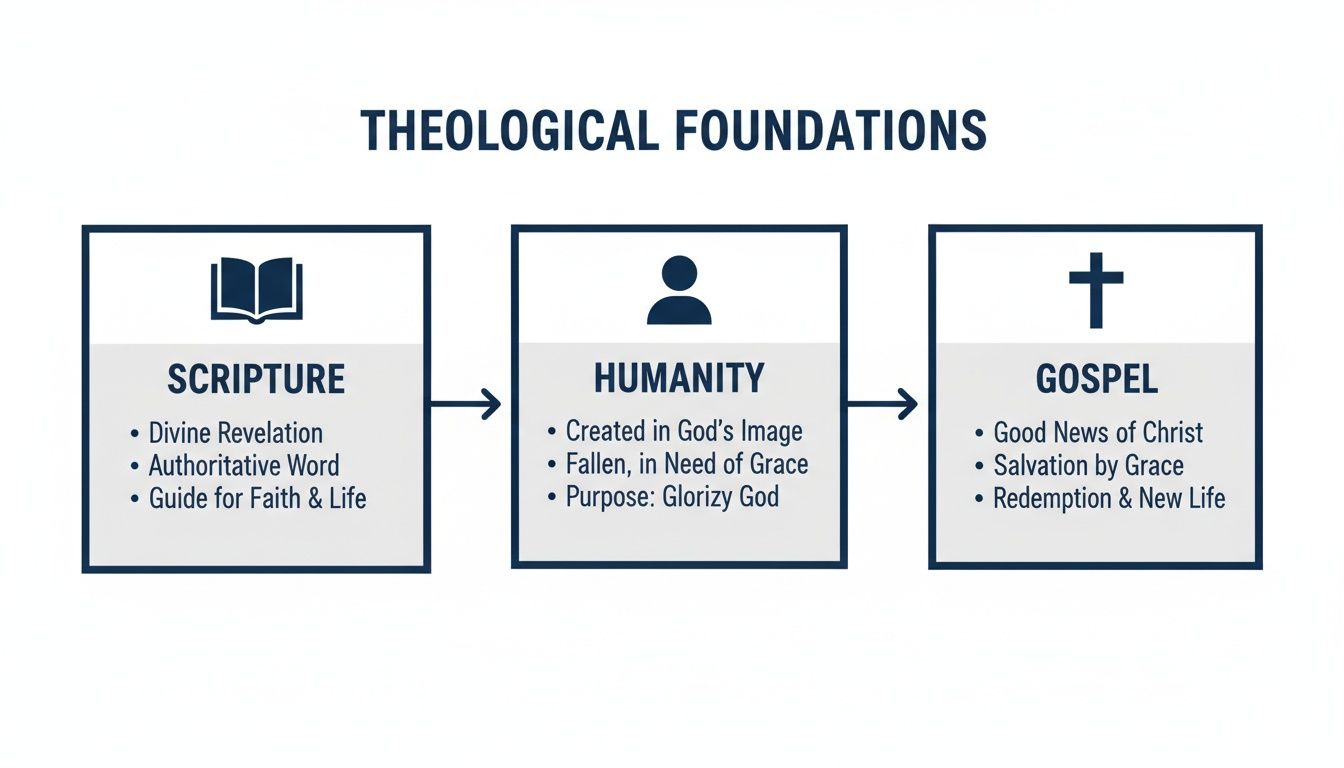
As this diagram shows, biblical counseling is built on three theological pillars: Scripture, a biblical view of humanity, and the gospel. These foundations ensure that every part of the counseling process is rooted in God's revealed truth, not in human-created theories.
To make these differences clear, the table below breaks down how each model approaches the foundational aspects of care.
Comparing Counseling Approaches
Aspect | Biblical Counseling | Christian Psychology (Integration) | Secular Psychology |
|---|---|---|---|
Ultimate Goal | Sanctification and Christlikeness | Mental health and spiritual growth | Self-actualization and symptom relief |
Source of Authority | The Bible as sufficient and authoritative | Scripture and psychological research | Scientific theory and clinical practice |
View of the Problem | Sin, idolatry, and suffering in a fallen world | A mix of psychological and spiritual issues | Maladaptive behaviors, cognitive distortions |
Method of Change | Repentance, faith, and Spirit-empowered obedience | Therapeutic techniques alongside spiritual disciplines | Cognitive-behavioral therapy, medication, etc. |
This clear, theologically distinct approach is precisely why The Bible Seminary is dedicated to training hearts and minds for kingdom service. We believe that true, lasting hope for a hurting world comes from leaders equipped with a robust, Scripture-first framework. It’s a commitment that unites scholarship, spiritual formation, and hands-on ministry in everything we do.
A Look Back: Where Did Biblical Counseling Come From?
To appreciate why biblical counseling matters so much today, it helps to understand its history. The modern movement was a direct response to a growing tendency in the church to look outside the Bible for solutions to life's deepest hurts.
The story truly gained momentum in the 1960s. At that time, many pastors felt overwhelmed and unequipped to handle the tough problems their congregations faced. The common practice was to "defer and refer"—sending people to secular therapists whose starting point was often a world away from a Christian one. This left a huge gap, pushing the church to the sidelines of caring for its own people.
The Foundational Shift
One voice rose up to challenge this drift: Presbyterian pastor Jay E. Adams. He argued passionately that the church was abdicating its God-given duty and neglecting its greatest resource—the all-sufficient Word of God. Adams questioned the reliance on secular psychology, insisting that real help for life’s struggles was found in Scripture. His 1970 book, Competent to Counsel, was the spark that lit a fire.
This was a massive shift in thinking. The biblical counseling movement was born from the core belief that Scripture gives us everything we need for life and godliness (2 Peter 1:3). This wasn't about being anti-psychology; it was about being radically pro-Bible. The focus swung back to equipping pastors and everyday believers to minister God’s Word with both compassion and confidence.
The impact was significant. For instance, by 2005, the Southern Baptist Convention's six theological seminaries—serving over 47,000 churches—announced they were fully shifting from a psychology-heavy 'pastoral care' model to a biblical counseling focus. You can dig deeper into this major historical turn in this insightful article.
Growth and Organization
From these early days, the movement began to grow and organize. Networks were established to provide solid training, create resources, and ensure accountability, establishing biblical counseling as a credible field of ministry.
A couple of key organizations shaped the landscape:
The Association of Certified Biblical Counselors (ACBC): Originally founded as the National Association of Nouthetic Counselors (NANC) in 1975 with Jay Adams’s involvement, ACBC has become the leading organization for certifying biblical counselors.
The Biblical Counseling Coalition (BCC): Formed more recently, the BCC brings together a diverse collection of organizations, churches, and individuals committed to biblical soul care, fostering collaboration around shared gospel-centered values.
These organizations have been vital in advancing the mission of biblical counseling by creating robust training materials, hosting conferences, and building a community where counselors can sharpen one another.
This journey shows that biblical counseling isn't a new idea. It’s about recovering the church’s ancient calling to disciple and care for its people using the living Word of God.
This rich heritage is exactly why we at The Bible Seminary are so passionate about equipping leaders to impact the world for Christ. We stand on the shoulders of these pioneers, carrying on the work of preparing hearts and minds for this vital kingdom service.
Applying Biblical Counseling in Ministry
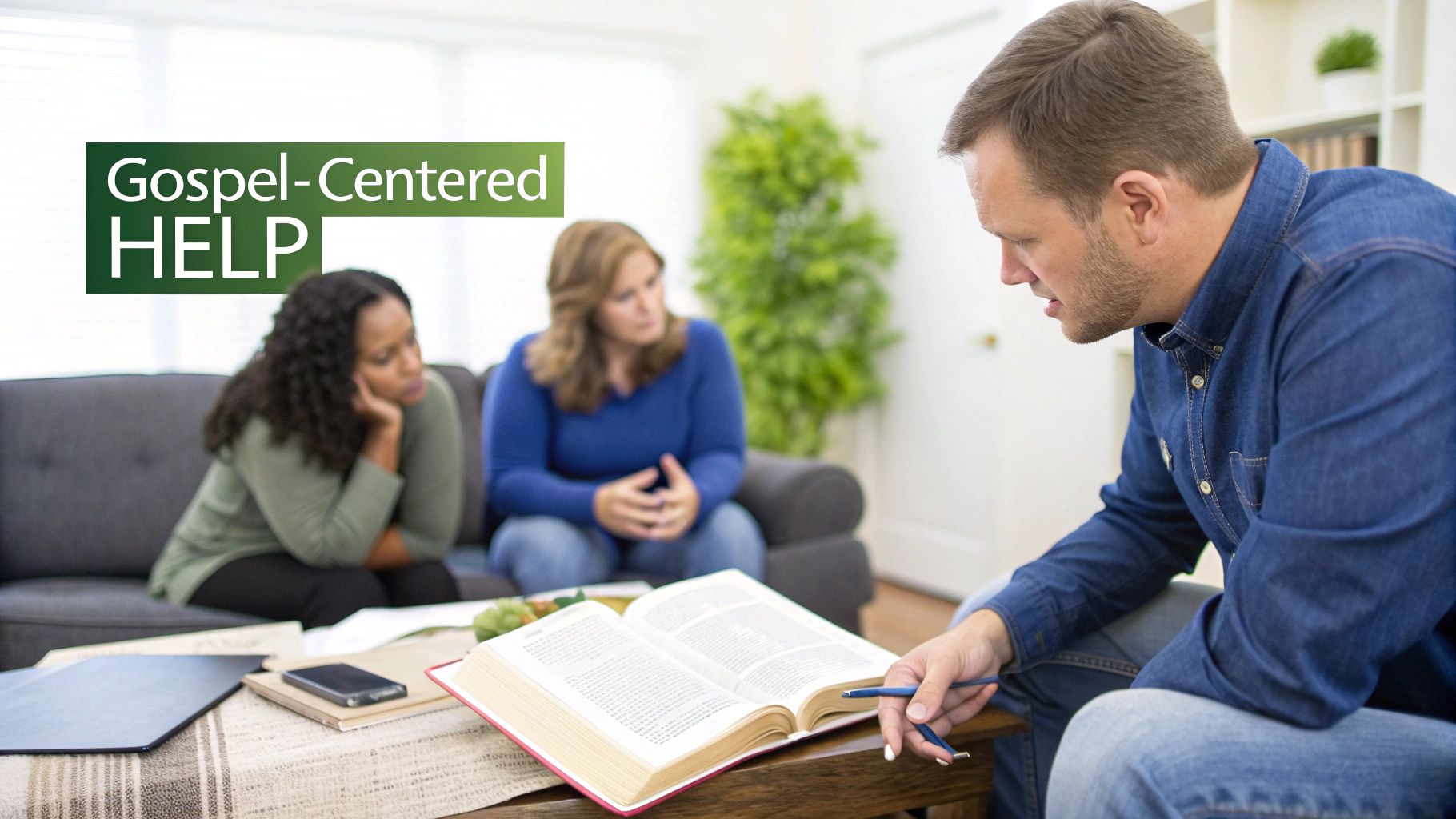
It’s one thing to discuss theology, but what does biblical counseling actually look like in the day-to-day life of a church? This is where theory becomes practice. It’s not a sterile, clinical process but a vibrant, deeply personal ministry that builds up the body of Christ.
Biblical counseling moves from abstract ideas to real help, offering genuine hope in the middle of life’s messiest moments. It’s about applying God’s Word with compassion, wisdom, and a complete reliance on the Holy Spirit. This practical, hands-on approach is exactly what we champion at The Bible Seminary: uniting scholarship, spiritual formation, and hands-on ministry.
Pre-Marital Guidance with Gospel Hope
Imagine a young couple preparing for marriage. They meet with their pastor, filled with excitement but also with unspoken fears and unresolved baggage. A biblically-trained counselor does more than hand them a compatibility test.
Instead, they open God’s Word to explore the profound mystery of marriage as a picture of Christ and the church (Ephesians 5). They help the couple build a foundation on a shared spiritual purpose, teaching them biblical strategies for communication, conflict, and forgiveness. The goal isn’t just a happy wedding day; it’s a lifelong covenant that brings glory to God.
Walking Through the Valley of Grief
Now, picture a church member who has just lost a spouse. The grief is a crushing weight, and the future feels empty. A biblical counselor comes alongside them not with clichés but with the real, sustaining comfort of Scripture.
They don’t rush the grieving process. They create a safe space for lament, pointing to the Psalms as a God-given language for pouring out one's heart. They gently turn the grieving person’s eyes to the unshakable hope of the resurrection (1 Thessalonians 4:13–14), anchoring their sorrow in the promise of eternal life. This ministry is the embodiment of the command to "weep with those who weep" (Romans 12:15). Practical support, sometimes through a church benevolence fund, can also be a vital part of this care.
“Biblical counseling isn't just about changing behavior; it's about shepherding hearts toward deeper dependence on Christ, who meets us in our deepest pain with His all-sufficient grace.”
Discipling Through Habitual Sin
What about someone trapped in a cycle of habitual sin, like pornography or explosive anger? A biblical approach goes far deeper than just saying, "Stop that." It helps them uncover the heart idols that are fueling the behavior (Ezekiel 14:3).
Through patient discipleship, a counselor walks with the individual to:
Identify the specific lies they believe in their moment of temptation.
Repent by turning away from the sin and turning toward Christ in faith.
Replace sinful patterns with godly habits through the power of the Spirit.
Connect with the church community for accountability and encouragement.
This process is a real-life application of putting off the old self and putting on the new self in Christ (Ephesians 4:22–24). For anyone wanting to guide others this way, learning how to study the Bible effectively is a crucial first step. No matter the scenario, biblical counseling is a ministry of hope, proving that God’s Word is truly sufficient for every challenge we face.
How to Get Equipped for Biblical Counseling

Perhaps as you’ve read this, you have felt a stirring in your heart—a call to the profound ministry of soul care. The question then becomes a practical one: how can you get the training you need to counsel others biblically, effectively, and with compassion?
The journey to becoming a competent biblical counselor is an intentional one. It takes more than good intentions; it demands a deep grounding in God’s Word and specialized instruction in applying that Word to the complexities of life. This path is all about training hearts and minds for kingdom service, and it’s a journey we are passionate about guiding students through at The Bible Seminary.
Start with a Strong Biblical Foundation
Before you can effectively bring Scripture to bear on someone else’s life, you must know it deeply yourself. A robust education in the Bible and theology is the non-negotiable starting point for anyone serious about biblical counseling.
This foundational knowledge equips you to:
Think biblically about the root causes of problems, addressing the idols and beliefs of the heart.
Handle the Word accurately (2 Timothy 2:15), ensuring you are ministering God’s truth, not just your own opinions.
Connect all of life to the grand story of Scripture—creation, fall, redemption, and glory—which provides a solid framework of hope.
At The Bible Seminary, every degree program is built upon an in-depth study of all 66 books of the Bible. This comprehensive biblical literacy is the bedrock upon which any effective counseling ministry is built. You can learn more about how seminary courses can help you understand your faith better and prepare you for this work.
Pursue Specialized Counseling Training
Once that solid biblical foundation is in place, the next step is gaining specific counseling skills. This is where you learn the “how-to” of soul care—the practical methods and relational dynamics of walking with someone through their struggles.
This specialized training should cover essential areas like:
Understanding common counseling issues from a biblical perspective (e.g., anxiety, depression, anger, marriage conflict).
Developing key counseling skills like active listening, asking good questions, and assigning meaningful homework.
Learning how to structure counseling sessions to foster genuine, lasting change.
Effective biblical counseling unites theological depth with practical wisdom. It brings the full weight of biblical truth to bear on real-life problems with grace and skill.
Consider Your Training Path at TBS
We understand that everyone's journey into ministry looks different. That’s why we offer multiple pathways to get you equipped for the work of biblical counseling, whether you're a prospective student or an experienced ministry leader.
For those seeking comprehensive preparation, our Master of Arts and Master of Divinity programs provide the deep biblical and theological training necessary for advanced ministry roles. These degrees integrate robust scholarship with hands-on ministry application, preparing you for competent and confident soul care.
If you’re looking for an accessible starting point or want to add specialized knowledge to your current ministry, our certificate programs offer focused training in specific areas. These are excellent options for lay leaders, small group leaders, and pastors who want to grow their counseling skills.
No matter the path you choose, our mission is to equip leaders to impact the world for Christ. We invite you to explore the academic programs at The Bible Seminary and discover how we can prepare you for your call to this vital ministry.
Answering Common Questions About Biblical Counseling
As biblical counseling continues to offer hope and healing, it's natural that questions arise. We want to address some of the most common ones with clarity and grace, helping you feel confident in this approach to caring for souls.
Here at The Bible Seminary, our goal is to build your trust by giving thoughtful, Scripture-grounded answers. It’s all part of our commitment to being both academically credible and biblically faithful.
Is Biblical Counseling Only for “Big” Sins?
Absolutely not. While biblical counseling is equipped to walk with someone through deep-seated sin, its scope is as wide as the human experience.
It’s for the person feeling crushed by anxiety, the couple struggling to communicate, or the individual navigating the dark valley of grief. Biblical counseling addresses both sin and suffering. It brings the hope of the gospel to bear on every part of life in this fallen world, offering God’s wisdom for all of life’s challenges, big and small (2 Peter 1:3).
Does Biblical Counseling Ignore Mental Health Issues?
This is a very important question. A faithful biblical counselor never dismisses the genuine suffering tied to conditions like clinical depression, anxiety disorders, or trauma. The difference is in approaching these struggles from a theological framework that sees people as whole beings—body and soul.
This means we:
Acknowledge the physical aspects of human suffering and encourage appropriate medical care when needed.
Address the spiritual realities—like fear, hopelessness, or guilt—that are intertwined with these experiences.
Apply the sufficient wisdom of Scripture to the heart and mind, the ultimate source of our thoughts, feelings, and actions.
Biblical counseling seeks to care for the whole person, recognizing that our spiritual health is profoundly connected to our emotional and physical well-being. It is never a matter of choosing between faith and medicine, but of placing all aspects of our lives under the authority and care of Christ.
A key development in the modern movement was the formation of the Biblical Counseling Coalition (BCC). The BCC works to unite leaders around the goal of promoting Christ-centered change through the personal ministry of God's Word. You can learn more about the history and vision of the biblical counseling movement and how it has grown.
Do You Need a Degree to Be a Biblical Counselor?
While God calls every believer to the "one-another" ministry of encouragement and discipleship (Hebrews 10:24-25), there is a difference between that and providing formal, ongoing counseling. Effective soul care requires a deep well of scriptural knowledge, sound theology, and practical wisdom in applying God's truth to complex problems.
This is exactly why formal education and certification are so valuable. They provide the sturdy framework needed to minister God’s Word with integrity, skill, and compassion, equipping leaders to impact the world for Christ.
At The Bible Seminary, we are passionate about providing that very training. We believe the church is God's primary place for soul care, and we exist to equip leaders like you for this critical work.
Explore our degree programs and begin your journey toward deeper biblical training for ministry.