
What Is a Church Planter and Why Are They Essential?

So, what is a church planter, anyway?
You've probably heard the term, but it's more than just a job title. Think of a church planter as a spiritual pioneer—a visionary leader called by God to forge a brand-new Christian community, often starting with nothing but a calling and a handful of people. It’s a mission straight out of the New Testament, rooted in the Great Commission to make disciples in places where the Gospel needs a fresh voice.
The Heart of a Spiritual Pioneer
Imagine a farmer stepping into an uncultivated field. The soil is hard, the landscape is unfamiliar, and resources are scarce. But that farmer has a vision. With grit and faith, they start the hard work of plowing, planting seeds, and nurturing the ground until, eventually, a harvest comes.
That's the church planter in a spiritual sense. They step into a community—a neighborhood, a city, or even a digital space—where a vibrant church doesn't yet exist and begin the foundational work of building one from the ground up. This role is a unique blend of evangelism, leadership, community organizing, and strategic planning. A church planter is often a missionary to their own culture, prayerfully building relationships to share the hope of Christ.
More Than Just a Pastor
While pastors and church planters both have a shepherd's heart, their roles look very different, especially at the beginning. A pastor typically steps into an existing church to lead and care for an established congregation. A church planter, on the other hand, is both the architect and the builder, creating that structure from the ground up.
This demands a specific set of gifts and profound resilience. The day-to-day work of a church planter often includes:
Casting Vision: Painting a clear, compelling picture of the new church that inspires others to join the mission.
Gathering a Core Team: Finding and equipping a group of committed believers to help launch and lead the new community.
Engaging the Community: Building real relationships with people through service, outreach, and genuine care.
Establishing Systems: Creating the organizational and financial structures needed for a healthy, lasting ministry.
At its core, church planting isn't a modern invention—it's a timeless, apostolic calling. It's the same mission we see in the book of Acts, where leaders like the Apostle Paul moved from city to city, proclaiming the Gospel and establishing local bodies of believers.
Here at The Bible Seminary, we believe that equipping leaders to impact the world for Christ begins with a solid grasp of this biblical mission. Answering this high calling takes more than passion; it requires a deep theological foundation paired with practical ministry skills. Understanding what a church planter is shows us just how vital it is to prepare leaders who are ready to cultivate new ground for the Kingdom of God.
The Biblical Roots of Church Planting
To truly answer the question, “what is a church planter,” we must go back to the source: Scripture. Church planting isn’t a modern ministry trend or a clever growth strategy. It’s the primary method Jesus established and the apostles lived out to spread the Gospel and build His kingdom.
The mission flows directly from the Great Commission, where Jesus gave His final, authoritative command.
“Go, therefore, and make disciples of all nations, baptizing them in the name of the Father and of the Son and of the Holy Spirit, teaching them to observe everything I have commanded you. And remember, I am with you always, to the end of the age” (Matthew 28:19–20, CSB).
This wasn't just a call for individual conversions. Jesus was commissioning the formation of new communities of disciples—what we call local churches. The book of Acts is essentially the original playbook, documenting how this mission unfolded in real-time. It’s a Spirit-empowered history of the very first church planters at work.
The Apostolic Model of Planting
The quintessential biblical church planter is the Apostle Paul. His missionary journeys were not random preaching tours; they were strategic initiatives to establish vibrant, self-sustaining churches in key cultural centers.
Cities like Ephesus, Corinth, Thessalonica, and Philippi became hubs of Christian influence because Paul and his team didn't just preach and leave. They stayed, discipled new believers, and appointed local leaders to carry the work forward.
This apostolic model provides a blueprint with core principles that remain critical today:
Contextualized Preaching: Paul masterfully adapted his message. He reasoned from the Scriptures in a Jewish synagogue (Acts 17:1-3) and debated Greek philosophers in Athens (Acts 17:22-31). He met people where they were without compromising the Gospel's truth.
Team-Based Ministry: Paul rarely worked alone. He traveled with partners like Barnabas, Silas, Timothy, and the power couple Priscilla and Aquila. This highlights the vital importance of collaboration and mutual support in this demanding work.
Leadership Development: This was a non-negotiable part of Paul's strategy. He identified and trained local elders to shepherd the new churches long after he departed (Acts 14:23; Titus 1:5). This focus on local leaders ensured the long-term health of each congregation.
Endurance Through Hardship: The life of an early church planter was filled with persecution, rejection, and immense challenges. Paul’s letters are raw and honest, testifying to a perseverance fueled by unwavering commitment to Christ and His mission.
From Ancient Roots to Modern Mission
This biblical blueprint makes it clear that a church planter is fundamentally a missionary, carrying on the work of the apostles. They are sent to proclaim the good news and gather new believers into communities where they can be taught, baptized, and equipped to serve. The methods may look different—swapping dusty Roman roads for digital outreach—but the core mission hasn't changed.
At The Bible Seminary, we’re convinced that effective ministry training must be deeply rooted in this biblical foundation. Our mission of training hearts and minds for kingdom service means connecting the patterns in Acts to the real-world challenges planters face today. By studying Scripture's account of how the first churches were born, we equip modern-day pioneers to faithfully and effectively continue this vital work.
Why the Need for Church Planters Is So Urgent
The biblical command to plant churches is timeless, but our current reality makes this mission more critical than ever. Across the Western world, the spiritual landscape is shifting. Many churches are seeing declining attendance, while a growing number of people have no connection to a faith community.
This is not a reason for despair. It is a clear, urgent call to action.
New churches are incredibly effective at reaching people who are far from God. They are built to be agile, they speak the language of the culture, and their DNA is wired for outreach. A church planter is a Christian leader who steps into this gap, starting new congregations where the Gospel is needed most. They are pioneers bringing good news to people who might never set foot in a traditional church building.
The latest numbers from the United States highlight the urgency. Before 2020, estimates suggested that for every one new church planted, three existing ones closed their doors. We were planting about 3,000 new churches a year while losing up to 10,000. The net loss is staggering.
While we await updated post-COVID studies, early estimates suggest the gap is widening. We could be facing a net loss of 7,000 churches every year, with some projections putting the need as high as 8,000-12,000 new churches annually just to keep pace with population growth and closures. You can find more details in the research on church planting statistics.
A Stark Reality
To grasp the urgency, we must look at these numbers with clear eyes. They don’t paint a picture of failure, but of a massive mission field that demands a strategic, Spirit-led response.
This infographic gives a visual sense of the challenge we face—the tough ratio between church closures and new plants, which results in a significant net loss of churches across the United States each year.
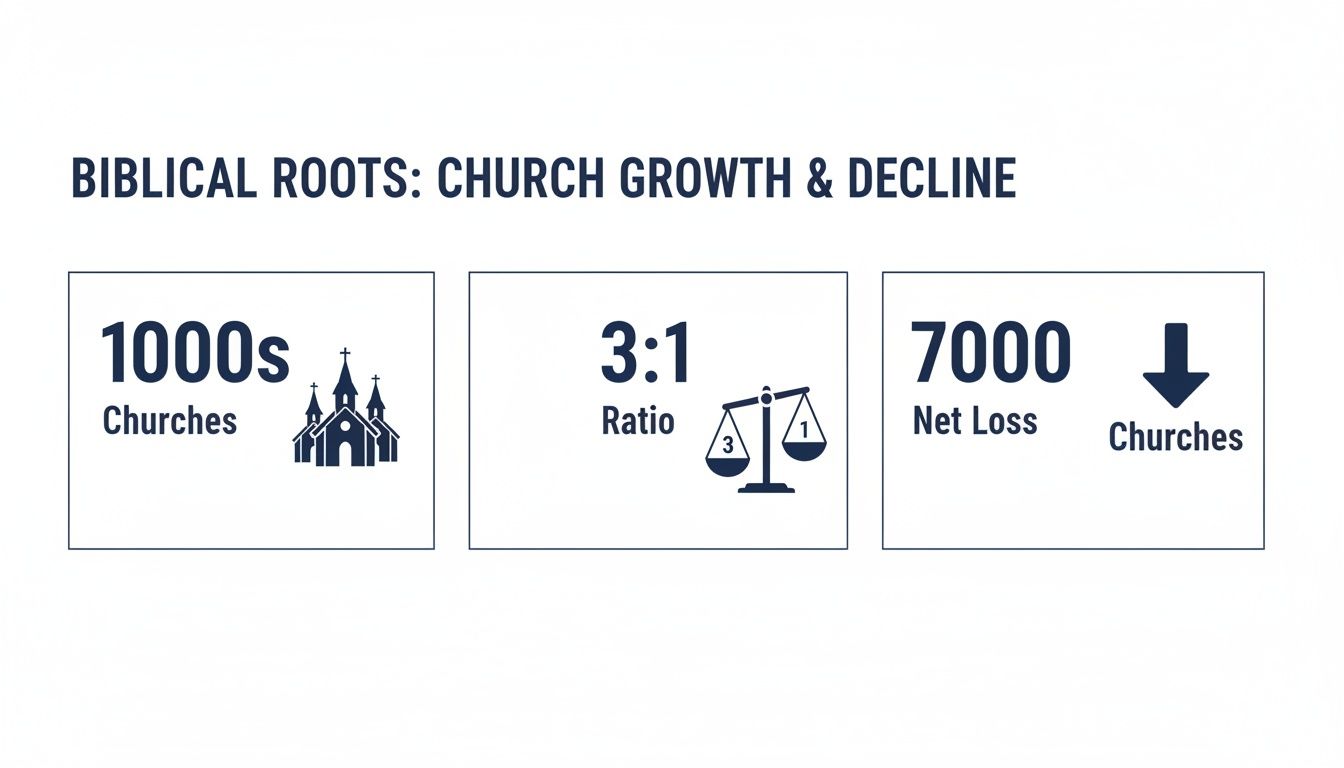
This data shows a critical gap. The only way to close it is with a renewed, passionate commitment to planting new, life-giving congregations.
Responding with Hope and Action
These numbers shouldn't discourage us; they should ignite a fire in our hearts for the mission. They prove that church planting isn’t just one ministry option among many; it is a primary strategy for renewing the spiritual health of our communities and fulfilling the Great Commission in our generation.
Every closed church represents a community that has lost a spiritual lighthouse. Every new church plant represents a new beacon of hope, shining the light of the Gospel into the darkness.
At The Bible Seminary, we see this urgency as a central part of our purpose. Our mission of “equipping leaders to impact the world for Christ” is directly tied to preparing men and women who can answer this call. We believe reversing this trend requires leaders who are deeply grounded in Scripture, spiritually mature, and practically equipped for the unique challenges of pioneering a new work.
The Strategic Impact of New Churches
Why are new churches so vital? Research consistently shows they excel in a few key areas:
Evangelistic Effectiveness: New churches are often more effective at reaching unchurched and dechurched individuals than established congregations.
Community Engagement: Planters must build relationships and serve their neighborhoods, making them naturally outward-focused from day one.
Leadership Development: New churches are fertile ground for raising up new leaders as people step into roles and discover their gifts.
This high-impact nature makes church planting one of the most strategic investments we can make in the future of the Church. It is a proactive, hope-filled response to the spiritual needs around us. The call for more church planters is a call for more missionaries to our own cities and towns—pioneers ready to build something new for the glory of God.
What It Really Takes to Plant a Church
So, what kind of person does it take to build a new church from the ground up? The mission of a church planter demands more than a good idea or a dynamic personality. It calls for a unique fusion of deep-seated character traits and practical skills, all grounded in a vibrant relationship with Jesus Christ.

This isn’t about chasing perfection. It's about pursuing Christ-like maturity. At The Bible Seminary, we believe in uniting scholarship, spiritual formation, and hands-on ministry for this very reason—we know that effective leaders are forged, not just born.
Let’s explore the essential qualities that define a fruitful church planter.
The Bedrock of Godly Character
Before considering strategy or skills, the heart of the planter matters most. The pressure of starting a new ministry will test a leader’s character to its core. Without a solid spiritual foundation, even the best-laid plans will crumble.
A few non-negotiable character traits stand out, echoing the qualifications for elders laid out in Scripture (1 Timothy 3; Titus 1):
Unyielding Faith and Resilience: Church planting is a journey of incredible highs and crushing lows. A planter must have a tenacious faith that trusts God’s sovereignty, even when progress feels invisible. This resilience is born from a deep prayer life and unshakable confidence in the Gospel.
Deep Humility and a Teachable Spirit: A successful planter knows they don’t have all the answers. They must be willing to learn from others, receive correction, and adapt their methods. Humility allows a leader to empower others and give glory to God.
Relational Integrity: A planter builds a church one relationship at a time. This requires genuine care, trustworthiness, and a commitment to living out the Gospel with authenticity. People are drawn to leaders whose lives match their message.
The most powerful tool a church planter has is a life visibly transformed by the grace of Jesus Christ. It is this authentic, lived-out faith that earns the trust of a skeptical world and draws people into a new community of believers.
The Toolkit of Practical Skills
Along with godly character, a planter needs a diverse set of practical skills. This is where theological training meets the real world. Think of Nehemiah—he wasn't only a man of prayer but also a brilliant organizer, motivator, and strategic planner as he rebuilt the walls of Jerusalem.
To be effective, a church planter must cultivate skills in several key areas. We've summarized the most critical ones in the table below.
Key Attributes of a Successful Church Planter
A summary of the core competencies and character traits essential for effective and sustainable church planting ministry.
Attribute Category | Specific Traits & Skills | Biblical Example |
|---|---|---|
Spiritual Foundation | Unyielding faith, resilience, deep prayer life, integrity | Daniel: Maintained steadfast faith and prayer despite intense political and cultural pressure in Babylon. |
Personal Character | Humility, teachable spirit, authenticity, servant heart | Jesus: Modeled the ultimate servant leadership, washing his disciples' feet and putting others first. |
Leadership & Vision | Ability to cast a compelling vision, motivate others, strategic planning | Nehemiah: Articulated a clear vision to rebuild Jerusalem's walls and mobilized the people to accomplish the task. |
Communication | Paul: Adapted his communication style to different audiences, from synagogues to the Areopagus, to clearly teach the Gospel. | |
Relational Skills | Community organizing, outreach, team building, pastoral care | Barnabas: Known as the "Son of Encouragement," he was gifted at building up individuals and connecting people in ministry. |
Entrepreneurial Spirit | Proactive, resourceful, willing to take faith-filled risks | Priscilla & Aquila: Tentmakers who used their trade to support ministry and establish house churches in new cities. |
These attributes work together, forming a leader who is both spiritually deep and practically effective. Let's look closer at some of these skills:
Visionary Leadership: The ability to cast a clear, compelling, and biblically-grounded vision that inspires people to join the mission. For a deeper look, you can read our thoughts on leadership living in a ministry context.
Gifted Communication and Teaching: A planter must teach God’s Word faithfully and apply it to people's lives. This includes preaching, leading small groups, and having one-on-one spiritual conversations.
Community Organizing and Outreach: The skill of turning a vision into a real, breathing community. It involves planning outreach, building a digital presence, mobilizing volunteers, and creating discipleship systems.
Entrepreneurial Drive: In many ways, a church planter is a spiritual entrepreneur. They must be proactive, resourceful, and willing to take calculated, faith-filled risks to see the new church take root and grow.
Ultimately, the ideal church planter embodies the Apostle Paul’s charge to Timothy: “The things you have heard me say in the presence of many witnesses entrust to reliable people who will also be qualified to teach others” (2 Timothy 2:2, NIV). They are disciples who make disciples, leaders who raise up leaders, and pioneers who build communities that will outlast them for the glory of God.
A Practical Roadmap to Becoming a Church Planter
When God places the call to plant a church on your heart, it can be both exhilarating and daunting. The path from that initial divine nudge to launching a new congregation is a journey best walked with prayer, wisdom, and a clear plan.

This isn't a road you travel alone. It demands a solid support system, deep spiritual preparation, and the right practical training. Think of it like preparing for a major expedition—you wouldn’t set out without a map, the right gear, and a seasoned guide.
The Foundational Steps of Preparation
While not a rigid formula, the roadmap to becoming a church planter involves foundational steps that build on one another. Each one is designed to prepare you spiritually, personally, and practically for the mission ahead.
Prayer and Personal Discernment: This is ground zero. The first and most vital step is to soak this calling in prayer. Seek God's confirmation through His Word, wise counsel from trusted spiritual mentors, and honest self-examination. This is a season for listening and ensuring this desire aligns with God’s will.
Assessment and Confirmation: After a season of prayer, the next step is a more formal assessment. Most denominations and church planting networks have tools to help potential planters evaluate their spiritual gifts, character, and skills. This external confirmation from the broader body of Christ is a crucial step.
Gaining Experience: Very few planters succeed by jumping straight into a launch. Serving in a residency or internship at a healthy, multiplying church is invaluable. This is where you learn the day-to-day realities of ministry under the guidance of experienced leaders.
Building Your Support Structure
No church planter is an island. A thriving new church is the fruit of a team effort, supported by a web of crucial relationships. Identifying and cultivating these connections early is key. You can discover more insights about these trends on Carey Nieuwhof's blog.
Key pillars of support include:
A Sending Church: Your home base—the church that formally sends you out, providing spiritual covering, initial funding, and often your first core team members.
Denominational or Network Support: Aligning with a denomination or a church planting network provides access to training, coaching, and a brotherhood of fellow planters.
Financial Partners: Raising support is a spiritual discipline. It requires you to cast a compelling vision that inspires individuals and other churches to invest financially in the new work.
The Indispensable Role of Theological Training
Finally, any solid roadmap must include robust theological and practical training. A deep understanding of Scripture is the fuel that will sustain your ministry through the challenges ahead. This is where formal education becomes a game-changer.
Equipping leaders to impact the world for Christ means providing them with the tools to teach God’s Word faithfully, lead with wisdom, and build a church on the solid rock of biblical truth, not shifting cultural sands.
At The Bible Seminary, our Master of Divinity (M.Div.) and Master of Arts (M.A.) programs are designed for this purpose. We walk you through an in-depth study of all 66 books of the Bible, ensuring you can handle the Word of God with accuracy and confidence. This theological depth, combined with practical ministry courses, prepares you to answer tough questions, disciple new believers, and establish a healthy church leadership structure. You can learn more by exploring our thoughts on choosing a church leadership structure. Aspiring church planters can also greatly benefit from various leadership development programs to equip them with necessary skills.
Your journey to becoming a church planter is one of the greatest adventures of faith. By following this roadmap, you can prepare not just to start a church, but to launch a healthy, lasting community that brings glory to God for generations.
How The Bible Seminary Prepares Church Planters
If you feel God stirring your heart toward the pioneering work of church planting, you are likely asking, “How do I get ready for this?” That’s an important question. The journey demands more than passion—it requires deep spiritual roots, a rock-solid grasp of God's Word, and a toolbox of practical ministry skills.
Here at The Bible Seminary, providing that kind of preparation is our mission.
Our entire approach is built on the conviction that effective ministry flows from a solid theological core. We believe training hearts and minds for kingdom service starts with knowing the whole counsel of God. That’s why our M.Div. and M.A. programs guide you through an in-depth study of all 66 books of the Bible, giving you the confidence to teach God's truth with clarity and grace.
Uniting Scholarship and Hands-On Ministry
We are convinced that what you learn in the classroom must connect directly to real-world ministry. Our philosophy is one of uniting scholarship, spiritual formation, and hands-on ministry.
This means your biblical and theological studies are intentionally paired with practical application. You'll be mentored by faculty who are not just scholars but also seasoned ministry practitioners. They've been in the trenches. While some aspiring church planters seek out specialized institutions like the Springfield Christian College and Theological Seminary, our programs are similarly structured to build those essential, on-the-ground skills. You'll learn not just how to faithfully exegete Scripture, but how to communicate its timeless truths in a way that truly connects with your community.
A Mission With Kingdom Impact
The numbers show just how vital this calling is. One major church planting organization reports that 90% of their church plants are still missionally-engaged and sustainable after 20+ years. This demonstrates the long-term impact of well-prepared leaders.
Church planters are pioneers who blend theology, strategy, and sheer grit. Rigorous training equips them to breathe new life into communities and reach souls around the world.
Equipping leaders to impact the world for Christ isn’t just a slogan for us—it’s the mission that drives everything we do. We are committed to preparing you not just for the launch day of your church, but for a lifetime of faithful, fruitful ministry.
Your training at TBS is designed to forge the theological depth, spiritual resilience, and practical wisdom you'll need to build a healthy, lasting church. If you're exploring God's call, we invite you to take the next step. Our guide on finding your calling in Master's of Divinity programs can offer helpful direction.
We're here to walk with you as you prepare for the incredible adventure of planting a church for God’s glory.
A Few Common Questions About Church Planting
If you're exploring this path, you probably have many questions. To help bring some clarity, we've gathered a few of the most common questions we hear from ministry leaders and prospective students like you.
Do I Really Need a Seminary Degree to Plant a Church?
While it’s true that God can use anyone, regardless of formal education, a solid seminary degree provides the theological depth and biblical grounding that is vital for the long-term health of a new church. Think of it as building a strong foundation before you put up the walls.
A seminary education equips you to teach sound doctrine, counsel your flock with wisdom, and navigate the complex challenges of ministry. Here at The Bible Seminary, our programs are specifically designed to forge that essential foundation for an impactful, lasting ministry.
What’s the Real Difference Between a Church Planter and a Pastor?
This is a great question because the roles overlap. Both are called to shepherd a congregation. However, a church planter is, at their core, an entrepreneur and a missionary rolled into one. They are building something from nothing—a community from the ground up. This demands a unique skillset in evangelism, outreach, strategic planning, and fundraising.
A pastor of an established church typically focuses more on discipleship and administration within an existing structure. While the heart for people is the same, planting requires a distinct pioneering and apostolic gifting.
How in the World Are New Churches Funded?
This is one of the most practical—and often intimidating—questions. Typically, new church plants are funded through a mix of sources. This often includes initial support from a sending church or a denomination, personal fundraising from a network of individual partners, and, eventually, the tithes and offerings of the new congregation itself.
A key skill of a successful planter is the ability to cast a compelling, God-given vision that inspires others to partner with them financially, especially in those critical early stages.
I Feel a Stirring to Plant a Church. What's My First Step?
If you feel that call, the very first step is always prayer and discernment. Don't rush. Soak your desires in prayer and seek wise counsel from your pastor and other trusted Christian mentors who know you well. At the same time, dive into what Scripture says about the mission and nature of the church.
Your next practical step is to pursue assessment and formal training. Exploring a degree at a place like The Bible Seminary can provide the structured learning environment and like-minded community you need to clarify your calling and get the tools you'll need for the long journey ahead. We are here to help you train both your heart and your mind for effective Kingdom service.
At The Bible Seminary, our passion is to equip leaders like you to make a real impact on the world for Christ. If you're exploring a call to ministry, we invite you to see how our robust, Bible-centered programs can prepare you for whatever God has ahead.