
How to Prepare for a Sermon That Connects

Preparing a sermon is a two-sided coin: you have the deep spiritual communion on one side and the diligent academic study on the other. But let's be clear—the foundation of any message that actually connects isn't first found in commentaries or outlines. It's built in personal prayer, in the quiet moments where you let the scripture shape your heart before you ever think about shaping a message for others.
This initial spiritual work is what turns a well-researched lecture into a Spirit-led encounter. It's absolutely non-negotiable.
Laying the Spiritual Groundwork for Your Sermon
Before you even think about cracking open a commentary or sketching out an outline, the most critical part of sermon prep has to happen. This isn’t just an item on a to-do list; it’s the engine that powers a message with real impact. It’s all about shifting your mindset from, "What am I going to say?" to the much more important question, "God, what are you saying?"
This is what separates an authentic, Spirit-led message from just another public speaking gig.
It all starts with prayer, but not some generic request for a "good sermon." I’m talking about a genuine dialogue. It means laying your own questions, your personal struggles, and the very real needs of your congregation before God as you wrestle with the text. This kind of prayer forces humility and dependence. It positions you as a conduit for a divine message, not its sole creator.
Moving from Reading to Receiving
A sermon that’s only prepared in the head rarely reaches the heart. The spiritual groundwork demands that you let the passage speak to you long before you try to make it speak to anyone else. This means sitting with the text in personal meditation, allowing its truths to challenge and comfort your own soul first.
This isn’t about hunting for sermon points; it’s about an encounter with God. To really deepen your own engagement with the text, try a few of these practices:
Pray Through the Passage: Literally turn the words of the scripture into your own prayer. Ask God to shine a light on its meaning and apply it directly to your life, right here, right now.
Practice Lectio Divina: Read the passage slowly, maybe three or four times, just listening for a single word or phrase that seems to jump out. Meditate on that piece and ask what God might be trying to communicate to you through it.
Journal Your Reflections: Get it all down on paper—your honest reactions, your nagging questions, any new insights. The physical act of writing has a way of clarifying your thoughts and revealing deeper layers of meaning you might otherwise skim right over.
This personal application is everything. If a passage on forgiveness doesn't convict you of your own need to forgive, how can you authentically call others to do the same? Believe me, the congregation can sense the difference between a preacher who is teaching from personal experience and one who is just relaying information they read.
"One reason 'Johnny Can’t Preach' is because Johnny isn’t godly and doesn’t understand people. Some may need to get into their study, but others may need to get out of their study and show that the fruit of the Spirit is evident in their life."
This insight is a powerful reminder that spiritual preparation isn’t confined to a quiet study. It happens in the messiness of a life lived in communion with God and in real community with other people.
Cultivating a Receptive Heart
Ultimately, how you prepare a sermon comes down to posture. It’s about approaching God's Word with a heart that is receptive, open, and ready to obey.
This spiritual prep is what fills your well. So when you finally turn to the academic work of exegesis and structuring, you're drawing from a place of genuine spiritual conviction. It ensures your message is built on the solid rock of a personal encounter with the living God—and that’s the only foundation strong enough to support a sermon that truly changes lives. This groundwork makes all the difference.
Uncovering the Meaning Through Biblical Exegesis
After laying the spiritual groundwork, it's time to shift gears from personal reception to academic investigation. This is the scholarly heavy lifting we call biblical exegesis.
It might sound intimidating, but exegesis simply means “to draw out” the original meaning from a biblical text. The goal here is to understand what the passage meant to its first audience before you can ever hope to figure out what it means for your congregation today. This disciplined study gives your sermon an unshakable theological core and keeps you from accidentally reading your own ideas into the scripture.
Make no mistake, this is the most time-consuming part of the process, but it's absolutely essential.
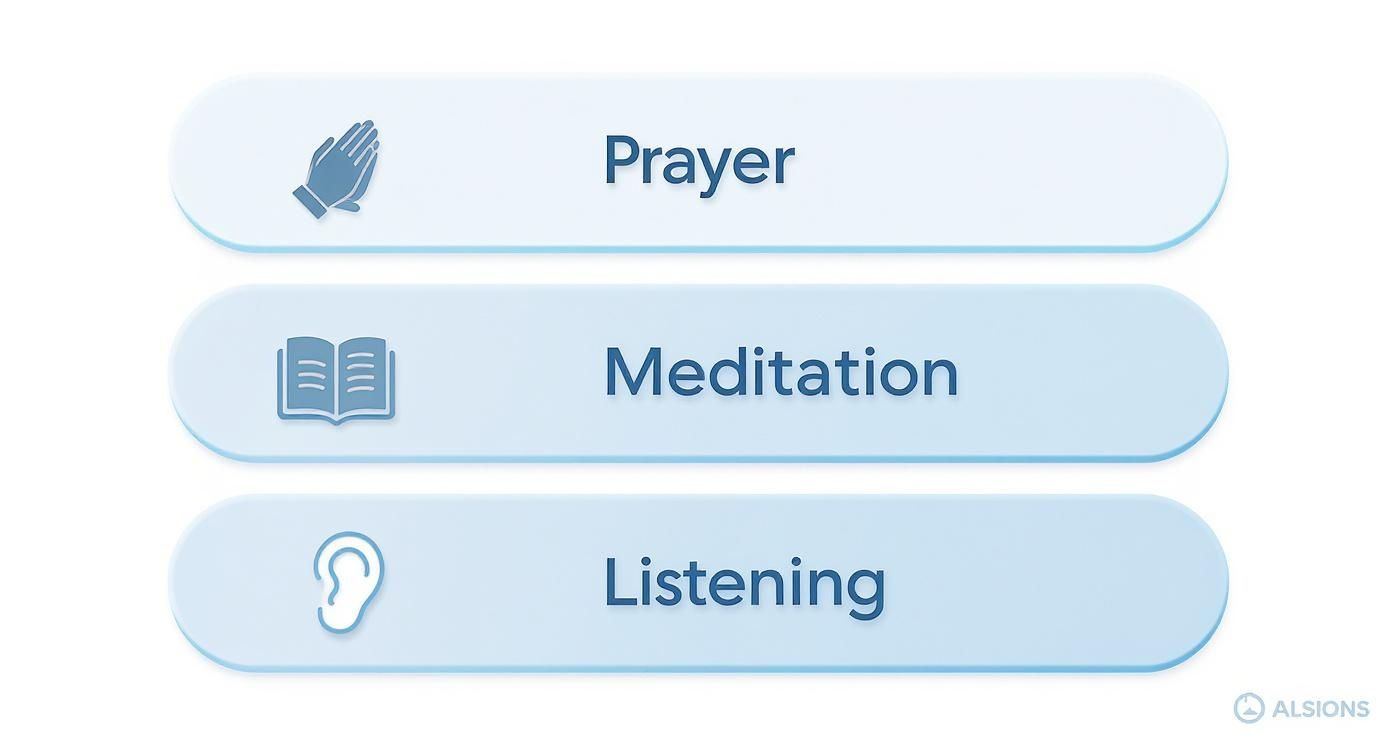
Prayer, meditation, and listening are the foundational pillars you build your exegesis upon. One flows directly into the other.
Investigating the Historical and Literary Context
Every passage in the Bible was written in a specific time, to a specific culture, for a specific purpose. Ignoring this context is one of the fastest routes to misinterpreting scripture.
So, where do you start? Begin by asking some foundational questions to ground your understanding. Who wrote this? Who were they writing to? What was going on in the world at that time that might have influenced the message? Answering these questions paints the necessary backdrop for an accurate interpretation.
From there, you have to consider the literary context. Ask yourself what genre you're reading. Is it a historical narrative, poetry, prophecy, law, or an epistle? The genre fundamentally shapes how you read and interpret the text. You wouldn't read a Psalm the same way you'd read a chapter in Leviticus, right? Recognizing the literary style keeps you from making rookie mistakes, like taking a poetic metaphor literally.
Performing Insightful Word Studies
Words matter. Digging into the original Greek or Hebrew can unlock layers of meaning you'd otherwise miss. And thankfully, you don't need to be a language scholar to do effective word studies anymore.
Accessible digital tools like Blue Letter Bible or BibleHub are game-changers. They allow you to look up original words, see how they’re used elsewhere in Scripture, and explore their full range of meaning.
A word of caution, though: avoid the temptation to build an entire theological point on a single, obscure definition of a word. The real goal is to see how a word is used in context—both within your passage and throughout the author's other writings. This practice adds precision and depth to your sermon. For more on this, our guide on how to read the Bible for all it's worth offers some great strategies.
The real danger is not in doing a word study, but in doing a sloppy one. A careful look at the original language should illuminate the text, not become a platform for a novel idea disconnected from the author's intent.
This principle will keep your exegesis grounded and your sermon faithful to the text.
Analyzing Grammar and Sentence Structure
Sometimes the most profound insights are hiding in plain sight—right in the way a sentence is put together. Pay close attention to the grammar of the passage.
Look for connecting words like "for," "therefore," and "but." These little words are huge clues, revealing the logical relationships between ideas.
Also, try to identify the main verbs and subjects in key sentences. This simple exercise can help you pinpoint the central action or focus of a paragraph. Don't be afraid to actually diagram a complex sentence on a piece of paper. It might feel like you're back in middle school English, but this simple act can untangle complicated thoughts and reveal the author's main point with surprising clarity.
This meticulous, detailed work is a huge part of why sermon prep is so intensive.
Sermon Preparation Time Breakdown
A poll from SermonCentral.com gives a clear picture of just how much time pastors pour into this process each week.
Time Spent per Sermon | Percentage of Pastors |
|---|---|
1-3 hours | 2% |
4-6 hours | 7% |
7-9 hours | 10% |
10-12 hours | 11% |
13-15 hours | 24% |
16-18 hours | 23% |
19-21 hours | 10% |
22-25 hours | 7% |
25+ hours | 6% |
As you can see, nearly 70% of pastors dedicate between 10 to 18 hours to preparing a single sermon, with the largest groups spending 13-15 hours (24%) and 16-18 hours (23%). This underscores that deep exegetical work isn't a luxury; it's a major, non-negotiable part of pastoral ministry.
This detailed exegetical work ensures your sermon is built on the solid rock of authorial intent, creating a message that has both integrity and authority. It’s the bridge that connects your spiritual preparation to the final crafting of a message that will speak truth to your people.
Connecting Ancient Truths to Modern Listeners
You’ve done the hard work of exegesis. You’ve wrestled with the text, studied the original language, and now have a solid grip on what the passage meant to its first audience. That’s a huge win, but it’s only half the battle.
A sermon that stops there risks becoming a history lesson—accurate, but ultimately sterile. The next step is where the rubber meets the road. It’s about building a sturdy bridge from that ancient world into the everyday reality of your listeners.
This is the art of application. We have to identify the timeless theological truths woven into the fabric of the passage and then translate them into practical, life-altering takeaways. This is what makes a 2,000-year-old text feel like it was written directly for the person sitting in the back row this Sunday morning. This is how a sermon truly connects.
Finding the Timeless Principle
Before you can apply a passage, you have to distill its core, universal truth. I’m talking about the theological principle that rises above culture, time, and specific circumstances. It’s the essential "so what?" that links their world to ours.
To find that principle, ask some hard questions about the passage you’re preaching:
What does this text reveal about the character and nature of God?
What is it teaching me about humanity, our fallenness, or our need for a Savior?
What facet of the gospel or God’s overarching redemptive plan is on display here?
Is there a command, a promise, or a warning that applies to all believers in every era?
Think about a passage like Israel’s idolatry with the golden calf. It’s more than just a historical account of a specific sin. The timeless principle might be that human hearts are idol factories, prone to create and worship substitutes for God, especially when we feel uncertain or afraid. That truth is just as relevant in our world of careerism, materialism, and social media validation as it was in the ancient Sinai desert.
Moving from Principle to Specific Application
Once you’ve nailed down that timeless truth, you have to ground it in the concrete realities of your listeners' lives. This is where truly knowing your congregation is non-negotiable. You have to move from the general principle to specific, actionable steps.
Think about the unique challenges, hopes, and struggles your community is facing right now. How does the timeless truth of the passage speak directly into their situation?
The goal is to move beyond cheap moralism—you know, the "try harder" or "be better" sermons—and point people back to the gospel. Application isn't about behavior modification. It’s about heart transformation that flows from a deeper understanding of our desperate need for Christ and His all-sufficient provision for us.
Let's go back to that principle of modern idolatry. You wouldn't just tell people, "Don't have idols." That’s not helpful. Instead, you could ask probing, personal questions that get under the surface:
Where do you run for security when your job feels unstable or your future looks bleak?
What do you look to for validation when you feel unseen or unappreciated by others?
How does your use of social media shape your sense of identity and self-worth?
Questions like these guide your listeners to connect the biblical truth to their own lived experience. That’s what makes a sermon personal and penetrating. And that kind of genuine relevance has never been more critical.
The world’s Christian population is projected to hit 3 billion by 2050. Yet, in places like the United States, church attendance habits have shifted dramatically. While nearly 50% of people went to church weekly as kids, only about 20% maintain that practice as adults. This shift tells us something important: people aren’t just showing up out of habit anymore. They are actively looking for value and relevance, and a sermon that connects ancient truth to their modern lives is exactly what they need. You can learn more about church statistics and what they mean for ministry today.
Using Illustrations That Illuminate
Good illustrations are the windows of a sermon—they let the light in. A well-chosen story or a real-world scenario can make an abstract theological concept suddenly feel crystal clear.
Your own life is one of the best sources. A story about a personal struggle with impatience will resonate far more deeply than some generic example you pulled from a book.
Try to mix it up and keep your message engaging with different kinds of illustrations:
Personal anecdotes: Share stories of your own successes and, more importantly, your failures. Vulnerability builds connection.
Current events or cultural references: Show how the biblical text speaks into something everyone is already talking about.
Historical examples: Use stories from church history or world events to demonstrate the timelessness of a principle.
Imaginary scenarios: Craft a relatable "what if" story that helps people imagine themselves within the biblical narrative.
The key to all of this is authenticity. Your listeners can spot a fake, manufactured story from a mile away. Use real, honest examples to show how the timeless truth of Scripture intersects with the messy, beautiful reality of our everyday lives.
Crafting a Sermon Structure That Sticks
Even the most profound biblical insights can fall flat if they're presented in a confusing, disorganized, or predictable way. After you’ve done the spiritual groundwork and the exegetical digging, the next vital step is building a framework for your message. Think of this structure as the trellis that helps the vine of God’s truth grow, making it accessible and memorable for your listeners.
This is about more than just slapping together a tidy three-point outline. It's about designing an intentional journey for your congregation—one with a compelling start, a logical flow, and a powerful finish that prompts a real response. A solid structure gives your sermon clarity and helps the central truth stick with people long after they’ve left the building.
Capturing Attention with a Powerful Introduction
You’ve got about thirty seconds. That's it. In that brief window, you have to give your listeners a compelling reason to lean in and engage. A weak opening risks losing them before you’ve even gotten to the heart of the message.
Your introduction needs to do two things: grab their attention and introduce the problem or tension the sermon will resolve. You’re essentially creating an itch that only the biblical text can scratch.
Here are a few tried-and-true approaches for a strong opening:
Start with a relatable story. A personal anecdote or a compelling narrative can instantly illustrate the core human dilemma your passage addresses.
Pose a provocative question. Ask something that makes your listeners think and immediately connects with their own experiences or beliefs.
Share a surprising statistic or fact. A startling piece of information can pique curiosity and set the stage for your message in a powerful way.
Whatever you choose, make sure it connects directly to your sermon's main idea. The introduction is a promise you make to your audience about what’s to come, so make it a good one.
Choosing a Sermon Model That Fits the Text
The classic three-point deductive sermon is a reliable tool, but it’s not the only one in the toolbox. The best structure is often the one that flows most naturally from the biblical text itself. Forcing a narrative passage into a three-point outline can strip it of its power, just as an inductive approach might obscure a direct command.
Exploring different models can bring new life and authenticity to your preaching.
Common Sermon Structures
Structure Type | Best For... | Example |
|---|---|---|
Deductive | Teaching clear doctrines or commands. You state the main point upfront and then support it with sub-points. | "God is faithful, and here are three ways we see His faithfulness in this passage." |
Inductive | Exploring a question or mystery with the congregation, leading them to a conclusion discovered together. | "Why did Jesus respond this way? Let's walk through the scene together to find out." |
Narrative | Preaching from stories. You retell the biblical narrative, letting its inherent plot, characters, and climax deliver the message. | Retelling the story of David and Goliath, focusing on the rising tension and dramatic resolution. |
Let the passage guide your choice. The goal is to select a structure that honors the text's original form and makes its truth as clear as possible. The Blog expression for impact offers further thoughts on how form and delivery shape your message's reception. To see how other public speakers craft their messages for maximum effect, you might also look at professional script examples for spoken word delivery for inspiration.
The sermon's structure isn't just a container for the content; it's part of the message itself. A well-chosen structure can make the journey from introduction to conclusion feel both inevitable and illuminating.
This principle is key. The right framework makes the message feel cohesive and purposeful. This sense of cohesion is often enhanced by long-term planning. Expert preaching resources emphasize the benefits of systematic planning, like having a yearly sermon calendar prepared months in advance. This approach fosters peace of mind, allowing for deeper theological reflection and more thoughtful messaging. You can discover more insights on strategic sermon planning to see how it benefits the entire process.
Designing a Conclusion That Inspires Action
A sermon should never just fade out. The conclusion is your final opportunity to drive the central message home and call for a specific response. It’s where you answer the crucial "So what now?" question that should be on every listener’s mind.
A powerful conclusion summarizes the main idea in a fresh, memorable way and then clearly articulates what you’re asking the congregation to do, think, feel, or believe as a result of hearing God's Word.
Avoid introducing new ideas here. Instead, circle back to the tension you created in the introduction and show how the gospel, as revealed in your text, is the ultimate resolution. Whether it's a call to repentance, an encouragement to trust, or a challenge to serve, make the final moments of your sermon clear, compelling, and Christ-centered.
Moving from the Study to the Pulpit

All those hours spent in prayer, digging through the text, and wrestling with structure have led to this moment. Now comes the final—and for many, the most intimidating—step: bringing that message to life in front of the congregation.
This isn't about simply reading your notes. It's about moving from being a student of the Word to its messenger, embodying the truth you've uncovered with Spirit-led confidence. Without this intentional shift to delivery, all that careful study can get lost in a hesitant or disconnected presentation.
Finding Your Delivery Style
One of the first practical decisions is what to bring with you to the pulpit. There's no single "right" answer when choosing between a full manuscript and a brief outline; it’s about what serves you best in communicating God's Word with clarity and passion.
A full manuscript provides precision. When you're tackling sensitive or theologically complex topics, having every word carefully chosen can be a huge comfort. It keeps you on track and ensures you say exactly what you mean. The risk? You can easily sound like you’re reading an essay instead of preaching a sermon, which puts a wall between you and the listeners.
A brief outline, on the other hand, encourages a more conversational, engaging style. It gives you signposts and structure while leaving room for the Spirit to move in the moment. The downside is the potential to lose your place or forget a critical point under pressure. My advice is to experiment with both to find the balance that lets you be faithful to the text and authentic in your delivery.
Rehearsing for Internalization, Not Memorization
The word "rehearsal" might sound like you're preparing for a stage performance, but in preaching, its purpose is internalization. The aim isn't to memorize a script. It’s to absorb the message so deeply—its logic, its flow, its emotional heartbeat—that it becomes a part of you. You want to own the sermon in your heart, not just hold it on a piece of paper.
Here are a few ways to rehearse that actually work:
Preach to an empty room. Seriously. Hearing the words out loud is the fastest way to find the natural rhythm of the sermon and catch those clunky phrases that looked fine on the page.
Time yourself. This is a simple act of respect for your congregation's time and helps you fit within the flow of the service.
Nail your transitions. Know exactly how you're going to get from one point to the next. Smooth transitions are the glue that holds a sermon together, guiding your listeners on a clear journey.
Rehearsal isn't about a flawless performance. It’s about building the confidence to get your eyes off your notes so you can focus on your people and depend on the Spirit.
That shift is what makes a sermon feel alive and powerful, not stiff and recited.
Mastering Your Non-Verbal Communication
A huge part of your message is sent before you even open your mouth. Your tone of voice, your pacing, even your posture—they are all powerful tools that can either reinforce the truth you're proclaiming or completely undermine it. This is where investing in your public speaking and presentation skills pays huge dividends.
Pay attention to these crucial elements:
Vocal Variety: Nothing kills a sermon faster than a monotone voice. Vary your pitch, volume, and speed to add emphasis and keep people engaged.
Intentional Pauses: Don't be afraid of silence. A well-placed pause right before a key takeaway builds anticipation and gives people a moment to let the truth sink in.
Body Language: Stand with a posture that communicates confidence. Make eye contact with different people around the room. Use natural gestures that match what you're saying. Your physical presence should scream, "I believe this!"
A great way to practice these skills is through the discipline of reading Scripture publicly. For more on that, you're invited to join us in-person or online for the public reading of Scripture. When you intentionally practice these elements, you prepare yourself to deliver God's Word with the power and authenticity it demands.
Common Questions on Preparing Your Sermon
Even with a solid game plan, you're always going to run into practical questions as you get into the weekly rhythm of sermon prep. You'll find yourself making judgment calls on timing, what tools to use, and how to develop your own unique style behind the pulpit.
Think of this section as a conversation starter, answering some of the most common questions pastors wrestle with. There's no single perfect formula, but these insights can bring some real clarity and confidence to your weekly efforts.
How Far in Advance Should I Start Preparing?
This is a great question. Ideally, you want to start praying over and doing your initial reading of the text at least two weeks out. That gives the core themes and big ideas enough time to really sink in—to marinate in your mind and spirit. You'll be surprised what insights pop up when you're not rushing.
When it comes to the heavier lifting—the deep exegesis and structuring of the message—you’ll want to get that started about 7-10 days before you preach. Building in this buffer helps you avoid that last-minute scramble that almost always leads to a shallow sermon.
For a real game-changer, try planning an entire sermon series months in advance. It lets you build richer thematic connections and dramatically cuts down your weekly stress.
A sermon prepared in a hurry often sounds like it. Giving yourself margin isn't a luxury; it's a critical component of crafting a message that feels thoughtful, Spirit-led, and deeply considered.
What Are the Best Tools for Biblical Exegesis?
For pastors who are serious about deep, faithful biblical study, investing in professional-grade Bible software is a huge help. Tools like Logos or Accordance are invaluable; they put original languages, a massive library of commentaries, and powerful lexical tools all right at your fingertips.
But don't feel like you're out of luck if the budget is tight. There are some fantastic free resources that can take your study to the next level:
Blue Letter Bible: An incredible tool for word studies and cross-referencing Scripture. Its built-in concordances and lexicons are top-notch.
BibleHub: Perfect for comparing multiple translations side-by-side. It also gives you access to a wide array of classic and modern commentaries.
And let’s not forget the power of a good old-fashioned physical library. A solid Bible dictionary, a theological dictionary, and a few trusted commentary series are companions no preacher should be without.
How Do I Preach on a Difficult or Unfamiliar Passage?
Stepping up to preach a challenging text requires two things: a good dose of humility and extra diligence in your study. First off, block out significantly more time for prayer and study, asking God to grant you wisdom and clarity. It's also not a bad idea to be transparent with your congregation and acknowledge the text's difficulties right from the start.
Make it a point to consult several respected commentaries, especially from different theological perspectives. This will help you see the full range of scholarly interpretations and keep you from presenting one narrow view as the final word.
When you finally sit down to write, focus on the most central, identifiable theological truth you can confidently stand on. It’s always better to preach with conviction on one clear point than to speculate about many unclear ones.
Should I Use a Manuscript, an Outline, or No Notes?
Honestly, this comes down to your personal style and what helps you connect with your people most effectively. Each approach has its own strengths.
Full Manuscript: This gives you precision and control, which is perfect for tackling complex or sensitive topics. The big risk, of course, is sounding robotic or like you're just reading to the congregation.
Detailed Outline: This is a great middle ground. It provides the structure and key phrases you need while giving you the freedom for a more conversational, flexible delivery. A lot of preachers find their sweet spot here.
No Notes: This can feel incredibly authentic and engaging when done well. But it absolutely requires that you’ve deeply internalized the message and rehearsed it extensively. You have to know the sermon in your heart, not just in your head.
At the end of the day, the best method is whichever one frees you to connect with your listeners and deliver God's Word with clarity and Spirit-led passion.
At The Bible Seminary, we are dedicated to equipping ministry leaders with the tools for deep, faithful biblical interpretation and powerful preaching. Our graduate programs are designed to move you from the study to the pulpit with confidence and conviction.

