
What Is Pneumatology? A Guide to the Study of the Holy Spirit

If you've spent time in church or theological circles, you have probably heard the term pneumatology. It might sound academic, but it's the study of the Holy Spirit—who He is, what He does, and how He works in our lives and in the world.
The word comes from the Greek term pneuma, which can mean "breath," "wind," or "spirit." It’s a beautifully fitting word for the third person of the Trinity, capturing both His unseen power and His life-giving presence. For us at The Bible Seminary, understanding pneumatology isn't just an intellectual exercise; it has massive implications for your faith, spiritual growth, and ministry effectiveness.
Grasping the Unseen God

Trying to understand the Holy Spirit can feel a bit like trying to catch the wind. We see His effects and feel His presence, yet His divine nature remains a profound mystery. Jesus Himself drew this parallel when talking with Nicodemus.
“The wind blows where it pleases, and you hear its sound, but you don’t know where it comes from or where it is going. So it is with everyone born of the Spirit” (John 3:8, CSB).
This illustration hits on a core truth: the Holy Spirit is both powerfully active and wonderfully mysterious. Pneumatology is our humble, faith-filled effort to explore what Scripture reveals about Him. It pulls us away from abstract ideas and invites you into a deeper relationship with the Spirit who convicts, comforts, guides, and empowers us.
A Quick Look at Key Areas
To make this study more concrete, it helps to break it down into its main components. The table below offers a snapshot of the core topics within pneumatology.
Key Aspects of Pneumatology at a Glance
Area of Study | Description | Biblical Example |
|---|---|---|
Personhood of the Spirit | Examining the biblical evidence for the Holy Spirit as a distinct, divine person with intellect, emotion, and will—not just an impersonal force. | "And do not grieve the Holy Spirit of God..." (Ephesians 4:30) |
Deity of the Spirit | Affirming the Spirit's full divinity as a co-equal member of the Trinity, possessing divine attributes and performing divine works. | "But Peter said, 'Ananias, why has Satan filled your heart to lie to the Holy Spirit...? You have not lied to men but to God.'" (Acts 5:3-4) |
Work in the Old Testament | Exploring the Spirit's role in creation, empowering leaders and prophets, and inspiring the Scriptures. | "The Spirit of God has made me, and the breath of the Almighty gives me life." (Job 33:4) |
Work in the Life of Christ | Understanding the Spirit's unique relationship with Jesus—His conception, baptism, ministry, and resurrection. | "...how God anointed Jesus of Nazareth with the Holy Spirit and with power." (Acts 10:38) |
Work in Salvation | Focusing on the Spirit's essential role in drawing people to Christ, regenerating them, and sealing them for salvation. | "...he saved us, not because of works done by us in righteousness, but according to his own mercy, by the washing of regeneration and renewal of the Holy Spirit." (Titus 3:5) |
The Gifts of the Spirit | Studying the spiritual gifts (charismata) given to believers for the building up of the church and the advancement of the gospel. | "Now there are varieties of gifts, but the same Spirit..." (1 Corinthians 12:4) |
The Spirit-Filled Life | Investigating the ongoing process of sanctification, where believers are led, filled, and empowered by the Spirit to live a godly life. | "But I say, walk by the Spirit, and you will not gratify the desires of the flesh." (Galatians 5:16) |
This framework shows how pneumatology touches every aspect of the Christian experience, from the moment of your salvation to your daily walk with God.
Foundations of Pneumatology
The study of the Holy Spirit isn’t a new trend; it has deep roots reaching back to the earliest days of the church. Pivotal figures like Athanasius of Alexandria helped shape its foundational doctrines amid intense theological debates. Though he was exiled multiple times—including a dramatic raid on his church by 5,000 soldiers in 356 AD—his work solidified the core understanding of the Holy Spirit's essential role in salvation. You can learn more about the development of early pneumatology in historical resources.
A healthy pneumatology is grounded in the entirety of Scripture. It helps us answer vital questions that shape your Christian walk, such as:
Who is the Holy Spirit? Exploring His divine nature and personhood as a member of the Trinity.
What does the Holy Spirit do? Understanding His work in creation, salvation, sanctification, and the life of the church.
How do we relate to the Holy Spirit? Living a life that is filled, led, and empowered by Him.
Not Just for Scholars
At The Bible Seminary, we believe that understanding the Holy Spirit is fundamental for every believer, not just academics in an ivory tower. A robust, Bible-based pneumatology is crucial for anyone preparing for ministry or simply seeking to grow in their faith.
It's the bridge that connects theological knowledge to vibrant, Spirit-led living. It shapes how we pray, worship, serve, and share the gospel. This journey into what is pneumatology is a vital part of training hearts and minds for kingdom service.
The Holy Spirit in the Bible: From Genesis to Revelation
To truly grasp pneumatology, you have to start with the Bible itself. The story of the Holy Spirit isn’t just a New Testament phenomenon; it’s a golden thread woven through the entire biblical narrative, from the very first page to the last. His work unfolds progressively, revealing God's consistent plan through the ages.
This journey through all 66 books is foundational to how we train pastors and leaders at The Bible Seminary.
Right from the second verse of the Bible, the Spirit is on the scene, active and present. Before God even spoke light into existence, we find this powerful image of divine order emerging from primordial chaos.
“The earth was without form and void, and darkness was over the face of the deep. And the Spirit of God was hovering over the face of the waters” (Genesis 1:2, ESV).
This isn't a passive role. The Spirit is the active agent of God, bringing life and purpose to creation. This first appearance establishes Him as eternally present and intimately involved in God’s work from the very beginning.
Empowering Leaders and Prophets in the Old Testament
Throughout the Old Testament, the Holy Spirit comes upon specific people for specific tasks. Think of it as a divine empowerment for a particular service—an anointing that equipped them for roles they simply couldn't fulfill in their own strength. It was a clear sign of God's favor and calling.
We see this happen in a few different ways:
Creative Skill: God filled Bezalel with the Spirit, giving him supernatural wisdom and skill to craft the intricate designs of the tabernacle (Exodus 31:3). This wasn’t just raw talent; it was divinely inspired artistry.
Wise Leadership: How did Joseph interpret Pharaoh's dreams and save a nation from famine? He was a man "in whom is the Spirit of God" (Genesis 41:38). His wisdom wasn't his own.
Prophetic Proclamation: The Spirit of the Lord came upon prophets like Isaiah, Jeremiah, and Ezekiel, compelling them to speak God’s authoritative word. David himself recognized this divine inspiration, saying, "The Spirit of the LORD speaks by me; his word is on my tongue" (2 Samuel 23:2).
These accounts make it clear that the Spirit has always been at work, preparing God’s people and advancing His redemptive plan forward, long before the dramatic events of Pentecost.
The Spirit in the New Testament
The arrival of Jesus Christ marks a major shift in the Spirit’s ministry. He is central to every single stage of Jesus’s life—from His miraculous conception by the Spirit (Luke 1:35) to His baptism, where the Spirit descended on Him like a dove (Matthew 3:16).
Jesus promised that after He left, He would send the Spirit as the Paraclete—a Greek word packed with meaning: advocate, comforter, and helper. That promise was spectacularly fulfilled at Pentecost, an event that utterly transformed the timid disciples and launched the global mission of the church.
“But you will receive power when the Holy Spirit has come upon you, and you will be my witnesses in Jerusalem and in all Judea and Samaria, and to the end of the earth” (Acts 1:8, ESV).
From that point on, the Spirit’s presence was no longer limited to select leaders for temporary tasks. His presence was now promised to all believers as a permanent, indwelling guide.
He now empowers our witness, produces spiritual fruit in our lives (Galatians 5:22-23), and distributes spiritual gifts to build up the body of Christ. He is the one who convicts the world of sin, regenerates our dead hearts, and seals us for the day of redemption (Ephesians 1:13-14).
When you trace the Spirit's work from Genesis to Revelation, you see a beautiful, unified story. It’s the story of God’s personal presence with His people, equipping every generation to fulfill His purposes. This is why a biblical-theological approach is so critical—it grounds every aspect of ministry in the full counsel of God’s Word.
How Christian Thinkers Have Understood the Spirit
Our grasp of who the Holy Spirit is wasn't just handed down in a single, neat package. It was forged over centuries of prayer, intense debate, and a deep desire to know God as He revealed Himself in Scripture. This journey through the history of pneumatology is a powerful story, underscoring why historical theology is so critical for training leaders to bring timeless wisdom into today's ministry challenges.
Laying the Foundation in the Early Church
In the first few centuries after Christ, the church found itself fighting off various ideas about God's nature. Fierce debates erupted over the divinity of both the Son and the Spirit. Was the Holy Spirit a created being? A lesser force? Or was He truly and fully God?
These weren't just academic squabbles; they struck at the very heart of the Christian faith. The questions eventually came to a head at major church councils. The first, the Council of Nicaea (325 AD), was laser-focused on affirming that Jesus Christ is fully God. The creed they developed, however, ended with a surprisingly simple statement: "And in the Holy Ghost." It was a start, but the Spirit’s role and identity needed a much clearer defense.
That crucial work was taken up by a trio of brilliant theologians known as the Cappadocian Fathers—Basil the Great, Gregory of Nyssa, and Gregory of Nazianzus. They masterfully explained the orthodox view of the Trinity: God is one essence (ousia) existing in three distinct persons (hypostases). Their thinking was vital in shaping the language used at the Council of Constantinople (381 AD), which expanded the Nicene Creed to give the Holy Spirit his proper due:
We believe in the Holy Spirit, the Lord, the giver of life, who proceeds from the Father, who with the Father and the Son is worshiped and glorified, who has spoken through the prophets.
This declaration was a landmark moment. It settled the issue for historic Christian orthodoxy, affirming once and for all that the Holy Spirit is co-equal and co-eternal with the Father and the Son.
Reformation Insights on the Word and Spirit
Fast forward a few centuries, and the Protestant Reformation sparked a renewed focus on the Holy Spirit's work, especially His connection to Scripture and salvation. Leaders like Martin Luther and John Calvin pushed back hard against any teaching that tried to separate the Spirit from the written Word of God.
Martin Luther drove home the point that the Holy Spirit is the one who makes the gospel effective in our lives. He argued that no one can come to Jesus by their own power or intellect; it is the Holy Spirit who calls us through the gospel, illuminates our minds, and sets us apart in faith.
John Calvin is often called the “theologian of the Holy Spirit” for a reason—he wrote extensively on the topic. He emphasized the internal testimony of the Holy Spirit: the idea that the Spirit Himself persuades our hearts that the Bible is God's authoritative Word. For Calvin, the Spirit and Scripture were inseparable partners. The Spirit illuminates the meaning of the Word, and the Word channels our understanding of the Spirit.
This timeline helps visualize how the Spirit's work has been progressively revealed and understood throughout biblical history.
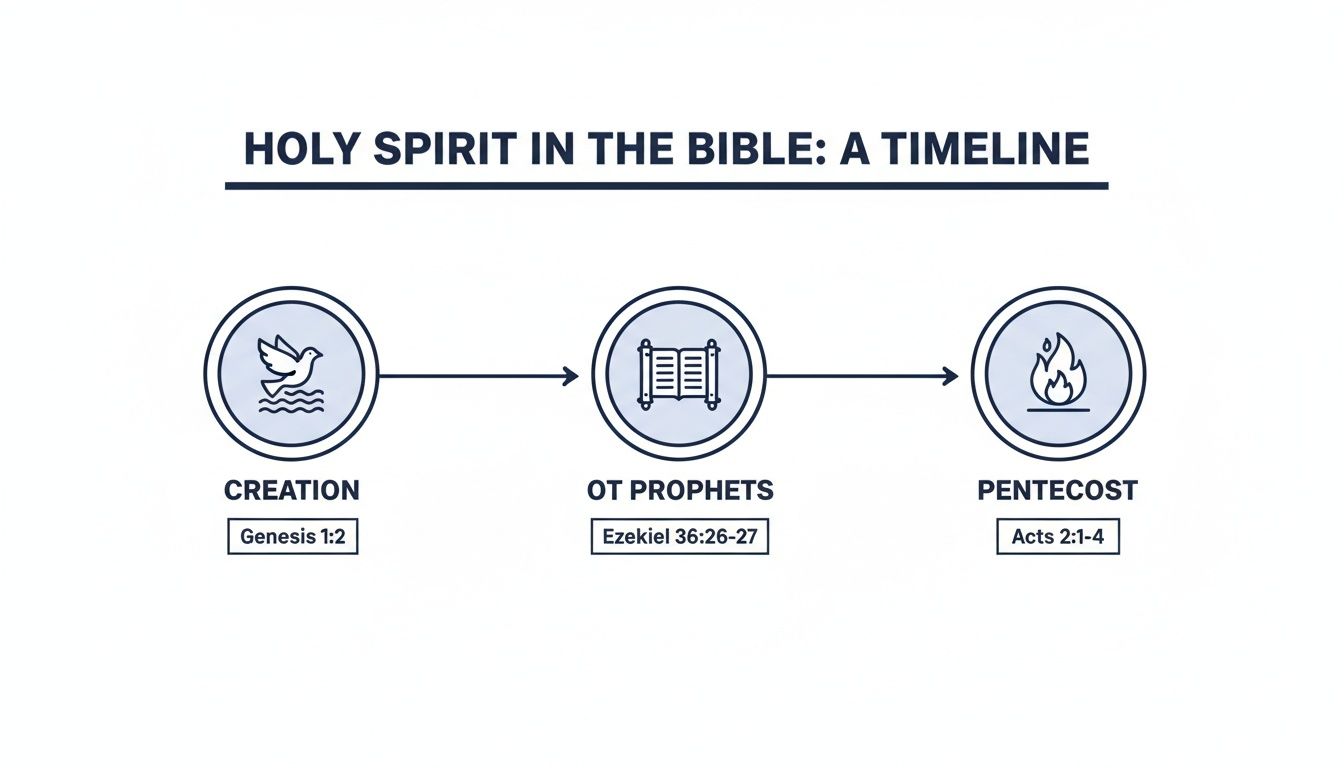
From His hovering over creation to anointing the prophets and finally His dramatic outpouring at Pentecost, this visual journey shows a consistent, unfolding divine plan.
Modern Movements and Ongoing Study
More recently, movements like Pentecostalism and the Charismatic renewal have brought the empowerment and gifts of the Spirit to the forefront. They have served as a powerful reminder to the global church that the Spirit's presence is active, personal, and available to empower every believer.
Walking through this rich history isn't just for academics. It gives you the tools to engage thoughtfully with different traditions, to discern truth from error, and to appreciate the faithful work of those who wrestled with these truths before us. At The Bible Seminary, we are convinced that studying historical theology is essential for preparing leaders to serve the church with wisdom, clarity, and a deep, personal reliance on the Holy Spirit.
The Unfolding Work of the Spirit in Church History
The study of the Holy Spirit isn't just an abstract theological exercise; it has tangible, world-changing consequences. Look back through church history, and you'll find a recurring pattern: whenever believers leaned into a deeper reliance on the Spirit’s power, the results were remarkable.
The story of great revivals and global missions is, in many ways, the story of pneumatology in action. It's one of the most encouraging themes in our shared history, showing what happens when our theology moves from the head to the heart, empowering God's people to fulfill the Great Commission.
The Great Awakenings and Missionary Zeal
Take the First and Second Great Awakenings in the 18th and 19th centuries. These were periods of intense spiritual renewal that completely reshaped the American landscape. Preachers like Jonathan Edwards and George Whitefield didn't just give good sermons; they emphasized the absolute necessity of a personal encounter with God, made possible only by the Holy Spirit’s work of regeneration.
This wasn't just about emotional camp meetings. It was about lives being fundamentally transformed. The Spirit’s conviction led to widespread repentance and a renewed passion for holiness, which in turn fueled a powerful missionary impulse. When you are filled with a fresh awareness of God’s grace, you feel compelled to share that hope.
This era reveals a vital principle: a high view of the Spirit’s power directly fuels a high commitment to mission. When the church is confident in the Spirit’s ability to change hearts, its members become bold witnesses. This very truth continues to inspire our mission at The Bible Seminary, where we are passionate about equipping leaders to impact the world for Christ.
The numbers from that era tell an incredible story. The explosive growth of early American Christianity during the Second Great Awakening was tied directly to this heightened focus on the Spirit. For instance, the Methodists surged from just 20 congregations in 1770 to an astounding 19,883 by 1860—a 994-fold increase. Baptists grew 81-fold during the same period. These aren't just statistics; they're a testament to the Spirit's incredible role in church multiplication. You can explore more church growth statistics from this period to see the profound impact of these movements.
Pentecostalism and the Global Church
Fast forward to the turn of the 20th century, which saw the birth of the Pentecostal and Charismatic movements. Events like the Azusa Street Revival in Los Angeles brought the gifts and empowerment of the Spirit to the forefront of modern Christianity in a powerful way. These movements emphasized a direct, personal experience of the Holy Spirit, including speaking in tongues and other spiritual gifts mentioned in the New Testament.
While different theological traditions approach these gifts in various ways, the impact of these movements is undeniable. They re-energized millions of Christians with a vibrant faith and a renewed focus on the Spirit’s active, daily presence and power.
At its core, this emphasis on the Spirit’s empowerment serves as a powerful reminder that ministry is not conducted in our own strength. It is God the Spirit working in and through us to accomplish His purposes.
This historical pattern offers profound encouragement for us today. It confirms that the same Spirit who moved at Pentecost, who fanned the flames of the Great Awakenings, and who sparked global revivals in the last century is still at work. He is the one who empowers preaching, guides mission strategy, and ultimately brings people from death to life.
Understanding what is pneumatology through the lens of church history makes it clear that this isn't an optional topic for ministry leaders. It grounds our service in a confident reliance on God’s power, reminding us that He is the one who builds His church and advances His kingdom in every generation.
Why Pneumatology Matters for Your Life and Ministry Today

This is where theology moves out of the ivory tower and into your everyday life. Why does digging deep into the doctrine of the Holy Spirit really matter for your own walk with God and how you serve others?
The answer is actually pretty straightforward: pneumatology is the study of how God is actively present and working in the world right now.
Without the Holy Spirit, the Christian life simply doesn't exist. He is the one who convicts you of your need for a Savior, drawing you to the grace found in Jesus Christ. He's the divine agent of your new birth—what theologians call regeneration—breathing life into spiritually dead hearts and making you alive in Christ (Titus 3:5).
The Spirit’s Role in Your Personal Walk
From that very first moment of salvation, the Holy Spirit's work is intensely personal, and it never stops. He doesn't just save you and then leave you to figure things out on your own. He walks with you, step-by-step, guiding your growth and providing a hope that can't be shaken.
This ongoing process of becoming more like Jesus is known as sanctification. It’s a lifelong journey, but it's not one you take in your own strength. It's powered by the Spirit, who produces His fruit—love, joy, peace, patience, and more—in your character as you learn to walk in step with Him (Galatians 5:22-23).
And what's more, the Spirit gives you the assurance of your salvation. He’s the one who bears witness with your own spirit that you are truly a child of God (Romans 8:16), giving you an inner confidence that silences doubts and anchors your faith.
"For all who are led by the Spirit of God are sons of God. For you did not receive the spirit of slavery to fall back into fear, but you have received the Spirit of adoption as sons, by whom we cry, 'Abba! Father!'" (Romans 8:14-15, ESV)
This is practical, life-giving theology. It means you are never truly alone in your struggles, your decisions, or your spiritual journey.
The Spirit’s Empowerment for Ministry
For anyone in leadership—whether you're a pastor, a ministry leader, a church planter, or a small group facilitator—a solid pneumatology isn't just a "nice-to-have"; it's non-negotiable.
Ministry that relies on human strength and clever strategies will always lead to burnout and produce little lasting fruit. Real, kingdom-advancing work is always Spirit-empowered ministry.
Think about it in these practical ways:
Empowering Preaching: The Spirit is what takes a well-researched sermon and turns it into a life-changing encounter with God’s truth. He gives power and conviction to the Word being proclaimed.
Guiding Decisions: From big-picture strategic plans down to daily pastoral care moments, the Spirit offers wisdom and direction to leaders who are humble enough to seek Him.
Distributing Spiritual Gifts: The Spirit gives unique gifts to every believer to build up the church (1 Corinthians 12:7). A healthy ministry helps people find and use those gifts for the good of the whole body.
Fostering True Unity: Lasting unity isn't built on slick programs or shared interests. It’s a supernatural work of the Holy Spirit, who binds believers together in peace (Ephesians 4:3).
At The Bible Seminary, we are passionate about uniting scholarship, spiritual formation, and hands-on ministry. This means our students don’t just learn about the Spirit in a classroom; they learn to depend on Him in their lives. Whether you're considering a Master of Divinity or another of our programs, learning to lead in the Spirit’s power is at the very heart of everything we do.
Deepen Your Understanding at The Bible Seminary
If this dive into the person and work of the Holy Spirit has stirred something in you, perhaps it's time to go deeper. Here at The Bible Seminary, we’re not about surface-level knowledge. Our entire mission is to ground you in the full counsel of God’s Word.
We believe that a rich, Spirit-led understanding of pneumatology isn't just one class you take—it's a vital truth that breathes life into our entire curriculum.
Training Hearts and Minds
Our degree programs, like the Master of Divinity and Master of Arts, are built to walk you through all 66 books of the Bible, from Genesis to Revelation. Why is that so crucial? Because the doctrine of the Holy Spirit isn't static; it unfolds and deepens across the entire biblical story.
You'll see this as you study. For instance, Paul’s letters often focus on a 'soteriological' pneumatology, connecting the Spirit directly to our salvation. Then you turn to Luke-Acts, and you find a 'prophetic' pneumatology that emphasizes the Spirit's power for bold witness. Grasping these nuances is only possible when you engage with the whole of Scripture.
At TBS, you’ll learn from faculty who aren't just academics. They’re seasoned pastors and ministry leaders who live what they teach, dedicated to helping you bridge the gap between deep theology and Spirit-empowered service.
Equipping You for Your Calling
We are passionate about showing how rigorous biblical study must translate into real-world ministry. Whether your path is pastoral ministry, missions, teaching, or counseling, a profound reliance on the Holy Spirit is the non-negotiable foundation.
Our mission is simple and direct: we are committed to “training hearts and minds for kingdom service.” Every class, every discussion, every assignment is intentionally designed to prepare you for the unique, Spirit-led calling God has on your life.
If you’re wrestling with the question of how seminary training can truly impact your walk with God, we have a helpful article exploring how Bible seminary courses can help you understand your faith better.
Whether you’re ready for a full degree or a more flexible certificate program, we invite you to take a closer look. Come and see how The Bible Seminary can equip you to serve Christ faithfully in a world desperately in need of His hope.
Got Questions About Pneumatology?
As you dive into the rich, complex doctrine of the Holy Spirit, some common questions naturally pop up. Let's tackle a few of them head-on with clear, biblically-grounded answers to help you on your journey.
What is the difference between pneumatology and Christology?
Think of it this way: while both are essential areas of theology, they focus on different persons of the Trinity. Christology is the study of the person and work of Jesus Christ—His nature, life, death, and resurrection. Pneumatology, on the other hand, zeroes in on the person and work of the Holy Spirit.
But here’s the key: you can't truly separate them. The Holy Spirit is deeply involved in the story of Christ. He conceived Jesus (Luke 1:35), anointed Him for ministry (Acts 10:38), and raised Him from the dead (Romans 8:11). In turn, Jesus promised to send the Spirit to His followers as their advocate and guide. They are distinct fields of study, but they are completely intertwined.
Does the Holy Spirit still give spiritual gifts today?
Yes. Historic Christian orthodoxy has always affirmed that the Holy Spirit continues to graciously give spiritual gifts (charismata) to believers. Why? To build up the church. The Apostle Paul’s letters make it clear that these gifts are distributed by the Spirit as He wills, all for the common good (1 Corinthians 12:7-11).
“Now there are varieties of gifts, but the same Spirit; and there are varieties of service, but the same Lord; and there are varieties of activities, but it is the same God who empowers them all in everyone.” (1 Corinthians 12:4-6, ESV)
While different theological traditions may discuss the nature and modern-day manifestation of certain "sign gifts," the core principle remains a foundational New Testament teaching: the Spirit equips believers for ministry.
How can I be filled with the Holy Spirit?
This is a fantastic and practical question. Scripture describes being "filled with the Spirit" as an ongoing experience, a daily yielding to His guidance and empowerment. While the Spirit indwells every believer at the moment of salvation, the command in Ephesians 5:18 to "be filled with the Spirit" suggests this isn't a one-and-done event. It’s a continual state of dependence and surrender.
This isn't about chasing a single, emotional high. It's about a moment-by-moment choice to:
Walk in obedience to God’s Word.
Cultivate a life of prayer and communion with God.
Put sin to death through His power.
Serve others with the gifts He has given.
Ultimately, it’s less about you getting more of the Spirit and more about the Spirit getting more of you.
Is the Holy Spirit a person or a force?
The Bible is unmistakably clear on this: the Holy Spirit is a distinct, divine person—not some impersonal force or abstract power. This is a crucial piece of understanding what is pneumatology. The Spirit possesses all the attributes of personhood: He has a mind (Romans 8:27), He has emotions (He can be grieved, Ephesians 4:30), and He has a will (1 Corinthians 12:11).
Jesus Himself refers to the Spirit using personal pronouns, calling Him the "Comforter" or "Advocate" (Paraclete) who will teach and guide believers. He acts in personal ways—He speaks, He intercedes, He commands, and He testifies. When you grasp that the Spirit is a person, it invites you into a real, dynamic relationship with God Himself.
If you’re ready to move beyond basic questions and into deep, biblically-centered training, The Bible Seminary offers a range of programs designed to equip you for a life of effective, Spirit-led ministry.