
Exodus 33 Explained: A Guide to God's Presence in the Wilderness

Exodus 33 tells the powerful story of what happens when God’s people commit a devastating sin and find themselves at a divine crisis point. It’s about the very real possibility of a future without God’s presence and a leader’s desperate plea to restore it.
Following Israel's catastrophic failure with the golden calf, God delivers a stunning verdict: He will not personally travel with His "stiff-necked" people to the Promised Land. This chapter captures Moses' desperate intercession for God's presence, a raw and honest plea that culminates in one of the most profound revelations of God’s glory in all of Scripture. It’s a passage that reminds us that our greatest need is not God’s blessings, but God Himself.
The Crisis of God’s Withdrawn Presence

To feel the weight of Exodus 33, we have to understand the painful moment it’s born from. While Moses is on Mount Sinai receiving the law, the people below have already broken the most fundamental commandments by building and worshiping a golden calf. It is an act of profound spiritual betrayal that shatters their covenant relationship with a holy God.
God’s initial response is both just and absolutely terrifying. He promises to keep His word—they will still inherit the land He promised—but He will withdraw His personal, guiding presence. An angel will go instead. God’s warning is chillingly logical: His holy presence in the midst of such a rebellious people would utterly consume them (Exodus 33:3). This isn't just a threat; it’s a statement of reality when sin meets perfect holiness. To truly grasp what’s happening here, you almost need to approach it with the detailed eye of a qualitative research content analysis.
This divine withdrawal brings the entire journey to a grinding halt. It plunges the people into deep mourning and pushes Moses into his most critical role yet: mediator.
The rest of the chapter unfolds in three powerful movements, each building on the last. This table offers a quick overview of how the tension builds and resolves.
Key Movements in Exodus 33
Verses | Key Event | Central Question | Resolution or Outcome |
|---|---|---|---|
vv. 1-6 | The People's Repentance | How will Israel respond to God’s judgment? | They mourn and strip off their ornaments in humility. |
vv. 7-11 | Moses’ Intimate Communion | How can anyone bridge the gap between a holy God and a sinful people? | Moses meets God “face to face” outside the camp, showing his unique role as mediator. |
vv. 12-23 | Moses’ Audacious Plea | Is repentance enough, or is God’s presence essential? | Moses successfully intercedes for God’s presence and asks to see His glory. |
Let's break down each of these sections.
The People’s Repentance (vv. 1-6): When Israel hears God's "disastrous word," the party stops. They respond with genuine sorrow, removing their jewelry and finery as an outward sign of their inner grief and repentance.
Moses’ Intimate Communion (vv. 7-11): Moses sets up the Tent of Meeting far outside the defiled camp. Here, he meets with God "face to face, as a man speaks to his friend," a stunning picture of the powerful, personal relationship that makes his intercession possible.
Moses’ Audacious Plea (vv. 12-23): This is the heart of the chapter. Moses boldly argues for God's presence to return, and then, even more daringly, asks to see God’s very glory. This leads to an unforgettable revelation that reshapes everything.
When a Holy God Confronts a Stiff-Necked People
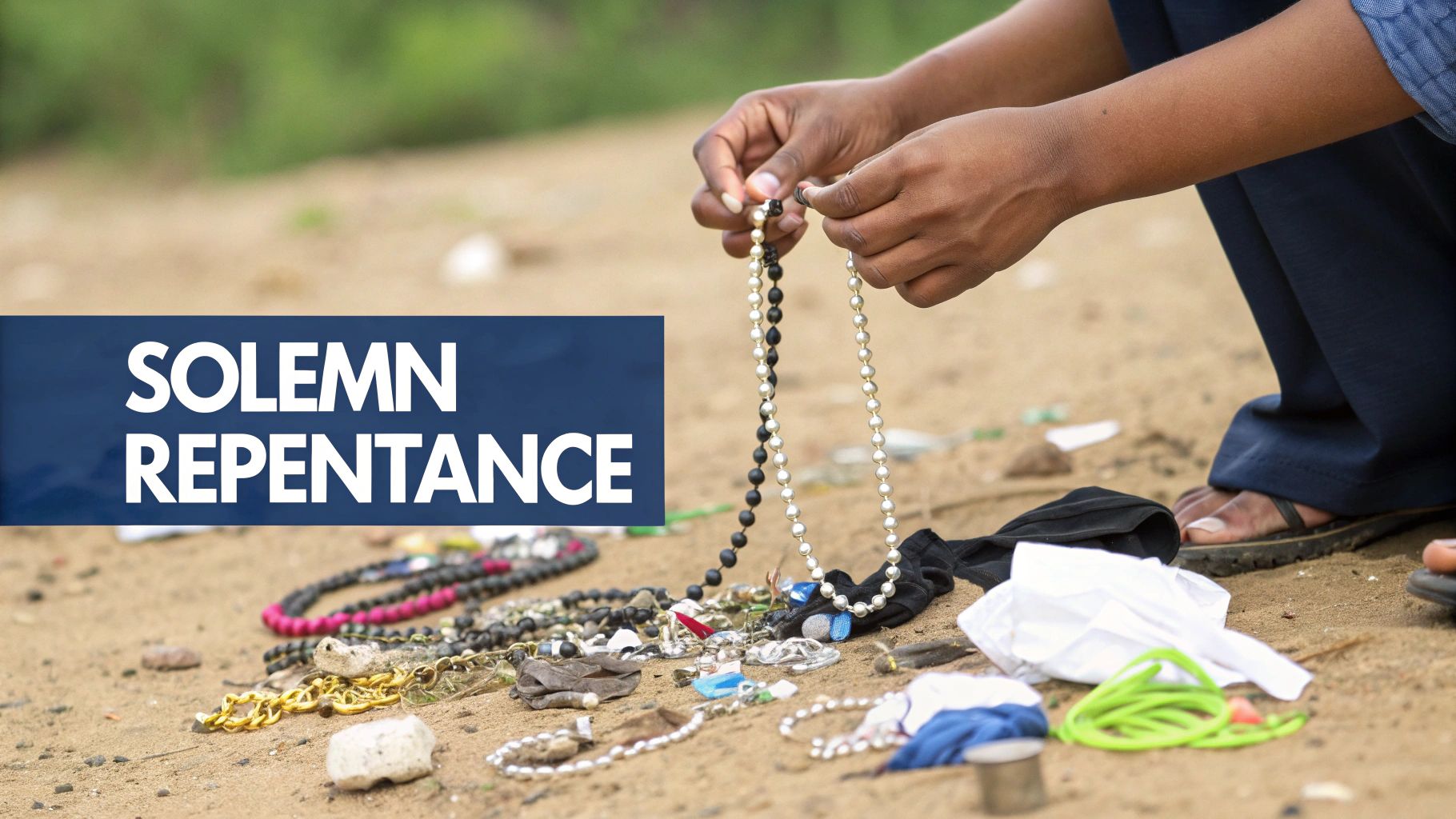
Exodus 33 opens in the shadow of a catastrophe. The wild celebration around the golden calf has gone silent, replaced by the crushing weight of reality. God speaks to Moses, and His message is a jarring mix of fulfilled promise and severe judgment.
He tells Moses to get moving and lead the people toward that land flowing with milk and honey sworn to Abraham, Isaac, and Jacob. An angel would even go before them, guaranteeing their conquest of Canaan. At first glance, this sounds like great news. The promise holds.
But then comes the gut punch, a condition that changes everything:
“Go up to a land flowing with milk and honey. But I will not go up among you, for you are a stiff-necked people, and I might consume you on the way.” (Exodus 33:3, CSB)
This is the central crisis of the entire chapter. God’s presence, the one thing that set Israel apart from every other nation on earth, was being pulled back. This wasn't God being petty; it was a matter of spiritual physics. His searing, perfect holiness simply could not dwell among raw, unrepentant sin without utterly destroying the very people He'd called.
The Weight of Being Stiff-Necked
The phrase “stiff-necked people” is a brilliant, earthy metaphor drawn straight from the farm. Think of a stubborn ox that braces its neck against the yoke, refusing to be guided. Spiritually, it paints a vivid picture of a people who resist God’s will, stubbornly determined to forge their own path. And Israel had just given the ultimate demonstration of that stubbornness.
God's verdict gets at a core theological truth we constantly unpack in our degree programs at The Bible Seminary: sin creates separation. His refusal to go with them was, ironically, an act of mercy to keep them from being instantly consumed. For Israel, though, it felt like a death sentence.
The people understood immediately what was truly at stake. A Promised Land without God’s presence is just a tract of land. The gifts of God are empty without the Giver. Their entire identity, their purpose, their hope—it was all tied to the reality that Yahweh was with them.
A Community in Mourning
When this "disastrous word" hits the camp, the response is immediate and visceral. The community plunges into mourning. This isn't just quiet sadness; it's a public, visible display of grief and repentance. They strip off their jewelry and ornaments—the very gold that likely supplied the material for their idol.
This act was a powerful outward sign of an inward shift. It was a physical admission of guilt, a posture of humility, and a recognition of the catastrophic gravity of their sin. This scene in Exodus 33, taking place around 1446 BC right after the golden calf debacle, is pivotal. The divine withdrawal prompts a nationwide repentance; Exodus 33:4-6 notes that after hearing God's decree, the people mourned and removed their ornaments from Mount Horeb onward, a symbolic act that continued indefinitely. You can find deeper historical analysis in scholarly articles on the subject.
This moment of national brokenness is what sets the stage for Moses. The people's grief shows that their stiff necks are beginning to soften, creating the crucial opening for their leader to step into the gap and plead for God’s presence to return.
The Tent of Meeting as a Place of Intimate Communion

In the raw aftermath of God’s withdrawal, Moses does something radical. Verses 7-11 introduce us to a sacred space born not from a divine blueprint, but from a divine crisis: the Tent of Meeting.
Now, it is important not to confuse this with the ornate, centrally located Tabernacle that would come later. This was a simple, provisional tent Moses pitched “outside the camp, far off from the camp” (Exodus 33:7).
That location speaks volumes. Pitching the tent far away created a physical separation that was a gut-wrenching mirror of their spiritual reality. The community was stained by the sin of the golden calf, ritually unclean. A holy God simply could not dwell in their midst.
And yet, this place of separation paradoxically became a place of breathtaking intimacy. It was here that God would meet with Moses. Anyone who wanted to seek the LORD had to physically leave the comfort and familiarity of the camp and make a journey to this consecrated spot.
A Visible Encounter
When Moses entered this tent, the text paints a stunning picture. A pillar of cloud—the visible sign of God’s glorious presence—would descend and stand right at the tent’s entrance. From their own tent openings, the people of Israel would watch this awesome sight and worship from a distance.
This visible display drove home two critical points:
It affirmed Moses’ unique role. The people saw with their own eyes that their leader had a special, direct line of communication with God.
It reminded them of the gap. While they could worship from afar, only Moses could enter. Sin had created a barrier that demanded a mediator.
The description of what happened inside that tent is one of the most remarkable in all of Scripture.
“Thus the LORD used to speak to Moses face to face, as a man speaks to his friend.” (Exodus 33:11, ESV)
This powerful phrase doesn't mean Moses saw God’s physical face—verse 20 makes it clear that’s impossible for any human. Instead, it paints a picture of unparalleled, open, and personal communion. This was an intimate dialogue, not a one-way dictation. It was this friendship, this "face-to-face" relationship with God, that empowered Moses to intercede so boldly for his people.
A Temporary Solution to a Deeper Problem
The Tent of Meeting in Exodus 33:7-11 was Moses' personal site for these divine encounters, set apart from the sinful camp. This transitional structure was set up months before the more formal Tabernacle was built.
In the immediate fallout of the golden calf, 3,000 were slain by the Levites. While a horrific number, this represented a tiny fraction—perhaps only 0.1-0.5% of the population—sparing the nation from the complete annihilation God initially threatened.
This temporary tent serves as a stark reminder of the gap that sin creates—a chasm that only Jesus Christ, our ultimate Mediator, could permanently bridge. Understanding the theological weight of biblical structures like the Tent of Meeting and the Tabernacle is a cornerstone of study at The Bible Seminary. Our approach is enriched by tangible connections to the past, like those you can find in our 3J Museum of Biblical Archaeology and through learning about recent discoveries at ancient Shiloh, the very site where the Ark and Tabernacle once rested.
Moses’ Bold Plea: Show Me Your Glory
The peak of Exodus 33 is a raw, stunning dialogue between Moses and God. The nation's future is literally hanging by a thread, and Moses steps up—not just as a political leader, but as a desperate intercessor who knows his entire mission hinges on one thing: God’s actual presence. What unfolds in verses 12-23 is one of the gutsiest, most intimate prayers in the entire Bible.
Moses begins with a powerful, almost lawyerly argument. He reminds God, “You have been telling me, ‘Lead these people,’ but you have not let me know whom you will send with me” (v. 12). Then, he leans into the personal relationship God Himself has established, saying, “You have said, ‘I know you by name and you have found favor with me.’”
This isn't just sweet talk. It's a strategic move, holding a mirror up to God's own words and character. Moses is essentially asking God to be consistent with His promises and His relationship with the very man He chose for the job.
A Land Without God Is Not the Promise
Moses' intercession then builds to its most critical point, uncovering a profound theological truth we strive to embed in every student at The Bible Seminary. He draws a line in the sand with this unforgettable statement:
“If your Presence does not go with us, do not send us up from here. How will anyone know that you are pleased with me and with your people unless you go with us? What else will distinguish me and your people from all the other people on the face of the earth?” (Exodus 33:15-16, NIV)
This is a jaw-dropping declaration. Moses is saying that the Promised Land—the goal of this whole exhausting journey—is worthless without God's presence. For Moses, God Himself is the prize, not the real estate or the blessings He provides. The very thing that makes Israel distinct isn't their territory, their law, or their leader, but the tangible presence of Yahweh living right there with them.
This is the kind of leadership—one rooted in a desperate dependence on God—that forms the bedrock of effective, Christ-centered ministry. It puts the relationship with God over the results, a core value we emphasize in our ministry training programs.
The Audacity to Ask for Glory
In a moment of incredible grace, God agrees to Moses’ plea. He assures him, “My Presence will go with you, and I will give you rest” (v. 14). But Moses, emboldened, pushes even further. He makes a request of breathtaking audacity: “Now show me your glory” (v. 18).
He's not asking for a divine light show or some cheap miracle. Moses is yearning for a deeper, more personal revelation of who God is. He's seen God's power in the plagues and felt His presence in the pillar of cloud, but now he wants to know God’s very character, His nature, His essence.
This bold move by Moses becomes the pivot point for Israel, pulling them back from the brink of disaster after the golden calf fiasco. By bargaining for God's presence and asking to see His glory, Moses sparks a dialogue that leads straight to covenant renewal, turning the story away from sin and back toward restoration. You can explore the theological nuances of this encounter in more detail.
God’s response is incredibly tender and revealing. He agrees, but on His terms. He tells Moses:
“I will cause all my goodness to pass in front of you.”
“I will proclaim my name, the LORD, in your presence.”
“I will have mercy on whom I will have mercy, and I will have compassion on whom I will have compassion.”
Notice what God defines as His glory. It’s not about raw power, but about His goodness and His sovereign mercy. He reveals that His ultimate glory is found in His character. It's a powerful lesson: true intimacy with God isn't about demanding signs and wonders, but about desperately seeking the Giver Himself.
Understanding God's Glory in the Cleft of the Rock

How can a holy God possibly grant a mortal man’s request to see His glory? God’s response to Moses is a masterful display of careful, compassionate revelation. He doesn’t rebuke Moses for his boldness; instead, He makes a way.
The answer is wrapped in powerful, protective imagery. God points Moses to a place near Him, a spot where he can stand on a rock. This simple instruction is packed with theological weight, reminding us that God is our firm foundation, our stability in a chaotic world.
“When my glory passes by, I will put you in a cleft in the rock and cover you with my hand until I have passed by. Then I will remove my hand and you will see my back; but my face must not be seen.” (Exodus 33:22-23, NIV)
This is both an act of deep mercy and a sobering lesson. God tucks Moses safely into a crevice, shielding him with His own hand from the consuming fire of His unveiled presence. It’s a vital truth for all of us: no human can endure the fullness of God’s raw, unfiltered glory and live.
God's Back, Not His Face
The theological depth of Moses seeing God's "back" but not His "face" has been a source of rich reflection for centuries. This isn't about physical anatomy. The language suggests that humanity can know God truly, but never completely or exhaustively.
We come to know God through:
His actions in history: We see the "aftermath" of His work, the undeniable evidence that He has passed by.
His self-revelation: We know what He chooses to reveal about Himself in His Word.
His character: His glory is ultimately tied to His nature—something He is about to proclaim out loud.
This concept keeps us humble in our theological studies. While we can gain incredible insight into biblical texts by studying their original context, much like one might go about deciphering ancient languages, we must always remember our limitations. Our knowledge of God this side of eternity will never be complete. We see the effects of His glory, not the source in its fullness.
What is God's Glory?
The ultimate answer to Moses’ request doesn't come in a blinding light but in a profound declaration. In the very next chapter, God fulfills His promise. As His presence passes by, He proclaims His own name and character.
“The LORD, the LORD, the compassionate and gracious God, slow to anger, abounding in love and faithfulness, maintaining love to thousands, and forgiving wickedness, rebellion and sin. Yet he does not leave the guilty unpunished…” (Exodus 34:6-7, NIV)
Here it is. In this breathtaking moment, we learn what God's glory truly is. God’s glory is His character. It isn't just overwhelming power or light; it is fundamentally His goodness, compassion, grace, justice, mercy, and faithfulness.
This gets to the very heart of the Christ-centered training we provide at The Bible Seminary. We are committed to equipping leaders to impact the world for Christ by helping them understand that ministry isn’t just about seeking spectacular experiences. It's about knowing the character of God as revealed in Scripture and reflecting that character to a watching world.
The greatest revelation Moses receives is not a vision, but a declaration of God’s heart—a heart that is both perfectly just and abounding in steadfast love. The cleft of the rock became the classroom where Moses learned that God’s goodness is His glory.
How Exodus 33 Shapes Our Life and Ministry Today
How can a crisis in the desert thousands of years ago possibly speak to our lives and ministries right now? The raw, timeless themes of Exodus 33 act as a powerful diagnostic tool for our own spiritual health and offer a compelling model for anyone in leadership. This chapter isn’t just history; it’s a living word that confronts us today.
Israel's golden calf scandal serves as a stark mirror for our own modern-day idols. We might not be forging metal statues, but we are experts at elevating other things—success, comfort, financial security, or even ministry itself—above our relationship with God. Exodus 33 forces us to ask a tough question: What promises do we chase that would feel hollow without God's presence? This kind of honest self-examination is absolutely critical for anyone preparing for kingdom service.
A Model for Pastoral Leadership
Moses' bold, gut-wrenching intercession gives us a profound model for what pastoral prayer and leadership should look like. He doesn't just pray for his people; he stands in the gap, identifies with their sin, and strategically reminds God of His own character and covenant promises. Moses' leadership was never about personal ambition. It was fueled by a desperate desire to see God's glory revealed among His people.
For ministry leaders today, Moses’ example is a call to a much deeper life of prayer. It’s a challenge to measure success not by attendance numbers or social media accolades, but by the tangible presence of God in our communities.
Discussion Questions for Reflection
Take some time to personally reflect on these questions or talk them through with a small group:
What are the modern "golden calves" that tempt you or your community to settle for a substitute for God's presence?
Read Moses’ prayer in verses 12-16. What can you learn from his honesty and boldness that you can apply to your own prayer life?
How does the truth that God’s glory is His goodness (Exodus 33:19) change the way you pursue a relationship with Him?
The greatest tragedy is not failure, but success without God. Moses understood this when he said, "If your Presence does not go with us, do not send us up from here." This must be the constant prayer of our hearts, our churches, and our ministries.
Sermon Outline: An Anchor for Your Teaching
For pastors and teachers looking to communicate the heart of Exodus 33, here is a simple outline to get you started:
The Crisis: The Emptiness of Blessings without God (vv. 1-6)
The Mediator: The Necessity of Intimate Intercession (vv. 7-11)
The Priority: The Supremacy of God’s Presence (vv. 12-17)
The Revelation: The Goodness of God’s Glory (vv. 18-23)
At The Bible Seminary, we are passionate about training hearts and minds for kingdom service. We equip leaders to faithfully apply Scripture, moving from ancient text to present-day transformation. If you want to learn more about how you can dive deeper into God's Word, we encourage you to check out our helpful guide on how to read the Bible for all it's worth.
Common Questions About Exodus 33
Exodus 33 is a dense, emotionally charged chapter that always sparks fantastic questions about who God is, how He relates to us, and what true leadership looks like. Let's walk through a few of the most common ones that come up when people dig into this text.
Why Did God Refuse to Go With Israel at First?
God’s initial refusal to go with Israel into the Promised Land was not a fit of divine temper. It was a terrifying act of holy protection.
Think about it: Israel had just committed profound spiritual adultery with the golden calf. God calls them “stiff-necked” (Exodus 33:3), a visceral image of a stubborn, rebellious animal refusing to be led. For a perfectly holy God to dwell in His full, unfiltered glory among a people actively choosing sin would have meant their instant annihilation.
So, His withdrawal was a severe, but paradoxically merciful, judgment. It was a wake-up call of the highest order, designed to preserve them from total destruction while graphically illustrating the gravity of their sin and their desperate need for a mediator.
What Does It Mean That God Spoke to Moses "Face to Face"?
When the text says God spoke with Moses “face to face, as a man speaks to his friend” (Exodus 33:11), it’s a powerful Hebrew idiom, a figure of speech meant to convey a jaw-dropping level of intimacy and directness. It doesn't mean Moses literally saw God's physical face—verse 20 makes that crystal clear: "you cannot see my face, for no one may see me and live."
Instead, this phrase highlights just how unique Moses’ relationship with God was. This was not a fuzzy dream or a cryptic vision like other prophets might receive. This was an open, personal, back-and-forth dialogue. That incredible access is precisely what empowered Moses to stand in the gap and intercede so boldly for the entire nation. It was God's way of affirming Moses' role as the mediator for His people.
What's the Difference Between the Tent of Meeting and the Tabernacle?
This is a great question, and it's easy to get them confused. The distinction is absolutely crucial to understanding what's happening in this part of Exodus.
The Tent of Meeting (Exodus 33): This was a temporary setup. It was Moses' personal tent, which he pitched outside the camp. This was a provisional solution born out of crisis. Sin had defiled the community, so this tent symbolized the painful separation that now existed between a holy God and a sinful people.
The Tabernacle (Exodus 25-27, 35-40): This was the permanent, divinely designed dwelling place for God that was later built and placed right in the very center of the camp.
The Tent of Meeting was a temporary fix for a broken relationship. The Tabernacle, on the other hand, was the permanent, covenantal dwelling that symbolized God’s presence being fully restored among His people once atonement was made.
Here at The Bible Seminary, we believe that wrestling with deep questions is the heart of growing in your faith and biblical knowledge. Our programs are built to give you the tools you need to explore Scripture faithfully and find solid, Christ-centered answers.