
The Tent of Meeting: God's Dwelling Place Explained

Imagine a sprawling desert camp, a nation on the move, and right at its heart, a single, sacred tent where heaven and earth met. This was the Tent of Meeting, also known as the Tabernacle—the vibrant, holy center of Israel's existence and the specific place God chose for His presence to dwell among His people.
At The Bible Seminary, we believe that understanding foundational biblical concepts like this isn't just an academic exercise; it's a vital part of training hearts and minds for kingdom service. Let's explore the profound purpose, design, and significance of this incredible structure.
God’s Dwelling Place in the Wilderness
The Tent of Meeting was far more than a portable shrine; it was the physical expression of God's deep desire for a relationship with His chosen people. After their stunning exodus from Egypt, the Israelites needed a constant, tangible reminder that Yahweh was with them, guiding and protecting them.
This sacred tent became the focal point of their worship, their community, and their life under the covenant. It was here that God would speak to Moses "face to face, as one speaks to a friend" (Exodus 33:11, ESV).
This structure wasn't just for show. It served several profound purposes:
A Place of Divine Presence: It was where God’s glorious presence, the Shekinah, would visibly descend, leaving no doubt that He was near.
A Center for Worship and Atonement: It housed the entire sacrificial system, providing a God-ordained way for people to atone for sin and approach a holy God.
A Source of Divine Guidance: It was the spot where Moses, and later the high priests, would inquire of the Lord for guidance on behalf of the nation.
To truly grasp the significance of the Tent of Meeting, it's helpful to see how it fits into the bigger picture of the core beliefs of the Christian faith. This structure taught Israel critical truths about holiness, sacrifice, and mediation—themes that echo throughout Scripture and find their ultimate fulfillment in the person and work of Jesus Christ.
Let's summarize the key aspects of this incredible structure.
The Tent of Meeting at a Glance
Aspect | Primary Function and Significance |
|---|---|
Divine Dwelling | Served as the tangible, localized presence of God (the Shekinah glory) among His people in the wilderness. |
Worship & Sacrifice | Centralized Israel's worship and provided the prescribed location for the sacrificial system necessary for atonement and fellowship. |
Covenant Center | Acted as the physical heart of the Mosaic Covenant, constantly reminding Israel of their unique relationship with Yahweh. |
Source of Guidance | The designated place where Moses and the high priests would seek and receive direct guidance from God for the nation. |
Theological Foreshadowing | Prefigured the coming of Jesus Christ, who would be the ultimate "tabernacle" of God's presence among humanity (John 1:14). |
This simple table highlights just how multifaceted the Tabernacle was, serving as the very anchor of Israel's spiritual and community life.
In this sacred space, Israel learned a foundational lesson: a holy God desires to live among a sinful people but provides a specific way for that relationship to be possible. This divine pattern points directly to the grace and truth that would one day come through Jesus.
Here at The Bible Seminary, we equip leaders to understand these rich biblical connections, uniting serious scholarship with genuine spiritual formation. Exploring the Tent of Meeting enriches our view of worship, deepens our appreciation for Christ's sacrifice, and illuminates God’s unwavering passion for His people. It’s where the Bible truly comes alive.
The Divine Blueprint for the Tabernacle
The construction of the Tent of Meeting was not left to human creativity. God Himself gave Moses a detailed, divinely revealed blueprint on Mount Sinai. This was more than a set of instructions; it was a profound visual sermon for Israel, packed with symbolism that would shape their understanding of God for generations.
Every single element—from the type of wood used to the layout of the rooms—was meticulously specified. Why? To communicate foundational truths about God’s perfect holiness, the incredible value of His presence, and the seriousness of sin. This divine blueprint laid out a sacred geography, teaching the people how a holy God could dwell in their midst.
Materials That Taught a Lesson
The materials for the Tabernacle weren't chosen for convenience but for their symbolic weight. They were gathered as a willing offering from the people, meaning every Israelite could participate in building God’s dwelling place.
Gold and Silver: These precious metals communicated royalty, divinity, and immense value, driving home the priceless nature of God's presence.
Bronze: Used for the altar and the laver in the Outer Court, bronze symbolized judgment and purification, as it could withstand the fires of sacrifice.
Fine Linens and Rich Colors: The blue, purple, and scarlet yarns spoke of heaven, royalty, and the blood of sacrifice, creating an atmosphere that was both beautiful and solemn.
Acacia Wood: This durable, desert-hardy wood formed the structural framework. Overlaid with gold, it represented humanity (wood) covered by divinity (gold)—a powerful picture of God dwelling with His creation.
God’s instructions in Exodus 25:8 are crystal clear: "And let them make me a sanctuary, that I may dwell in their midst." The design was always about relationship—God making a way to be near His people.
This idea of a physical structure reflecting a divine order was common in the ancient world. The Tabernacle’s design mirrored a heavenly pattern, bringing a tangible piece of God’s holy realm to earth. You can explore this concept further by reading about insights from the Nuzi Tablets on Genesis.
A Journey into God's Presence
The layout of the Tent of Meeting was a progressive journey from the common world into the sacred presence of God. It had three distinct areas with increasing levels of holiness, teaching a clear lesson about how one must approach a holy God.
The infographic below illustrates the hierarchy of access within the camp, showing the central role the Tent played in mediating the relationship between God and His people.
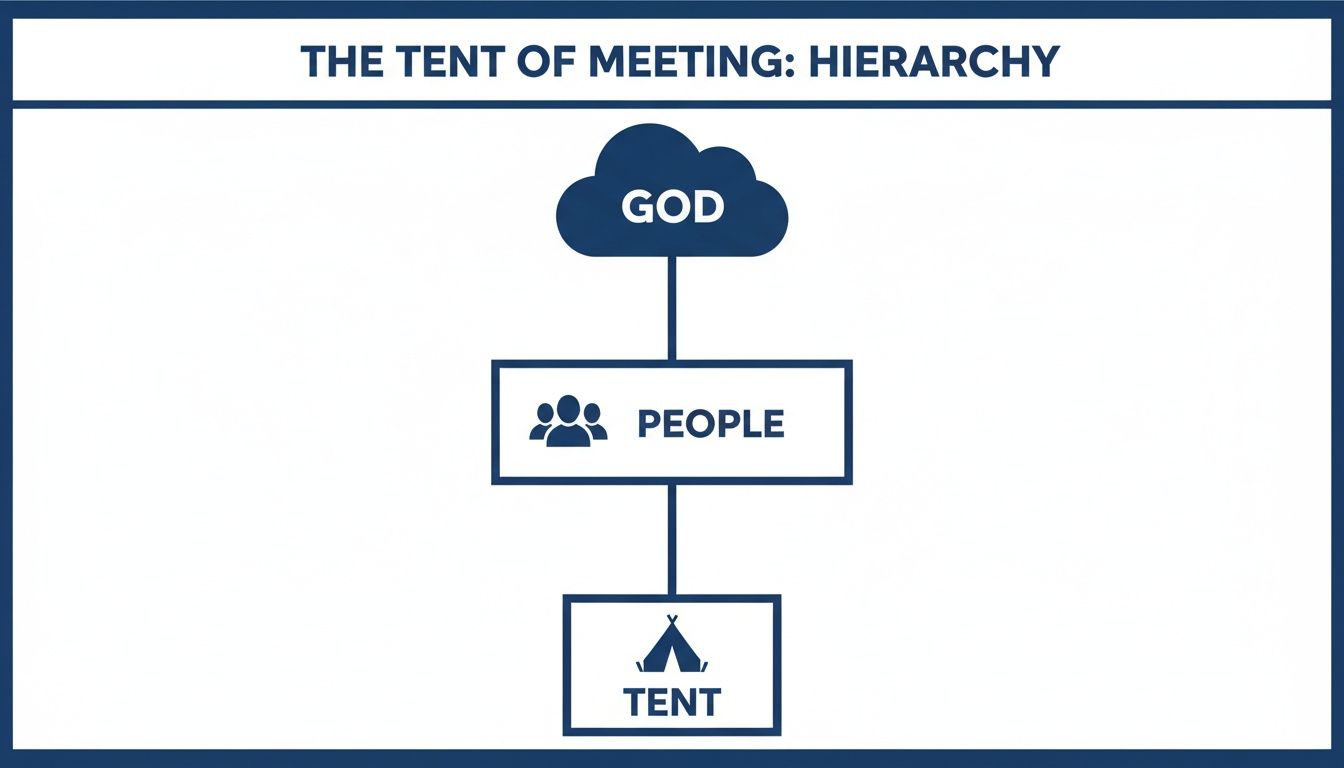
This visual hierarchy reinforces that God’s presence was central, yet access was carefully mediated through the sanctified space of the tent and the ministry of the priests.
1. The Outer Court This was the first area, open to any ritually clean Israelite bringing a sacrifice. It housed two crucial pieces of furniture:
The Altar of Burnt Offering: The first thing one would see. This is where sacrifices were made for sin, teaching that the way to God begins with atonement.
The Bronze Laver: A basin where priests washed, underscoring the need for personal purification and cleansing.
2. The Holy Place Only priests could enter this enclosed chamber. Inside, three pieces of furniture were used for daily service to God:
The Table of Showbread: Held twelve loaves of bread, representing God’s constant provision for the twelve tribes of Israel.
The Golden Lampstand (Menorah): Its seven lamps provided the only light, a powerful symbol of God as the source of all light and truth.
The Altar of Incense: Placed before the veil, this altar was for burning incense, representing the prayers of God’s people rising to Him.
3. The Holy of Holies Separated by a thick veil, this was the innermost sanctuary—the most sacred space on earth. Only the High Priest could enter, and only once a year on the Day of Atonement. It contained just one object:
The Ark of the Covenant: An acacia wood box overlaid with gold, containing the tablets of the Ten Commandments. Its lid, the Mercy Seat, was where God's presence dwelled between two golden cherubim.
This blueprint was a roadmap to God. Each element trained the hearts and minds of the Israelites, teaching them that approaching God required sacrifice, purity, and a mediator—a pattern that points directly to its perfect fulfillment in Jesus Christ.
Life Around the Tabernacle
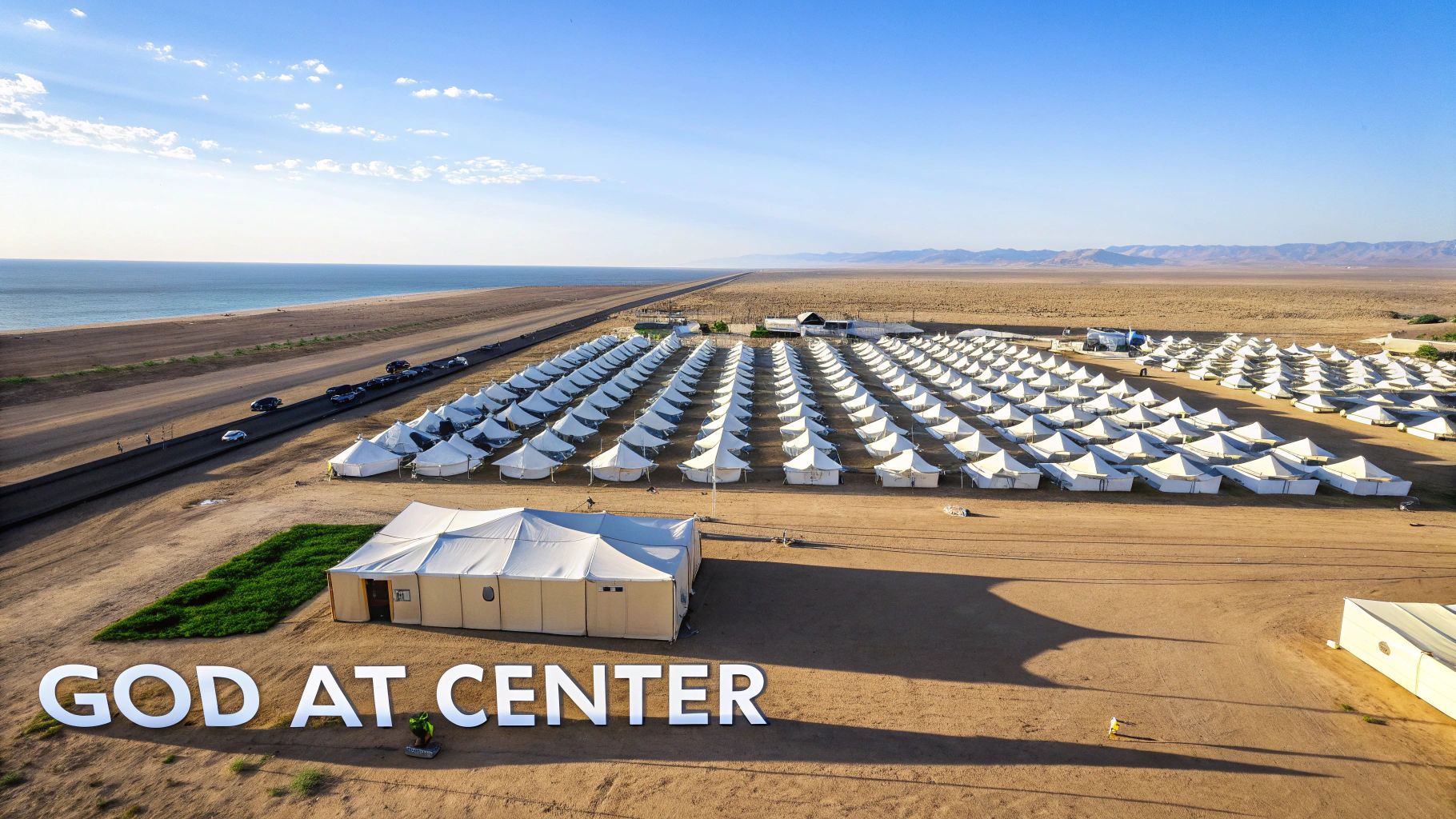
The Tent of Meeting was the vibrant, beating heart of Israel's national life. Its presence profoundly shaped the community's daily rhythms, social order, and identity as the people of God. Life was intentionally and meticulously organized around it.
This was a divine command. The structure served as a constant, visible sermon, reminding every person, every day, that God was to be at the absolute center of their existence. Every glance toward the middle of the camp revealed the sacred tent, reinforcing a powerful theological truth.
A Divinely Ordered Community
The physical layout of the Israelite camp, detailed in the book of Numbers, was a masterpiece of symbolic organization—a community designed with God as its literal center.
The Tent of Meeting was placed at the exact middle of the encampment. The Levites, the priestly tribe, camped in a protective ring immediately surrounding it. Beyond them, the twelve tribes were arranged in specific formations—three tribes on each of the four cardinal directions, all facing inward toward the holy tent.
Think about what that meant. No matter where an Israelite’s personal tent was pitched, their focus was always directed toward the place of God’s dwelling. It was a daily, practical outworking of the command to love and serve the Lord. The camp’s very structure was a map of their priorities.
“Now Moses used to take a tent and pitch it outside the camp some distance away, calling it the ‘tent of meeting.’ Anyone inquiring of the Lord would go to the tent of meeting outside the camp.” (Exodus 33:7, NIV)
While Moses used a separate tent before the Tabernacle's construction, the principle remained the same: God provided a specific place for encounter and guidance, anchoring the community. The later, more elaborate Tabernacle became the central religious structure for Israel throughout their 40-year wilderness journey. As recorded in Numbers and Joshua, it was the focal point around which the entire camp was organized.
The Hub of National Life
The Tent of Meeting was far more than a place for weekend worship. It was the integrated hub for nearly every major aspect of Israelite life, weaving together their spiritual, legal, and social worlds.
Religious Center: It was the exclusive location for prescribed sacrifices, festival celebrations, and priestly duties.
Judicial Center: Major disputes were often brought before the priests at the entrance to the tent. It was the supreme court where God's law was administered.
Social Gathering Point: The Tabernacle was the natural focal point for national gatherings and important announcements, unifying a diverse collection of tribes into one nation under God.
This integration shows how biblical structures directly informed real-world community practice. The lessons from places like Shiloh, where the Tabernacle stood for centuries, continue to resonate. For a deeper dive into the archaeology of these sites, you can read about recent finds in ancient Shiloh. This history offers timeless lessons for how our faith should shape our own communities today, reminding us to keep God at the center.
A Mobile Sanctuary Through History
The Tent of Meeting was designed as a mobile sanctuary, perfectly suited for a nation on the move. Its journey did not stop when Israel crossed the Jordan River. Its various relocations across Canaan tell the story of the nation's shifting spiritual and political life for hundreds of years.
This portability made a powerful theological statement. Unlike the massive, stationary temples in Egypt or Babylon, Israel’s God was not tied down to a single location. His presence was dynamic, leading His people wherever He called them. The tent's trek is a story of God’s faithfulness through victory, chaos, and change.
From Sinai to the Promised Land
The journey began at Mount Sinai, where God gave Moses the divine blueprints. For 40 years, the Tabernacle was carried through the wilderness, always at the center of the Israelite camp, a constant, moving symbol of God’s leadership.
When they entered Canaan under Joshua, the Tent of Meeting was first set up at Gilgal, near Jericho. This spot became their initial military and spiritual base for the conquest. It was from this sacred place they marched, anchoring their task in the presence of God.
A Long Rest at Shiloh
After the initial conquest, the Tabernacle was moved to a more central location. Joshua 18:1 tells us the entire assembly gathered at Shiloh to set it up. For several centuries, through the chaotic era of the Judges, Shiloh was the religious heart of Israel. This is where Hannah prayed for a son, and where the boy Samuel first heard the voice of the Lord.
Over its history, the Tent of Meeting moved to at least four major locations, spanning roughly 400 years. After its time in the wilderness and at Gilgal, the Tabernacle remained the primary religious center at Shiloh for over 300 years, until about 1050 BCE. You can discover more about the historical context of the Tabernacle's journey through ancient Israel.
A Scattered Presence
The story takes a dark turn when the Philistines capture the Ark of the Covenant in battle (1 Samuel 4). This disaster led to the destruction of Shiloh and, for decades, the separation of the Ark from the Tabernacle. The tent itself was moved first to Nob, where the priest Ahimelech served, and later to Gibeon.
"And Zadok the priest and his brothers the priests were before the tabernacle of the LORD at the high place that was at Gibeon, to offer burnt offerings to the LORD on the altar of burnt offering regularly, morning and evening, according to all that is written in the Law of the LORD that he commanded Israel." (1 Chronicles 16:39–40, ESV)
During this disjointed period, the sacrificial system continued at the Tabernacle in Gibeon, even while the Ark was elsewhere. This physical separation of God’s throne (the Ark) from His house (the tent) powerfully pictured the spiritual brokenness in the nation before the monarchy.
Ultimately, the transient nature of the Tent of Meeting points to a deeper truth. It was always a temporary dwelling, a shadow pointing to a greater reality. Its long journey created a deep longing in God's people for a more permanent, perfect, and accessible dwelling place for His presence. That longing would finally be fulfilled in the person of Jesus Christ.
Who Could Enter the Holy Place
Access to the Tent of Meeting was not a free-for-all. It was governed by strict, sacred rules that taught a powerful lesson about God’s perfect holiness. The tiered levels of entry were a physical sermon, illustrating the profound separation between a holy God and a sinful people. This divinely-ordered system drove home a critical truth: you can only approach God on His terms.
This structure was a teaching tool. Every Israelite learned that while God graciously lived among them, His awesome presence was not to be taken lightly. This system built a deep, healthy respect for God’s holiness and hammered home the need for a mediator.
A Hierarchy of Holiness
The entire system was organized in concentric circles of increasing holiness, with specific roles assigned to different groups. This was about function and the symbolic act of drawing near to God.
The Tent of Meeting was an incredibly exclusive space. According to Numbers 18:22, ordinary Israelites were explicitly forbidden from even getting close to the tent—the penalty was death. This created a clear hierarchy of access that reinforced God's holiness. You can read more about the specific roles within the Tabernacle service to see how this played out.
The levels were crystal clear:
The Israelites: The general population could come into the Outer Court to bring their sacrifices to the altar. But that was their hard stop.
The Levites: This tribe was set apart to care for the Tabernacle. They were the movers, builders, and guards for the sacred tent, acting as a buffer between the holy space and the rest of the camp.
The Aaronic Priests: Only Aaron’s descendants could go inside the Holy Place to maintain the lampstand, offer incense, and place the showbread on its table—ministering right before the veil.
The Unique Role of the High Priest
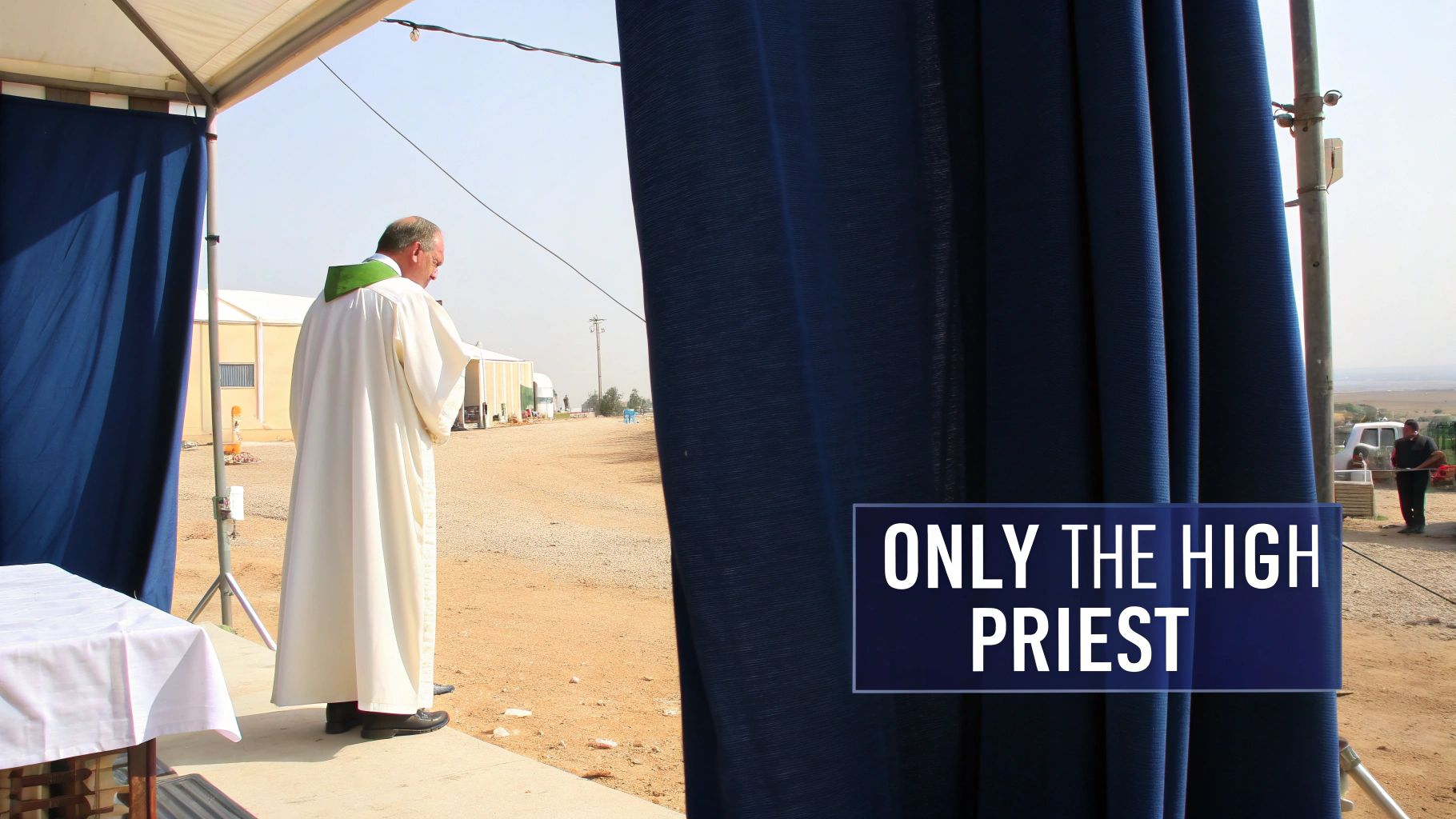
At the top of this sacred pyramid stood one man: the High Priest. He alone was granted the awesome privilege of entering the innermost sanctuary, the Holy of Holies. This was no daily commute.
“But only the high priest entered the inner room, and that only once a year, and never without blood, which he offered for himself and for the sins the people had committed in ignorance.” (Hebrews 9:7, NIV)
On this single day, the Day of Atonement (Yom Kippur), the High Priest would pass through the massive veil into the very throne room of God on earth. There, he would sprinkle the blood of the sacrifice on the Mercy Seat of the Ark of the Covenant to make atonement for the sins of the entire nation. His role as the sole mediator was unmistakable.
This structure cultivated a deep understanding of sin, holiness, and the absolute necessity of a perfect mediator. This Old Testament pattern provides the background we need to grasp the revolutionary work of Jesus, our Great High Priest, who tore the veil and gave all believers direct access to God.
How Christ Fulfills the Tabernacle
The intricate details of the Tent of Meeting, with its sacred objects and complex rituals, were never the final word. They were a profound, living blueprint—a foreshadowing of a far greater reality God had in store. The New Testament reveals that the Tabernacle was a shadow, but the substance it pointed to is Jesus Christ.
The True Dwelling Place of God
You can trace every piece of the tent's furniture and every ritual to Jesus. The sacrificial system, which revolved around the Bronze Altar, was a temporary solution for sin. But Jesus became the perfect and final sacrifice. As Hebrews 9:12 puts it, He entered God’s presence "not by means of the blood of goats and calves but by means of his own blood, thus securing an eternal redemption."
The Apostle John makes a stunning connection when he writes that "the Word became flesh and dwelt among us" (John 1:14). The Greek word for "dwelt," skēnoō, literally means "to pitch a tent" or "to tabernacle." Jesus Himself is the ultimate Tent of Meeting, God's very presence taking up residence with His people.
Just as God's glory filled the Tabernacle, Jesus is the one in whom "all the fullness of God was pleased to dwell" (Colossians 1:19). He is not a temporary shelter but the living, breathing presence of God in human form. This is a central truth we unpack in our degree programs at The Bible Seminary, training leaders to see and preach the rich connections between the Old Testament and Christ.
The Perfect High Priest and Torn Veil
The Tent of Meeting also needed a human high priest to mediate between God and the people. This role finds its ultimate completion in Jesus.
"For we do not have a high priest who is unable to sympathize with our weaknesses, but one who in every respect has been tempted as we are, yet without sin. Let us then with confidence draw near to the throne of grace, that we may receive mercy and find grace to help in time of need." (Hebrews 4:15–16, ESV)
Jesus is our Great High Priest. He did not enter a man-made sanctuary but heaven itself, where He now speaks to the Father on our behalf.
His final act on the cross brought the most dramatic fulfillment. When Jesus died, the massive veil in the Temple—the very barrier separating sinful humanity from the Holy of Holies—was torn in two from top to bottom (Matthew 27:51). This was a divine announcement that the old system of restricted access was finished. Because of Christ’s sacrifice, the way into God’s presence is now open for anyone who believes. He is the new and living way, the ultimate reality the Tent of Meeting could only promise.
Common Questions About the Tent of Meeting
As we explore the rich history and theology of this sacred space, a few questions often arise. Answering these helps clarify the practical and spiritual weight of the Tent of Meeting, connecting its ancient purpose to our faith today.
Are the Tent of Meeting and the Tabernacle the Same Thing?
Yes, for the most part, Scripture uses the terms “Tent of Meeting” and “Tabernacle” interchangeably to describe the same portable sanctuary. The different names simply highlight different facets of its purpose.
Tabernacle: This word comes from the Latin tabernaculum, meaning "tent" or "dwelling." It points to the structure as the place where God's presence literally dwelled among His people.
Tent of Meeting: This name, seen frequently in Exodus, underscores its function. This was the specific place where God would meet with Moses and where priests would meet God to intercede for Israel.
So, one name focuses on the who (God dwelling), while the other focuses on the what (the meeting). Both point to the same incredible reality: God drawing near to His people.
What Happened to the Original Tent of Meeting?
The Bible does not give a clear, step-by-step account of the Tabernacle structure's fate. Its story fades from the scriptural narrative as Israel’s worship became anchored in a permanent place.
Once King David brought the Ark of the Covenant to Jerusalem and his son Solomon built the Temple, the Temple fulfilled and replaced the role of the portable Tent of Meeting. The sacred furnishings were moved into the Temple (1 Kings 8:4), and the mobile sanctuary, having served its purpose faithfully for centuries, was no longer needed. Its job as a temporary dwelling was complete. Scholars still debate some historical details, a topic touching on the differences between biblical minimalists vs. maximalists.
Why Was the Design of the Tabernacle So Specific?
Every detail of the Tabernacle's design—from the acacia wood and gold to the layout of the courts—was a direct command from God. This specificity was crucial because the entire structure was a teaching tool, a physical sermon packed with symbolism.
Each element was designed to teach Israel profound truths about God's character and the pathway to a relationship with Him. The materials communicated His holiness and value, the layout illustrated the necessary steps for approaching Him, and the sacrificial system pointed to the seriousness of sin and the need for atonement. It was a divine blueprint that foreshadowed the greater reality to come in Jesus Christ.
At The Bible Seminary, we believe that understanding these biblical foundations is essential for effective ministry. Our programs are designed to equip leaders with the knowledge and spiritual insight needed to impact the world for Christ.
Explore our degree programs at The Bible Seminary and begin your journey toward deeper biblical training. Learn more at thebibleseminary.edu