
Finding Accredited Bible Colleges Near Me: Your Guide to 7 Top Resources
- The Bible Seminary

- Feb 15
- 14 min read
Embarking on the journey to deepen your biblical knowledge and prepare for ministry is a significant, Spirit-led decision. As you search for 'accredited bible colleges near me,' you're not just looking for a school; you're seeking a community that will equip you for a lifetime of kingdom service. Accreditation is a crucial first step, ensuring your education meets rigorous academic standards and that your degree is respected by churches, ministries, and other institutions.
This guide is designed to simplify your search. We will explore the best online resources for finding accredited programs, whether you are seeking an on-campus experience in the Houston area or flexible online options. Understanding this commitment is a major step, and it can be helpful to start by weighing the pros and cons of entering grad school to ensure you are fully prepared for the path ahead.
Our goal at The Bible Seminary is to help you find the right fit for your calling. We want to see you equipped in heart and mind to impact the world for Christ. Together, let's walk through seven key platforms, complete with screenshots and direct links, to help you compare programs and find where God is leading you.
1. The Bible Seminary: A Hub for Local and Global Ministry Training
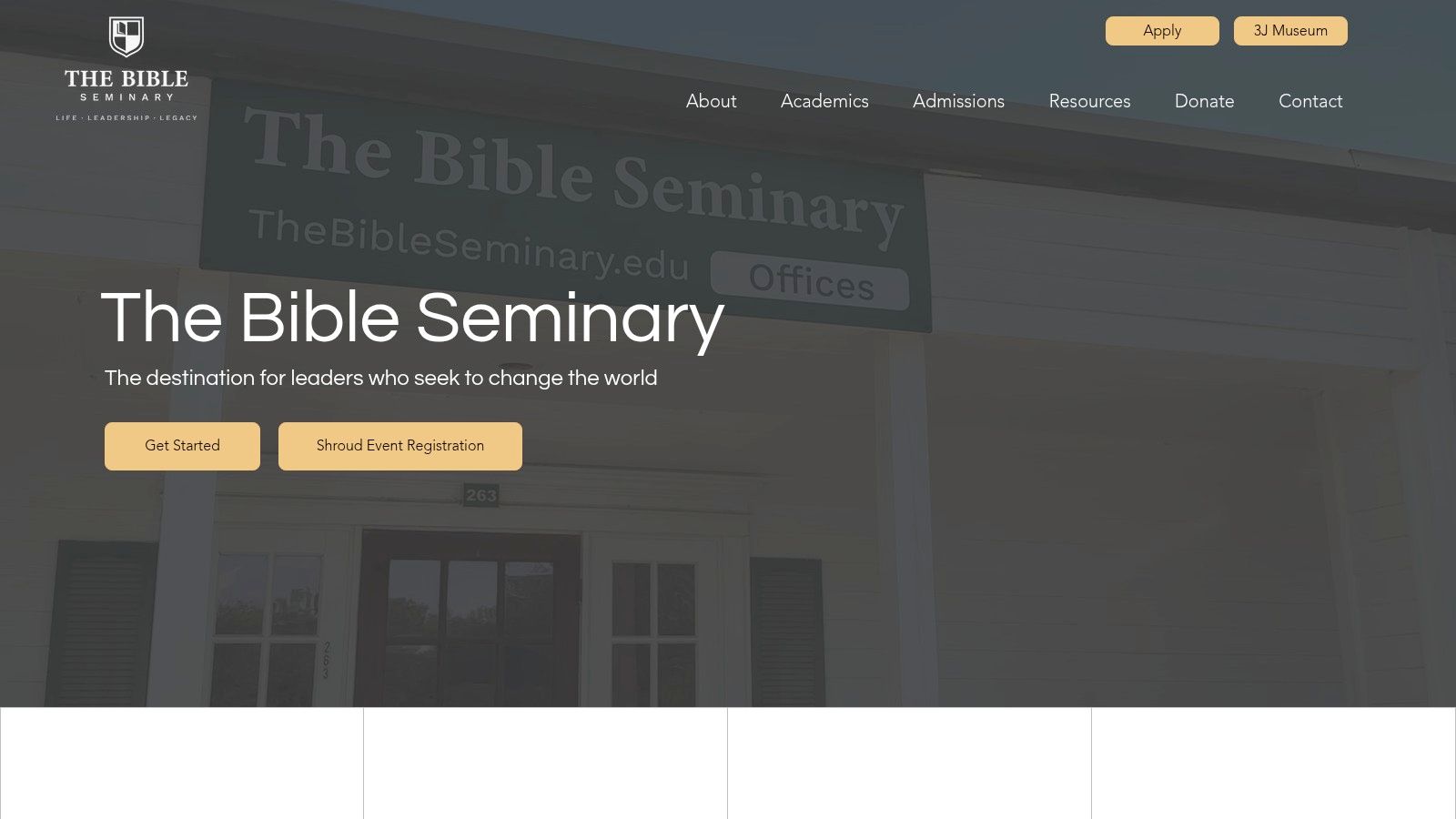
For those of you searching for accredited bible colleges near me in the Katy or Greater Houston area, we at The Bible Seminary (TBS) offer a compelling and uniquely integrated educational experience. Our programs are designed not just for academic learning but for deep spiritual formation and practical ministry readiness. TBS stands out by building its graduate-level education on a comprehensive, book-by-book study of all 66 books of the Bible, uniting rigorous scholarship with a passion for kingdom service.
This approach ensures you receive a holistic education where historical context, theological depth, and real-world application are woven together. Our mission of “training hearts and minds for kingdom service” is evident in our flexible and accessible programs, designed to equip leaders for impactful ministry.
Key Features and Academic Offerings
The Bible Seminary provides a robust framework for theological education, distinguished by our curriculum and learning environment. Our faculty is composed of internationally recognized scholars who are not only experts in their fields but also dedicated mentors committed to your growth. Beyond accreditation, a robust seminary program will equip you with vital skills, such as for mastering expository sermon preparation, a cornerstone of biblical teaching.
Core Strengths:
Comprehensive Biblical Study: Unlike programs that focus only on systematic theology or select biblical portions, our curriculum is anchored in a thorough study of the entire canon of Scripture.
Flexible Learning Pathways: TBS meets you where you are. You can pursue a full Master of Divinity (3 years) or Master of Arts (2 years), take a single course for credit, audit a class, or even engage as a Surveyor for personal enrichment. We offer both online and in-person formats.
Experiential Learning: Our on-campus 3J Museum is a unique asset, allowing you to interact with nearly 200 artifacts from biblical lands. This resource makes Scripture come alive, connecting classroom learning to tangible history and archaeology.
Debt-Free Education Commitment: A significant advantage is our focus on financial stewardship. We are proud that 100% of our students graduate debt-free, removing a major barrier to ministry preparation.
Why We Stand Out
What makes The Bible Seminary a premier choice is its synthesis of academic excellence, spiritual vitality, and practical application. We extend our impact beyond the classroom through resources like the Nehemiah Press and various podcasts, providing ongoing education for the wider Christian community. This commitment to equipping the global church is also reflected in our active community and global partnerships.
While we champion our debt-free graduation model, we encourage you to connect directly with our admissions office to confirm specific tuition costs for full degree programs and explore available financial aid. Similarly, we welcome you to inquire about alumni placement data to gain a clearer picture of post-graduation ministry impact.
Learn more at our official website: https://www.thebibleseminary.edu
2. Association for Biblical Higher Education (ABHE) – Member Directory
When your search for “accredited Bible colleges near me” prioritizes institutional focus and recognized biblical accreditation, the Association for Biblical Higher Education (ABHE) Directory is an indispensable resource. ABHE is a primary accreditor in the United States, specifically for colleges, seminaries, and universities centered on biblical and ministry education. Its directory is a direct gateway to these trusted institutions.
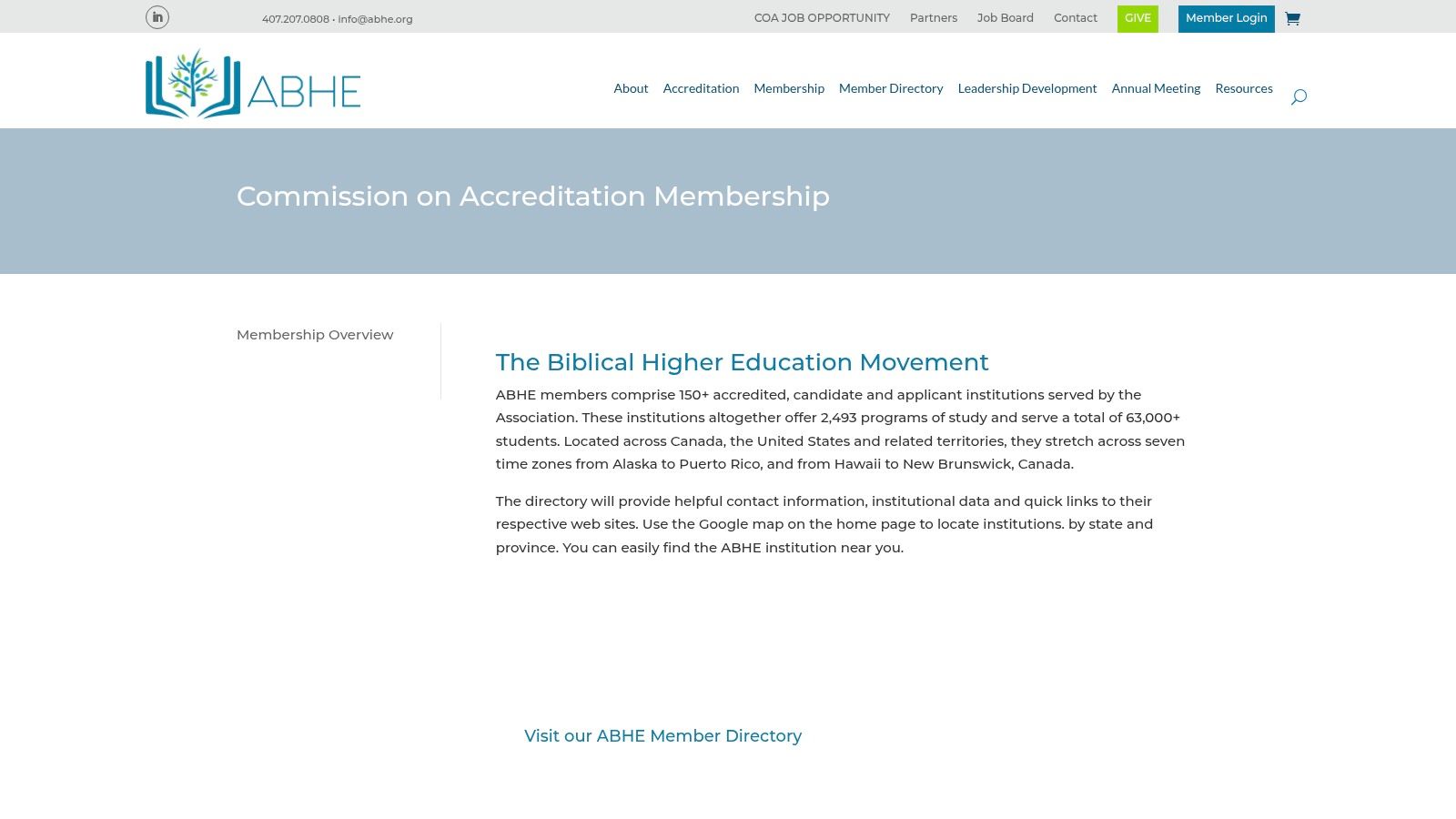
The platform is designed for one purpose: connecting prospective students like you with accredited, Bible-focused schools. This laser focus makes it incredibly efficient. You won't have to sift through hundreds of secular universities or unaccredited programs to find schools committed to training hearts and minds for kingdom service.
Navigating the ABHE Directory
Using the ABHE Directory is straightforward. The free-to-access platform features an interactive map and a state-by-state list of member institutions. This design allows you to quickly pinpoint schools in your geographic area.
Key features that make this tool effective include:
Accreditation Status: Each listing clearly indicates whether an institution is a member, candidate, or applicant for accreditation, giving you confidence in its academic standards.
Direct School Links: Instead of just providing a name, the directory gives you direct links to each school’s website. This allows you to immediately explore degree programs, read admissions requirements, and start an application.
Institutional Snapshots: You can see essential contact information and institutional details at a glance, helping you create a shortlist of schools to investigate further.
Pros and Cons of Using ABHE
The primary strength of the ABHE directory is its specificity. If you are committed to attending a school with a proven, biblically integrated curriculum, this is the best place to start. However, its specialization is also its main limitation; the directory only lists ABHE members. You may miss institutions accredited by other recognized bodies (like ATS or TRACS), so it's wise to use this tool in combination with others for a comprehensive search.
Ultimately, the ABHE Directory is an excellent first step for finding high-quality, accredited Bible colleges near me, ensuring your search begins with institutions that share a commitment to Christ-centered, biblically grounded higher education.
Website: https://www.abhe.org/directories/
3. Association of Theological Schools (ATS) – Member Schools & Program Search
For those of you called to advanced theological study or pastoral ministry, finding accredited Bible colleges near me often means looking for graduate-level institutions. The Association of Theological Schools (ATS) is the primary North American accreditor for seminaries and divinity schools. Its Member Schools & Program Search directory is the definitive tool for locating trusted graduate programs.
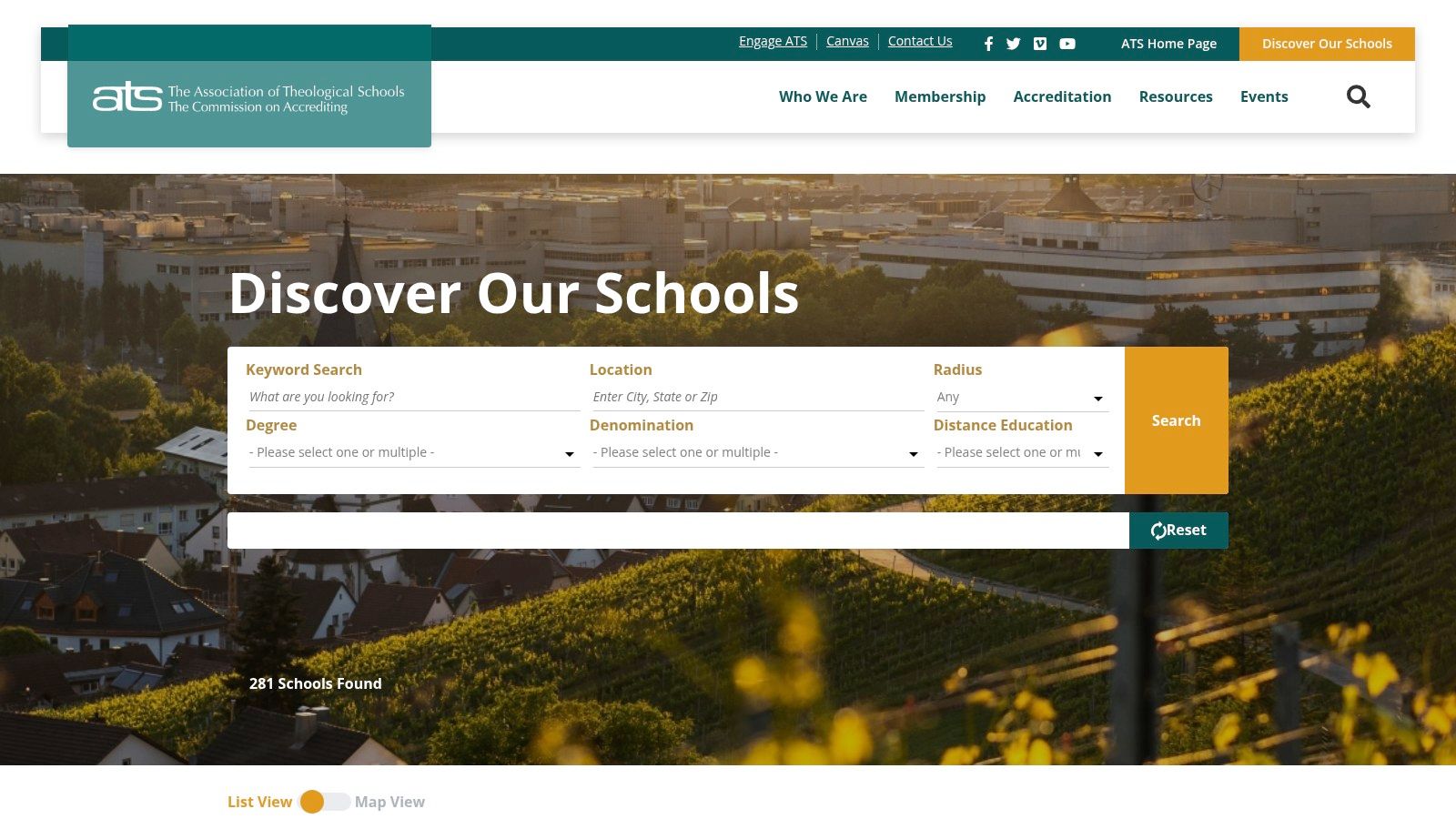
This free-to-use platform is specifically designed to connect aspiring ministry professionals with institutions offering Master of Divinity, Master of Arts, and doctoral degrees. Its focus on graduate theological education makes it an invaluable resource for anyone seeking to build upon an undergraduate degree and deepen their training for kingdom service.
Navigating the ATS Directory
The ATS directory offers a powerful and user-friendly search experience with robust filters that allow you to customize your search with precision. You are not just browsing a list; you are actively narrowing down options to find the perfect fit for your ministry goals.
Key features that make this tool effective include:
Location-Based Search: You can search by city or ZIP code and specify a radius, making it simple to find member schools within driving distance.
Granular Program Filters: Users can filter by degree type (M.Div., M.A., Th.M., D.Min., etc.), denominational affiliation, and even specific program delivery formats, including distance education options.
Direct Institutional Links: Each listing provides a direct link to the school’s website, where you can explore program details, contact admissions, and begin an application.
Pros and Cons of Using ATS
The greatest advantage of the ATS directory is its unparalleled authority in graduate theological education. If you are seeking a seminary degree, this is the gold standard for accreditation assurance. However, its specialization means it has fewer options for those seeking undergraduate Bible college programs. It is an excellent tool for post-graduates but may not be the primary resource for first-time college students.
For aspiring pastors, theologians, and ministry leaders, the ATS search tool is an essential step in finding a high-quality, accredited program to further equip them for a lifetime of impactful service.
Website: https://www.ats.edu/member-schools
4. TRACS (Transnational Association of Christian Colleges & Schools) – Member Institutions
When your search for an accredited institution includes a wider range of Christ-centered schools, the Transnational Association of Christian Colleges and Schools (TRACS) Member Directory is a vital tool. TRACS is recognized by both the U.S. Department of Education (USDE) and the Council for Higher Education Accreditation (CHEA), giving its member schools a respected mark of academic quality and institutional integrity.
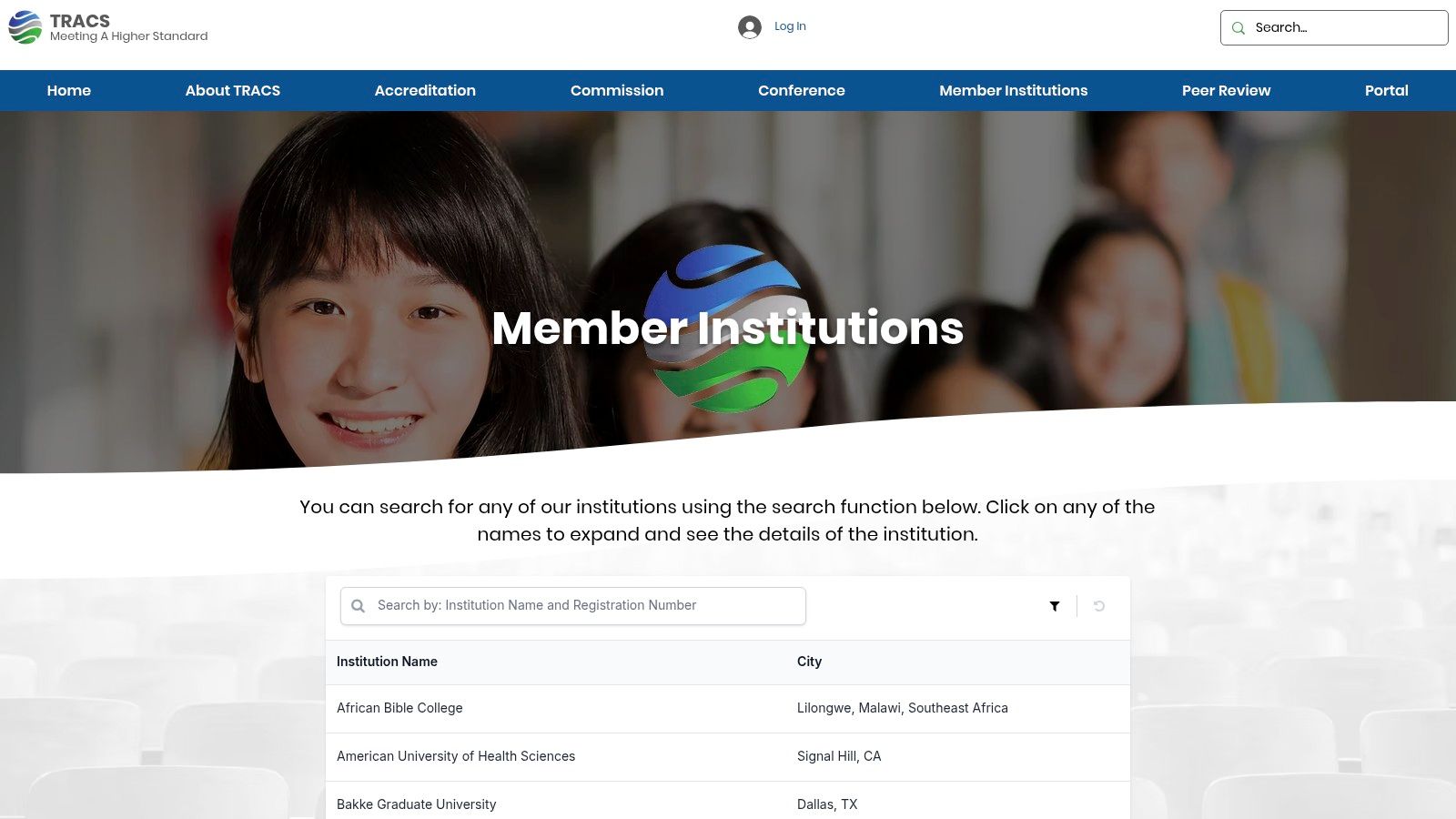
This directory is an excellent resource because it often includes smaller, ministry-focused colleges and seminaries that might not appear on larger, more generalized college search platforms. It provides a direct pathway to schools committed to providing biblically-based education designed to equip students for impactful service in ministry and the marketplace.
Navigating the TRACS Directory
The TRACS website offers a simple, free-to-use directory of its member institutions. You can view a comprehensive list or search by state, making it easy to locate schools in your preferred geographic area. The straightforward interface allows for efficient browsing without unnecessary distractions.
Key features that make this tool effective include:
Verified Accreditation: Every institution listed has achieved or is in the process of achieving TRACS accreditation, ensuring you are exploring schools that meet rigorous federal and academic standards.
Clear Status Indicators: The directory clearly labels each school’s accreditation status (e.g., Accredited, Candidate), so you can understand its standing within the association.
Direct School Links: The listings provide direct links to each institution’s website, empowering you to quickly access program details, admissions requirements, and contact information.
Pros and Cons of Using TRACS
The greatest strength of the TRACS directory is its government-recognized accreditation and its focus on Christian institutions. This gives you confidence that the schools listed offer a quality education from a biblical worldview. However, because the directory is limited to TRACS members, you won’t find schools accredited by other bodies like ABHE or ATS.
For a comprehensive search, the TRACS directory is best used alongside other resources. It is an essential stop for anyone looking for accredited Bible colleges near me and wants to ensure their chosen school is recognized for its academic excellence and commitment to training hearts and minds for kingdom service.
5. NCES College Navigator (U.S. Department of Education)
For a data-driven search that puts official government information at your fingertips, the National Center for Education Statistics (NCES) College Navigator is an unparalleled tool. Operated by the U.S. Department of Education, this free platform offers an unbiased, comprehensive database of all accredited postsecondary institutions. It is an authoritative resource for finding accredited Bible colleges near me based on concrete data rather than marketing.
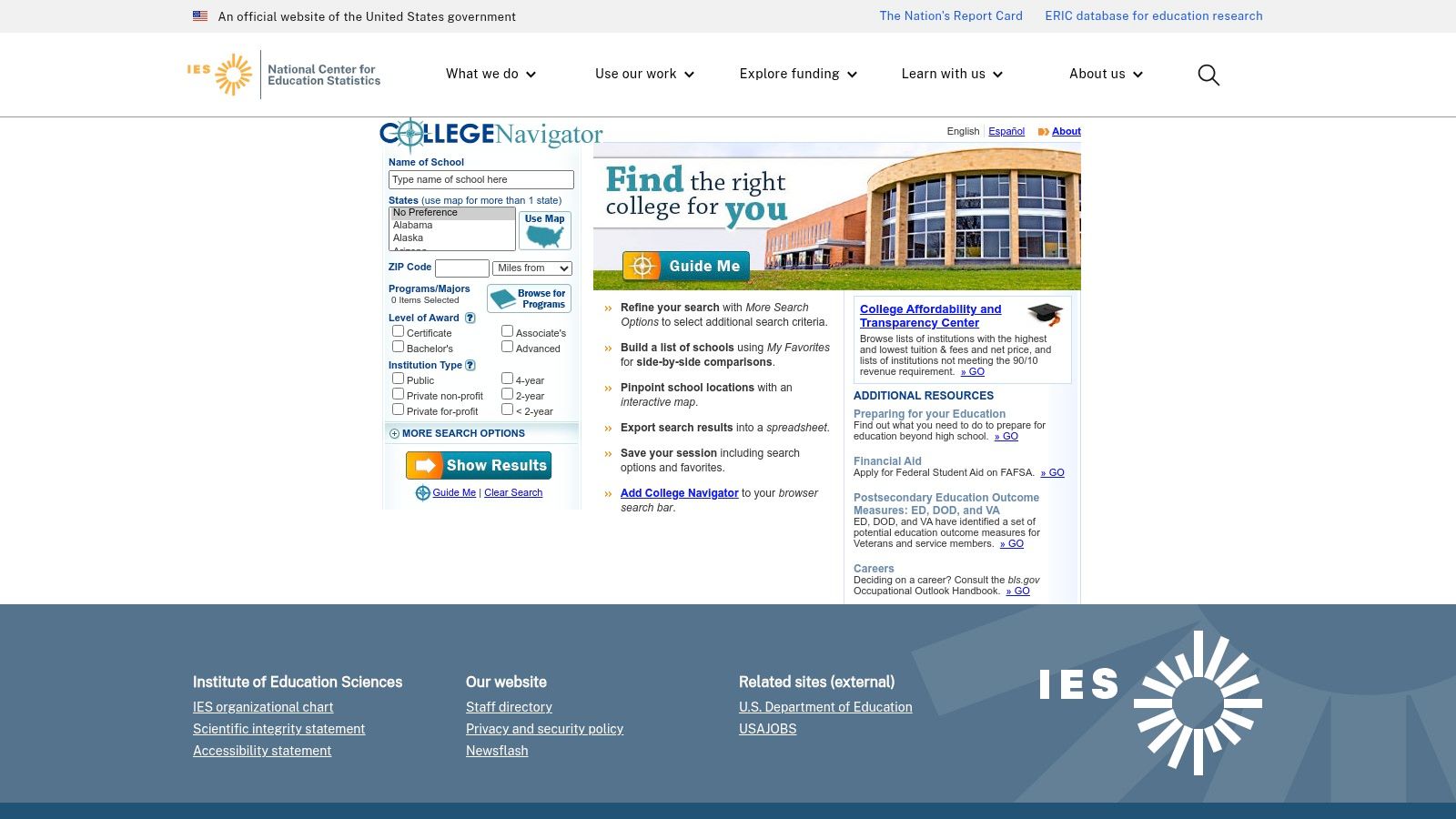
The platform is designed to provide neutral, factual information directly from institutions. Its power lies in its robust filtering capabilities, which allow you to move beyond a simple location search and pinpoint schools that match your specific academic and financial criteria. This makes it ideal for building a practical shortlist of potential schools.
Navigating the College Navigator
Using the College Navigator is a process of refining your search through detailed filters. You can start with a broad search by state or ZIP code radius and then narrow the results to find the perfect fit for your calling.
Key features that make this tool effective include:
Detailed Program Filters: You can search for specific degree programs like "Bible/Biblical Studies," "Theology and Religious Vocations," or "Pastoral Counseling and Specialized Ministries" to find schools offering the exact training you need.
Accreditation Verification: Every school profile explicitly lists its accrediting agency, providing immediate assurance of its academic legitimacy and standards.
Comprehensive Data Profiles: Each listing provides a wealth of information, including tuition costs, financial aid statistics, enrollment numbers, graduation rates, and admissions requirements, all in a standardized format for easy comparison.
Pros and Cons of Using College Navigator
The primary strength of the College Navigator is its comprehensive, unbiased data. You can trust the information because it comes from a federal source, and the ability to filter by ZIP code radius and specific biblical majors is perfect for a "near me" search. However, its utilitarian interface lacks the narrative descriptions or student reviews found on other platforms. You will need to know the specific names of majors you are interested in to use the filters effectively.
Ultimately, the NCES College Navigator is an essential tool for the analytical searcher who wants to compare accredited Bible colleges near me based on hard data, ensuring your educational path is built on a solid foundation of verified information.
6. CHEA (Council for Higher Education Accreditation) – Directory of Accredited Institutions & Programs
When your search for an "accredited Bible college near me" moves from discovery to verification, the Council for Higher Education Accreditation (CHEA) Directory is an essential final checkpoint. CHEA is a national advocate and institutional voice for academic quality through accreditation, recognized by the U.S. Department of Education. Its database serves as the ultimate authority for confirming if a college or program is accredited by a legitimate, recognized accrediting organization.
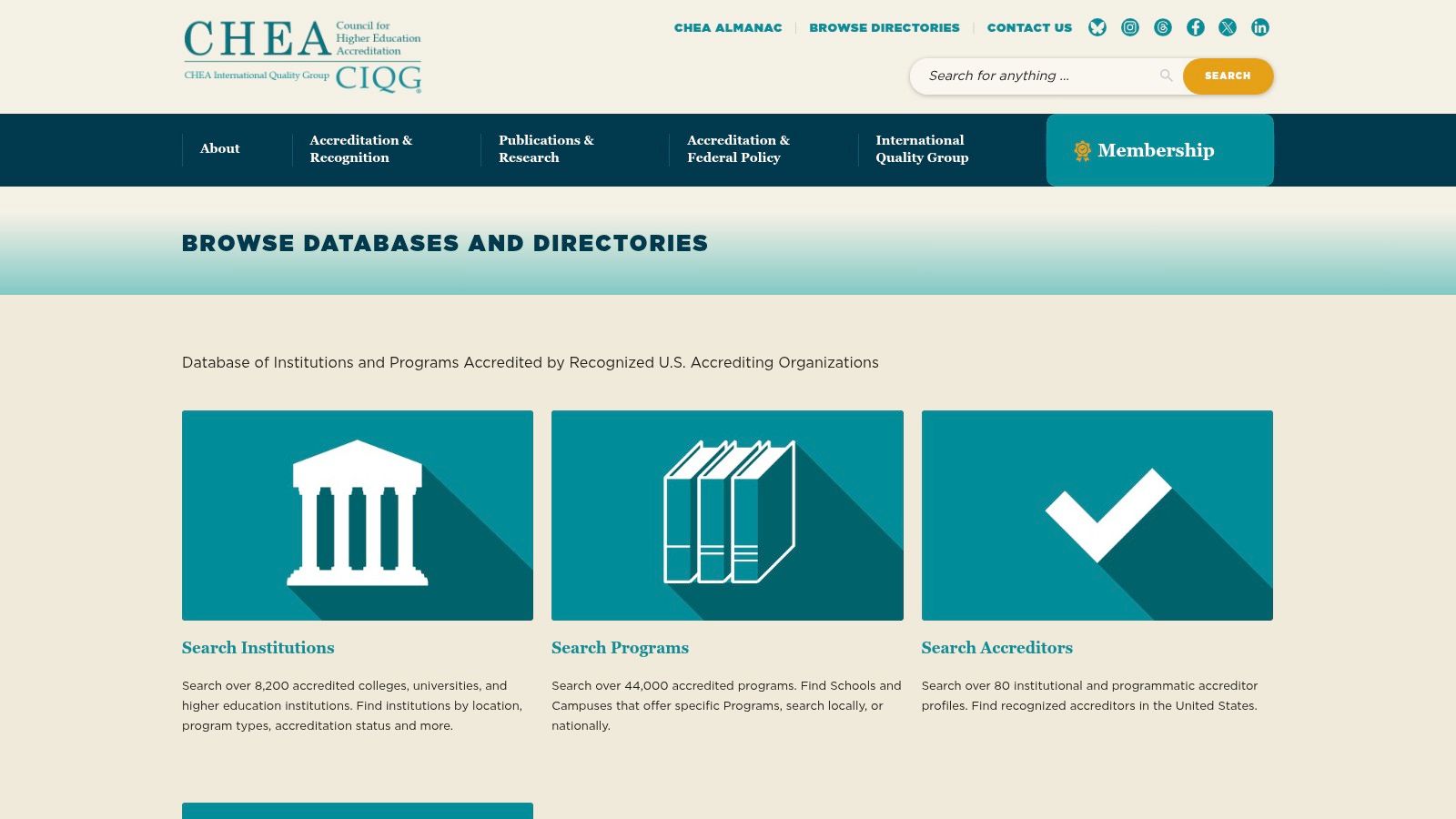
Unlike search-focused platforms, CHEA is a high-trust verification tool. Its purpose is not to help you shop for schools but to validate the claims made by institutions you have already found. This makes it an indispensable resource for ensuring the academic and professional value of your future degree, training you for kingdom service with academic integrity.
Navigating the CHEA Directory
The CHEA directory is a straightforward, free-to-use database designed for precision. You can search for an institution or program by name to confirm its status. The platform is designed to give you a clear, unambiguous answer about an institution's standing within the recognized higher education community.
Key features that make this tool effective include:
Comprehensive Database: The directory contains over 8,200 accredited institutions and 44,000 programs, giving you broad coverage for your verification needs.
Accreditor Lookup: You can research the accrediting agencies themselves to understand their standards and areas of focus. This is a crucial step in understanding the value of an accreditation.
Degree Mill Guidance: CHEA provides valuable resources to help you identify and avoid "degree mills" or unaccredited institutions that offer illegitimate credentials.
Pros and Cons of Using CHEA
The primary strength of the CHEA Directory is its authority and reliability. It is the gold standard for verifying accreditation, providing you with confidence that a school meets rigorous quality standards. Because it is so important, we have provided an in-depth explanation of the value of accreditation and what it means for your education. The main limitation, however, is that it is not a discovery tool. You cannot filter by location or major, so it is best used to vet a shortlist of schools you have compiled from other resources.
Ultimately, CHEA is a non-negotiable step for any student serious about finding a truly accredited Bible college near me. It provides the final assurance that your chosen institution offers a credible education that will be respected by employers, churches, and other academic institutions.
Website: https://www.chea.org/directories
7. Council for Christian Colleges & Universities (CCCU) – Institution Directory & Map
When your search for an “accredited Bible college near me” is part of a broader desire for a Christ-centered university experience, the Council for Christian Colleges & Universities (CCCU) Directory is an essential tool. The CCCU is a network of more than 150 Christ-centered institutions in the U.S. and Canada, plus global affiliates. Its directory serves as a gateway to campuses that intentionally integrate faith and learning across all disciplines.
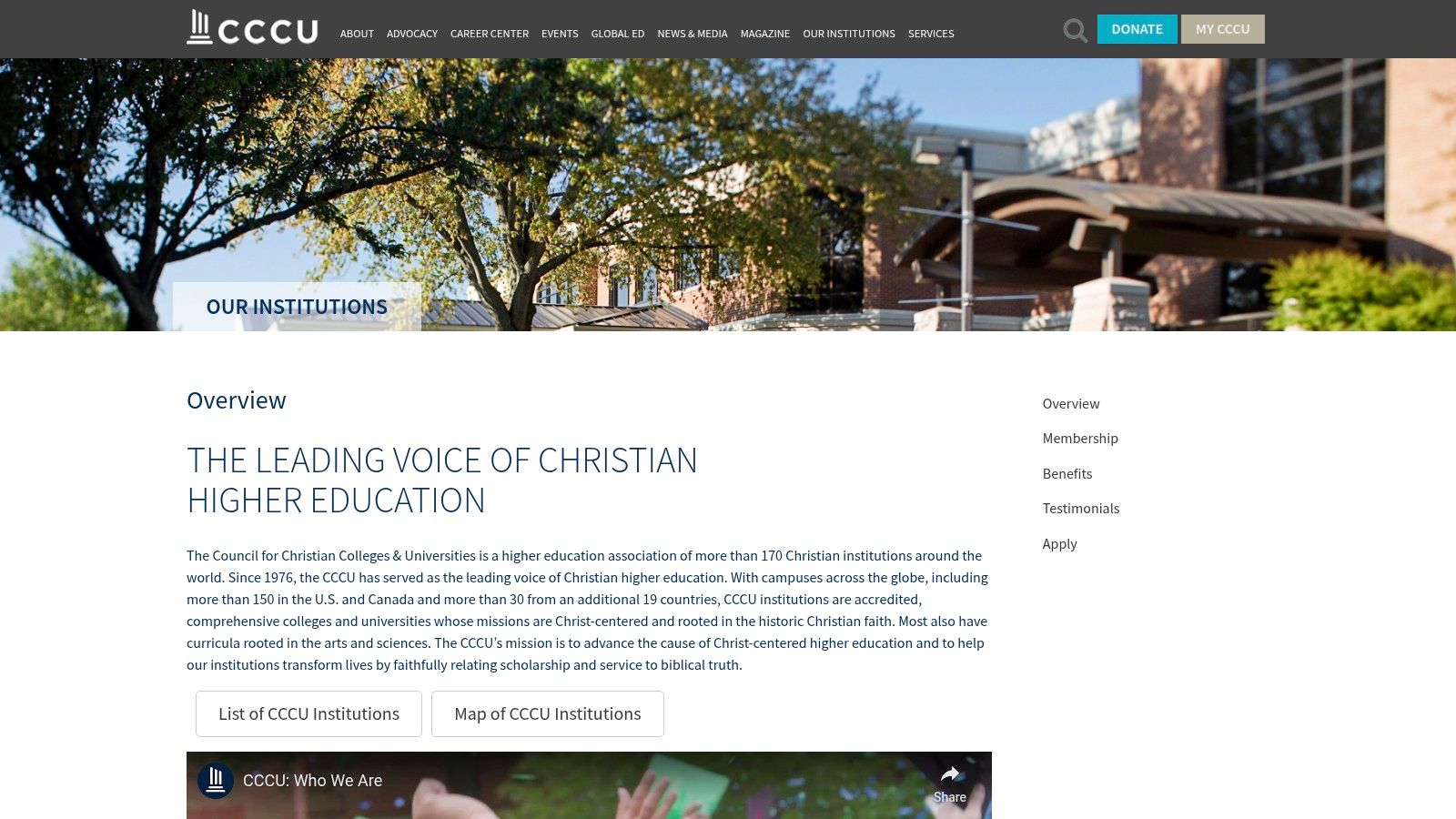
This platform provides a broader lens than directories focused solely on Bible colleges or seminaries. It helps you discover Christian liberal arts universities that offer strong undergraduate Bible majors and ministry pathways alongside a wide array of other academic programs. It’s ideal for students who want to ground their education in a Christian worldview, whether they are pursuing ministry, education, science, or business.
Navigating the CCCU Directory
Using the CCCU’s free Institution Directory is simple and intuitive. The platform offers both an interactive map and a filterable list view, allowing you to easily browse Christian colleges by region. This helps you quickly identify faith-forward campuses in your desired location.
Key features that make this tool effective include:
Map and List Views: Seamlessly switch between a visual map to see schools by location and a detailed list that you can filter, making it easy to find options near you.
Direct Institutional Links: Each listing provides a direct link to the school’s website, where you can explore degree programs, admissions requirements, and campus life in depth.
Denominational Diversity: The directory includes schools from a wide range of Christian traditions, all united by a shared commitment to Christ-centered higher education.
Pros and Cons of Using CCCU
The primary advantage of the CCCU directory is its curation of faith-forward institutions, providing a quick way to discover Christian campuses by region. It’s an excellent supplement to specialized directories like ABHE or ATS. However, the directory is membership-based, meaning not every accredited Christian or Bible college is included.
Because its scope is broader than just Bible colleges, you must still click through to each school and verify its specific accreditation and the strength of its biblical studies or ministry programs. Use this directory to expand your options and find schools committed to training hearts and minds for kingdom service across every vocation.
Website: https://www.cccu.org/institutions/
7-Source Comparison: Accredited Bible Colleges Near Me
Item | Complexity 🔄 | Resources ⚡ | Expected outcomes 📊 | Ideal use cases 💡 | Key advantages ⭐ |
|---|---|---|---|---|---|
The Bible Seminary (TBS) | Moderate — structured programs with flexible entry options 🔄 | Moderate — online & campus courses, museum, faculty; per‑class fees/paths ⚡ | Practical ministry formation, graduate degrees, experiential learning 📊 | Prospective M.Div/M.A. students, pastors, ministry leaders seeking Bible‑centered training 💡 | Comprehensive curriculum + 3J Museum; flexible enrollment and strong faculty ⭐ |
ABHE – Member Directory | Low — simple lookup of member schools 🔄 | Low — web access; directory filters and links ⚡ | Quick identification of ABHE‑member Bible colleges 📊 | Finding ABHE‑accredited Bible colleges by state or contact pages 💡 | Targeted directory for biblical higher education; direct school links ⭐ |
ATS – Member Schools & Program Search | Low–Moderate — searchable filters for graduate programs 🔄 | Low — web tool with robust filters (location, degree, denomination) ⚡ | Locate accredited seminaries and graduate theology programs 📊 | Pastors and ministry professionals seeking accredited graduate theology degrees 💡 | Strong assurance for graduate theological accreditation and advanced program search ⭐ |
TRACS – Member Institutions | Low — straightforward member roster lookup 🔄 | Low — searchable list with status indicators and links ⚡ | Verify TRACS accreditation and find faith‑based schools 📊 | Locating smaller, ministry‑focused Christian colleges and seminaries 💡 | USDE/CHEA recognition; includes ministry‑oriented institutions ⭐ |
NCES College Navigator | Moderate — many filters and data fields to interpret 🔄 | Moderate — federal data on costs, programs, outcomes; ZIP‑radius search ⚡ | Data‑rich comparisons, local program and outcome metrics 📊 | Building shortlists anchored to majors (e.g., Biblical Studies) and “near me” searches 💡 | Comprehensive, consistent government data on accreditation, costs, outcomes ⭐ |
CHEA – Directory of Accredited Institutions & Programs | Low — verification tool rather than search marketplace 🔄 | Low — database of recognized accreditors and accredited programs ⚡ | Confirmation of recognized accreditation status for schools/programs 📊 | Vetting accreditation claims and final due‑diligence for applicants 💡 | High‑trust accreditation verification; complements other directories ⭐ |
CCCU – Institution Directory & Map | Low — map/list browsing of member institutions 🔄 | Low — interactive map and member profiles; links to schools ⚡ | Discover regionally grouped Christian colleges and program options 📊 | Undergraduates seeking Christ‑centered campuses and related majors 💡 | Curated network of faith‑forward institutions; easy regional discovery ⭐ |
Your Next Step in Answering the Call
Choosing the right Bible college or seminary is a monumental step in your faith journey. It is more than just an academic choice; it is an act of stewardship over the unique calling God has placed on your life. The tools and directories we have explored are designed to bring clarity and confidence to this process, helping you move from a broad search for "accredited bible colleges near me" to a focused list of institutions that truly align with your goals.
As you reflect on the information, remember that accreditation is a vital baseline for academic quality. It ensures that your education will be recognized and respected. However, your decision will ultimately rest on factors that go deeper, including theological alignment, faculty engagement, community life, and a clear sense of spiritual fit. Each resource offers a different lens through which to view your options.
Key Takeaways for Your Search
To make the most of your research, keep these pivotal points in mind:
Define Your Non-Negotiables: Before you get lost in program details, clarify what matters most to you. Is it a specific doctrinal stance, a particular degree program, a flexible online format, or proximity to your home?
Verify Accreditation Directly: Use the accrediting agency’s own directory (like CHEA, TRACS, or ABHE) as the ultimate source of truth. This step confirms an institution's good standing.
Look Beyond the Website: Once you have a shortlist, your real research begins. Request information, schedule a call with an admissions advisor, and if possible, plan a campus visit. The true culture of a seminary is often felt, not just read about.
Pray for Discernment: Above all, commit this decision to prayer. Seek wisdom and guidance from the Holy Spirit, trusting that He will direct your path as you seek to honor Him with your education and future ministry.
This journey of preparation is a sacred one. It is a season of seeking, questioning, and trusting God to equip you for the work He has prepared for you. We pray that this guide has served you well by providing the practical tools needed to take your next faithful step.
If your search for accredited bible colleges near me has you considering a seminary that unites deep biblical scholarship with practical, hands-on ministry training, we invite you to discover The Bible Seminary. Our programs are designed to train hearts and minds for kingdom service, whether you join us on our Katy, Texas campus or study with us online. Explore our degree and certificate programs to see how we can equip you for your calling.