
A Theological Guide to Evil in the Bible

Welcome to what is easily one of the most challenging—and essential—conversations in Christian theology. The question of evil in the bible isn't just an abstract, academic puzzle. It's a deeply personal and pastoral reality that shapes our understanding of God and the world we live in.
Confronting One of Faith's Hardest Questions
The raw existence of suffering, pain, and outright wickedness in the world forces us to ask some very hard questions. If God is all-good and all-powerful, then why does evil exist? This guide is designed to move beyond simple platitudes and easy answers, offering a Christ-centered framework for thinking through this difficult topic. Here at The Bible Seminary, we believe that truly training hearts and minds for kingdom service means engaging honestly with Scripture—even its most challenging parts.
Wrestling with the reality of evil is a necessary part of a robust faith. It drives us deeper into God's Word, searching for answers that are both theologically sound and pastorally sensitive. Our goal is to equip you with the tools to navigate this complex subject with wisdom and integrity, whether you're a prospective student, a ministry leader, or simply a curious learner.
Building a Biblical Framework
To even begin to tackle the topic of evil, we have to build our understanding on the foundation of Scripture. This involves a lot more than just cherry-picking verses; it requires a comprehensive approach that takes in the whole counsel of God. A faithful examination of this topic will:
Define evil from a biblical perspective, not a cultural one.
Trace its origins as described in the biblical narrative.
Understand God’s just response to sin and rebellion.
Celebrate Christ’s ultimate victory over darkness.
Apply these truths to our lives as followers of Christ.
By exploring these facets, we can move from confusion and doubt toward a more profound trust in God’s sovereign and redemptive plan. The Bible doesn't shy away from the harsh realities of a fallen world, but it consistently points us toward the hope found only in Jesus Christ.
This guide is for anyone who has ever wondered why bad things happen to good people or struggled to reconcile God’s goodness with the world’s brokenness. We invite you to join us as we explore what Scripture reveals about evil, judgment, and the ultimate triumph of God's grace. This is where scholarship and spiritual formation unite, preparing you to impact the world for Christ.
Defining Evil from a Biblical Worldview
To really wrestle with the tough questions about evil in the Bible, we first have to get our arms around a clear, scripturally-grounded definition. This isn’t about looking up a word in the dictionary; it’s about grasping a core theological concept that runs through the entire biblical story. Once we understand how Scripture itself talks about evil, we have a much firmer foundation for tackling the harder questions that always follow.
The Bible is quite specific. In the Old Testament, the main Hebrew word is ra‘, a term that can describe anything from a physical disaster like a famine to the deepest kind of moral rot. The New Testament often uses the Greek word poneros, which points to a malignant, corrupting force that is actively hostile to everything good that God is and does.
A helpful way to think about evil is as a profound distortion of God's perfect creation. Picture a master composer crafting a beautiful, intricate symphony. Evil is the jarring, dissonant chord someone slams into the middle of it—it was never part of the original score, and it mars the beauty of the entire piece. It represents a twisting, a turning away from the good, true, and beautiful path God laid out for His creation.
The Three Faces of Evil in Scripture
Biblical authors don't paint evil with a single, broad brush. Instead, they show its different facets and manifestations. To bring some clarity, theologians often group these into three main categories. Making these distinctions is crucial if we want to interpret biblical events correctly and fully appreciate God’s redemptive work. For more on sound interpretation, our article on how to read the Bible for all it's worth is a great resource.
This theological framework, which sorts evil into moral, natural, and spiritual lenses, is illustrated below.
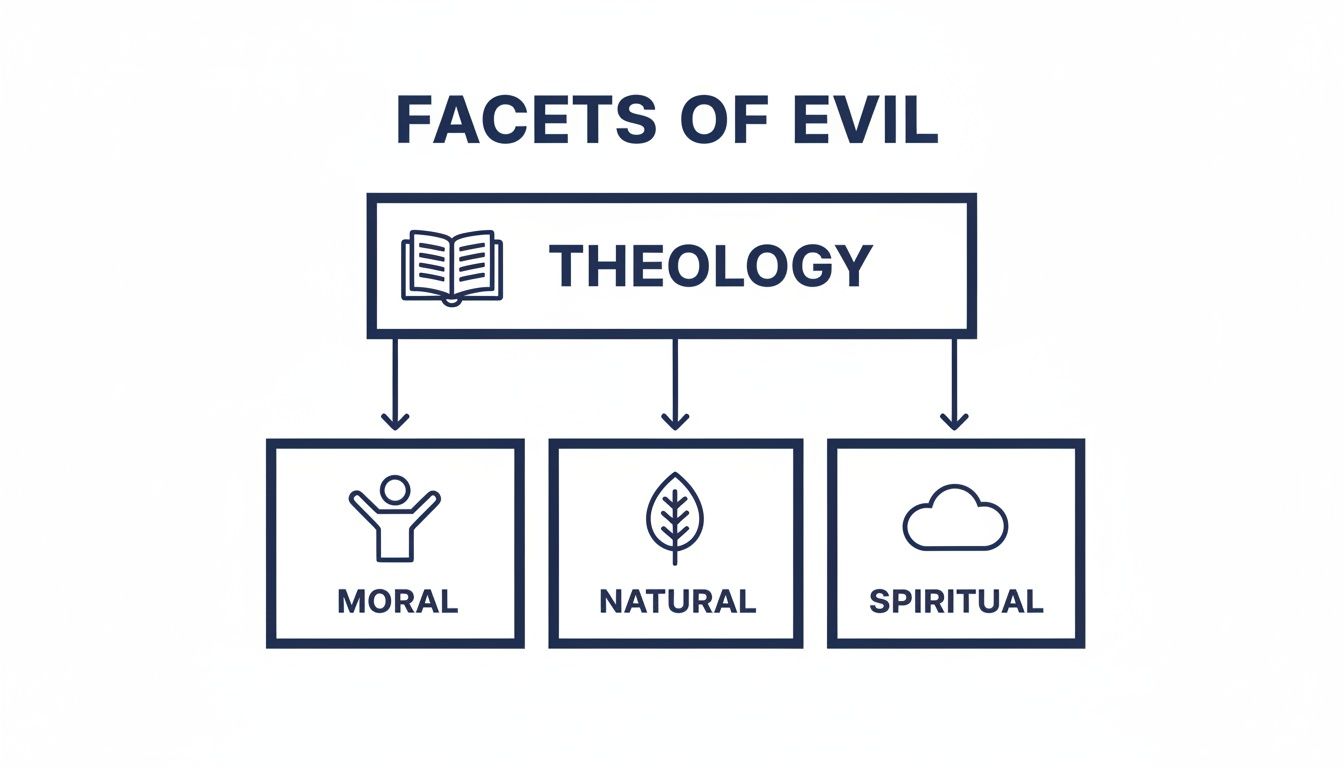
This framework helps us see that while all evil opposes God's created order, it shows up through different channels, and each requires its own unique theological and pastoral response.
Let's break down each of these categories.
Three Categories of Evil in the Bible
The table below summarizes the primary ways evil is manifested and understood within the biblical narrative, providing clear examples for each category.
Category of Evil | Biblical Definition | Scriptural Example |
|---|---|---|
Moral Evil | The willful rebellion of moral agents (humans, angels) against God's commands, resulting in sin, cruelty, and injustice. | The story of Cain murdering his brother Abel out of jealousy (Genesis 4). |
Natural Evil | The suffering and destruction that arise from the natural world itself, seen as a consequence of the Fall. | The "groaning" of creation, subjected to futility and decay (Romans 8:20-22). |
Spiritual Evil | The malevolent actions of Satan and demonic powers who actively oppose God and seek to thwart His redemptive plan. | The temptation of Jesus in the wilderness by Satan (Matthew 4:1-11). |
Understanding these categories helps us analyze suffering with more theological precision. Let’s look closer.
Moral Evil
This is what usually comes to mind when we talk about evil. It’s the willful sin and rebellion of humanity against God and His law. It covers all the acts of cruelty, injustice, hatred, greed, and pride—choices made by moral agents that cause suffering and shatter fellowship with both God and other people. The story of Cain and Abel in Genesis 4 is one of the starkest early examples.
Natural Evil
This category refers to the suffering and destruction that come from the natural world—things like earthquakes, tsunamis, diseases, and famines. From a biblical worldview, natural evil isn't just random bad luck; it’s a consequence of the Fall described in Genesis 3. As Paul writes in Romans 8:20-22, all of creation was subjected to frustration and decay because of human sin. The world itself groans, waiting for redemption.
Spiritual Evil
Scripture is unambiguous about the reality of a spiritual dimension to evil. This involves the hostile actions of Satan and demonic forces who actively oppose God, tempt humanity, and work to derail God’s redemptive plan for the world. Key examples include the temptation of Jesus in the wilderness (Matthew 4) and the Apostle Paul’s vivid descriptions of spiritual warfare (Ephesians 6:12).
It's important to remember that these three categories aren't always neatly separated; they often intersect and compound one another. A famine (natural evil) can be made far worse by human greed and hoarding (moral evil), which might itself be fueled by spiritual deception (spiritual evil).
Grasping this framework is a vital step in equipping leaders to impact the world for Christ. It allows us to approach the problem of suffering with theological clarity, offering biblically faithful answers to a world that is desperate for hope. This is exactly the kind of deep, practical training we are committed to at The Bible Seminary, where rigorous scholarship and hands-on ministry preparation come together.
Tracing the Origin of Evil in Scripture
If God’s creation was “very good,” as Genesis 1:31 declares, then where did evil come from? This question isn't just an academic puzzle; it gets to the very heart of the Christian faith and our understanding of God's character.
The biblical narrative is unwavering on this point: God is not the author of evil. Evil isn't some original part of the cosmic blueprint. Instead, it’s a corruption—a twisting and turning away from the God who is the source of all that is good and life-giving.
The story of evil, according to Scripture, doesn't begin on earth. It starts with a rebellion in the heavenly realms. While the Bible doesn’t give us every detail, passages in Isaiah and Ezekiel are widely seen as painting a picture of the fall of a mighty angelic being, later identified as Satan.
Isaiah 14:12–14 gives us a chilling glimpse into this being’s heart: “I will ascend to the heavens; I will raise my throne above the stars of God... I will make myself like the Most High.” (NIV)
This prideful ambition to overthrow God’s authority is the foundational sin. It's the ultimate rejection of being a creature in a vain attempt to become the Creator. This cosmic mutiny introduced a hostile spiritual force into God's creation, an entity actively working to oppose His will and ruin His work.
The Human Fall into Sin
Spiritual evil may have started with angelic rebellion, but moral evil crashed into the human story through a decisive act of disobedience in the Garden of Eden. The account in Genesis 3 isn't just an ancient myth; it's the foundational narrative that explains the brokenness we see all around us.
God gave Adam and Eve a real choice, the freedom to love and obey Him. But the Serpent, acting as the agent of this new spiritual opposition, planted seeds of doubt and temptation. He called God’s goodness and His word into question. By choosing to disobey God’s one clear command, humanity chose autonomy over dependence, their own will over God's.
That single decision unleashed catastrophic consequences, bringing several devastating new realities into the world:
Separation from God: The easy, intimate fellowship Adam and Eve had with their Creator was shattered.
Corruption of Human Nature: Sin became a deep-seated part of the human condition, an inheritance passed down through the generations.
Brokenness in Creation: The natural world itself was subjected to frustration and decay (Romans 8:20-22).
Evil Is a Corruption, Not a Creation
This biblical framework reveals a crucial truth: evil is not an eternal, competing force on equal footing with God. It has no life of its own. It's a parasite on the good, a distortion of God’s perfect design that came about through the misuse of free will by both angels and humans.
Grasping this origin story is vital. It completely absolves God of being the source of evil while still affirming His ultimate sovereignty over a world where evil tragically exists. When trying to understand these complex issues, applying rigorous document analysis strategies to these foundational biblical texts is key to gaining theological clarity.
But the story doesn't end there. God’s plan of redemption was no afterthought. From the moment evil entered the world, God put His grand rescue mission into motion. In Genesis 3:15, immediately after the Fall, He promised that the woman's offspring would crush the serpent's head. This was the first glimmer of the gospel, pointing forward to Jesus Christ—God’s ultimate and final answer to the problem of evil.
This understanding is foundational for ministry. At The Bible Seminary, we equip leaders to explain these core truths with clarity and confidence, uniting scholarship with a heart for kingdom service. Learn more about our approach to in-depth scriptural study by exploring our degree programs.
Understanding God's Judgment Against Evil
Let's be honest. Some of the most difficult passages in all of Scripture deal with God's direct, severe judgment against evil.
Accounts like the global flood in Genesis or the conquest of Canaan can be deeply unsettling for modern readers. How do we square these stories of divine wrath with the character of a loving, patient God we see revealed in Jesus?
Confronting these passages head-on is a crucial part of developing a mature faith. Here at The Bible Seminary, we’re convinced that digging into the text with rigorous, context-aware study is what equips Christian leaders to handle these hard questions—both for themselves and for those they serve. When you frame them correctly, these narratives aren't about an angry, arbitrary deity. They reveal the necessary, just response of a holy God to pervasive, unchecked wickedness that was threatening to corrupt His entire creation.
The Patience and Justice of God
One of the most overlooked themes in these judgment accounts is God's profound patience. Again and again, Scripture shows God giving people and entire nations staggering amounts of time to repent. His judgments are never rash or impulsive. They are always the last resort after prolonged, hard-hearted rebellion. The pattern is clear: His primary desire is always redemption, not destruction.
Take the Canaanite nations, for example. In Genesis 15:16, God tells Abraham that his descendants won't possess the land for another four hundred years, "for the iniquity of the Amorites is not yet complete." That’s a stunning statement. God literally waited for centuries, allowing the wickedness of these cultures—which included horrific practices like child sacrifice—to reach a point where judgment was the only just and merciful action left to protect future generations and preserve His covenant people.
You see this pattern of divine patience elsewhere, too. The Bible records God's incredible forbearance with the Amalekites. They faced 400 years of divine warnings before judgment finally came for their relentless, genocidal attacks on Israel. That long window, spanning from Exodus all the way to 1 Samuel 15, gave them repeated opportunities to turn from their destructive path.
Even the fall of Jericho in Joshua 6, which involved the destruction of its inhabitants, was presented as divine justice after the sins of Canaan had festered for centuries. When we view these accounts in their proper historical and theological context, they reveal a God who is slow to anger and abounding in steadfast love, but who will not allow evil to go unchecked forever. You can get more detail on how these stories ultimately point toward redemption by exploring the biblical response to God's actions.
The Purpose of Divine Judgment
It’s also critical to see that God's judgments in the Bible serve a redemptive purpose within His larger story. They aren't random acts of violence. Instead, they function to:
Restrain Evil: Judgment acts as a necessary boundary, stopping the spread of a moral cancer that harms and destroys human life.
Preserve Covenant Faithfulness: God's actions often protected the very lineage through which the Messiah, Jesus Christ, would come, safeguarding His plan of salvation for the whole world.
Demonstrate God's Holiness: These events reveal the sheer gravity of sin and the absolute moral purity of God. They remind us that He is a just judge who takes evil seriously.
This helps us see that God's justice and His love aren't opposing attributes; they are two sides of the same coin. A truly loving God must also be a just God who opposes the evil that destroys the people He loves.
Working through these difficult passages requires humility and a deep reliance on the Holy Spirit. It also requires the kind of robust academic and spiritual training we provide at The Bible Seminary, where we are passionate about training hearts and minds for kingdom service. God’s actions, even the most severe, are always rooted in His perfect character and His ultimate plan to restore goodness and bring lasting peace through the work of Christ. Rather than undermining our faith, a careful study of these texts can actually deepen our awe for a God who is both perfectly just and profoundly merciful.
Christ's Victory: The Decisive Blow to Evil
From the first whisper of redemption in Genesis to Malachi’s final prophecies, the entire biblical story builds toward a single, decisive moment. While the Old Testament wrestles with the problem of evil in the bible, the New Testament pulls back the curtain on God’s ultimate answer: Jesus Christ.
His arrival wasn't just another chapter in the story; it was the climax. Through His life, death, and resurrection, Jesus confronted evil in every conceivable form and guaranteed its final defeat.
Authority Over Every Realm of Evil
From the moment He began His public ministry, Jesus operated with a unique and absolute authority over the various dimensions of evil that plague our world. He didn't just teach about a distant future hope; He brought that hope crashing into the present through tangible displays of power.
His ministry was nothing less than a direct assault on the consequences of the Fall:
Over Spiritual Evil: Jesus cast out demons with a simple command (Mark 1:23–27), demonstrating His total dominion over the spiritual forces of darkness that seek to torment and destroy.
Over Natural Evil: He healed diseases, commanded storms to be still, and even raised the dead, proving His power over the brokenness and decay of the natural world itself (Luke 8:22–25).
Over Moral Evil: Most profoundly, He forgave sins (Mark 2:5–12), an act that went straight to the root of all evil—human rebellion against God.
Each miracle was more than a spectacle; it was a foretaste of the kingdom to come, a real-life preview of a world where all things are finally made new. For a deeper look into the significance of His arrival, check out our article exploring the Advent and Incarnation of Jesus.
The Cross as the Ultimate Triumph
The central event in God’s war against evil is the crucifixion. It's the one place where the forces of darkness appeared to have won, yet it became the very instrument of their complete undoing. At the cross, God in Christ took the full weight of human sin and suffering onto Himself.
This wasn't some tragedy that God scrambled to redeem; it was His intentional, strategic masterstroke from the beginning. On that cross, Jesus absorbed the penalty for moral evil, exhausted the power of spiritual evil, and bore the agony of natural evil in His own body.
The apostle Paul frames this victory in stunning terms: “He disarmed the rulers and authorities and put them to open shame, by triumphing over them in him” (Colossians 2:15, ESV).
The cross wasn't a defeat; it was a public disarmament. The resurrection that followed was the undeniable proof that death itself, the final enemy, had been conquered. Christ's victory is the guarantee that evil does not get the last word.
The Guaranteed Outcome
Because of Christ’s work, the final outcome of history is no longer in doubt. We still live in a world where the effects of sin and evil are painfully real, but their ultimate power has been shattered. We now find ourselves in the “already, but not yet”—that period between Christ's decisive victory on the cross and His final return when He will eradicate evil forever.
This truth is the bedrock of our hope and the engine of our mission at The Bible Seminary. We are equipping leaders to impact the world for Christ because we know the victory has already been won. Our job now is to proclaim this good news and live as agents of God’s restorative kingdom, confident that "the darkness is passing away and the true light is already shining" (1 John 2:8).
Living as Salt and Light in a Fallen World

After wrestling with the origins and realities of evil in the Bible, we’re left with the most important question of all: so what? How are we supposed to live now? The theological framework we’ve explored isn’t just some detached academic exercise. It’s the firm foundation for our mission in a world desperate for the hope of the Gospel.
Our calling isn't to retreat from the world’s brokenness, but to step right into it as agents of God’s goodness and grace. In Matthew 5, Jesus gives us a powerful picture for this mission, calling His followers to be “the salt of the earth” and “the light of the world.”
Overcoming Evil with Good
This calling demands an active, intentional faith. The Apostle Paul boils it down to a direct and practical command for confronting the darkness we all encounter.
“Do not be overcome by evil, but overcome evil with good.” (Romans 12:21, ESV)
This is the very heart of our personal and pastoral response. It’s a profound shift in perspective, moving us from being passive victims of a fallen world to becoming active participants in God’s redemptive work. This command is a call to be transformed from the inside out.
This principle touches every part of life:
In Personal Struggles: We overcome our own sinful inclinations not just by gritting our teeth and resisting temptation, but by actively pursuing holiness, kindness, and self-control through the power of the Spirit.
In Relationships: When we’re hurt or betrayed, our response isn't retaliation, but forgiveness and a commitment to reconciliation—a reflection of the very grace we ourselves have received.
In Society: We confront systemic injustice not with cynical despair, but with courageous advocacy for the vulnerable and a commitment to building communities that reflect God’s righteousness.
Anchored in Ultimate Hope
Let’s be honest: living as salt and light can be exhausting. There are days when it feels like our efforts make little difference against the tide. This is precisely why our hope must be anchored in something far greater than our immediate circumstances. We live in the light of how the story ends.
The book of Revelation promises a future where God will “wipe away every tear from their eyes, and death shall be no more, neither shall there be mourning, nor crying, nor pain anymore” (Revelation 21:4). This is our unshakable promise: evil has an expiration date.
This is where deep theology fuels our mission. At The Bible Seminary, we are committed to training hearts and minds for kingdom service—equipping leaders who don't just know these deep truths but are prepared to live them out. By rooting your faith in the promise of evil’s final eradication, you are empowered to serve with hope, resilience, and unwavering conviction.
A Few Common Questions About Evil in the Bible
When we start digging into the topic of evil, it doesn’t take long for some really tough, personal questions to surface. While a complete answer is the work of a lifetime of study, here are some biblically grounded responses to the questions we hear most often here at The Bible Seminary.
Why Does a Good God Let Evil Continue?
This is probably one of faith’s biggest challenges, often called the problem of theodicy. It’s a profound question, and the Bible approaches it from several angles rather than giving one simple answer.
First, God gave his creation—angels and humans alike—real freedom. And a staggering amount of the evil we experience is the direct fallout of humanity’s rebellion and sinful choices. The Bible is unflinchingly honest about this.
We also live in a creation that the Apostle Paul says is groaning, subject to decay and corruption (Romans 8:20–22). It’s not the world God originally intended. But Scripture also paints a picture of God’s incredible patience, showing He holds back final judgment because His desire is for people to turn to Him (2 Peter 3:9).
Most importantly, the Bible holds this tension: God is completely sovereign and can weave even the threads of human evil into His ultimate, good purposes (Romans 8:28). And it gives us the ultimate hope—a promised future where evil and suffering are gone for good (Revelation 21:4).
Are God's Violent Judgments in the Old Testament Evil?
This is a critical distinction to make: divine justice is not the same as human evil. When the Bible describes God’s judgments, like the conquest of Canaan, it’s not presenting them as evil acts. Instead, they are shown as righteous and necessary responses to generations of extreme, unrepentant wickedness—things like child sacrifice.
These aren’t random acts of cruelty. They are portrayed as God’s sovereign intervention to stop the spread of deep moral cancer and to move His larger redemptive plan for all humanity forward. Getting a handle on these difficult passages means we have to do the hard work of studying their historical and theological context, a skill we drill down on in our degree programs.
What’s the Difference Between God’s Judgment and Human Evil?
It really boils down to three things: motive, authority, and outcome.
Human evil is rooted in rebellion against God. It’s fueled by selfishness, pride, and hate, and its end game is always chaos and destruction.
God's judgment, on the other hand, flows from His perfect holiness and justice. Its goal is to punish sin, put a stop to wickedness, and ultimately restore goodness and order to His creation. While God’s judgment can be severe, it’s never unfair or impulsive. It is always the righteous act of a holy Creator dealing with the corruption that has marred His world.
At The Bible Seminary, we believe that wrestling with these hard questions is absolutely vital for anyone called to ministry. We’re all about uniting deep scholarship with real spiritual formation to equip leaders who can give Christ-centered, hope-filled answers to a world that’s hurting.
Explore our degree programs at The Bible Seminary and begin your journey toward deeper biblical training.